Papilio machaon
Old World Swallowtail
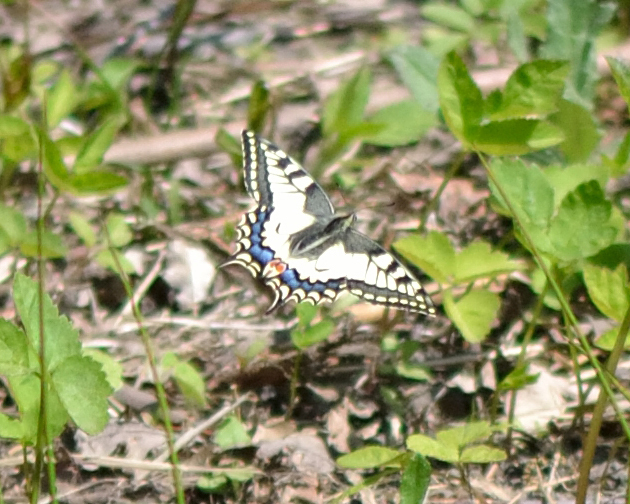
(c) Fyodor Pudovikov, some rights reserved (CC BY) · licence
Family: Papilionidae · Class: Insecta · Order: Lepidoptera
Papilio machaon (Old World Swallowtail) is a California animal in the Papilionidae family.
The Old World Swallowtail is a large butterfly with a wingspan ranging from 65 to 86 mm (2.6 to 3.4 inches). The wings display a distinctive pattern of yellow ground color marked with black bands and spots. The hindwings feature prominent blue and red eyespots near the tail extensions, which are characteristic of swallowtail butterflies. Males and females are similar in appearance, though females tend to be slightly larger with more pronounced markings. The species exhibits considerable geographic variation across its range, with some populations previously classified as separate species including P. oregonius and P. bairdii. This species has a Holarctic distribution, representing one of the most widespread butterflies in the world. In North America, the Old World Swallowtail ranges south from Alaska to northern British Columbia, extending east across Canada to western Quebec. The southern extent reaches from British Columbia south through New Mexico. This broad distribution reflects the species' adaptability to diverse climatic conditions and elevations. The Old World Swallowtail inhabits a variety of open habitats including meadows, prairies, tundra, and mountainous regions. The species occurs from sea level to elevations exceeding 3,000 meters (9,800 feet) in alpine environments. Adults are commonly found in areas where their host plants are abundant, particularly in dry, sunny locations with sparse vegetation. The species demonstrates broad ecological tolerance, occupying both arctic tundra and temperate grasslands. Larvae feed primarily on sagebrushes (Artemisia species), including Arctic wormwood and wild tarragon. Occasionally, caterpillars utilize plants in the parsley family (Apiaceae), though this occurs rarely compared to their preference for Artemisia. The species typically produces one generation per year in northern populations, while southern populations may have two broods annually. Adults are strong fliers and males engage in hilltopping behavior, congregating on elevated terrain to locate mates. Females deposit eggs singly on host plant leaves, with caterpillars developing through five instars before pupating. The Old World Swallowtail is not federally listed and faces no immediate conservation concerns across most of its range. The species' broad distribution and adaptability to various habitats contribute to its stability. However, localized populations may face pressure from habitat modification, particularly in areas where development encroaches on native sagebrush communities. Climate change represents a potential long-term threat, especially for high-elevation populations that may experience shifts in suitable habitat zones. The species' taxonomic complexity, with several formerly recognized species now considered subspecies or forms, reflects ongoing research into the evolutionary relationships within this widespread group. Conservation efforts focus primarily on maintaining intact sagebrush ecosystems, which benefit not only this butterfly but entire communities of sagebrush-dependent species.
Classification
Class: Insecta · Order: Lepidoptera · Family: Papilionidae
Frequently asked questions
How is Papilio machaon classified?
Papilio machaon belongs to class Insecta, order Lepidoptera, family Papilionidae.
What family does Papilio machaon belong to?
Papilio machaon is in the Papilionidae family.
What is Papilio machaon?
The Old World Swallowtail is a large butterfly with a wingspan ranging from 65 to 86 mm (2.6 to 3.4 inches).
Is Papilio machaon found in California?
Yes. Papilio machaon is recorded in California in The California Species Project's catalogue.
Related species
Other California species in the same genus, family, or bioregion.
Data from The California Species Project — 14,000+ California species with verified data from CNPS, CDFW, USFWS, and more.