Papilio multicaudata
Two-tailed Swallowtail
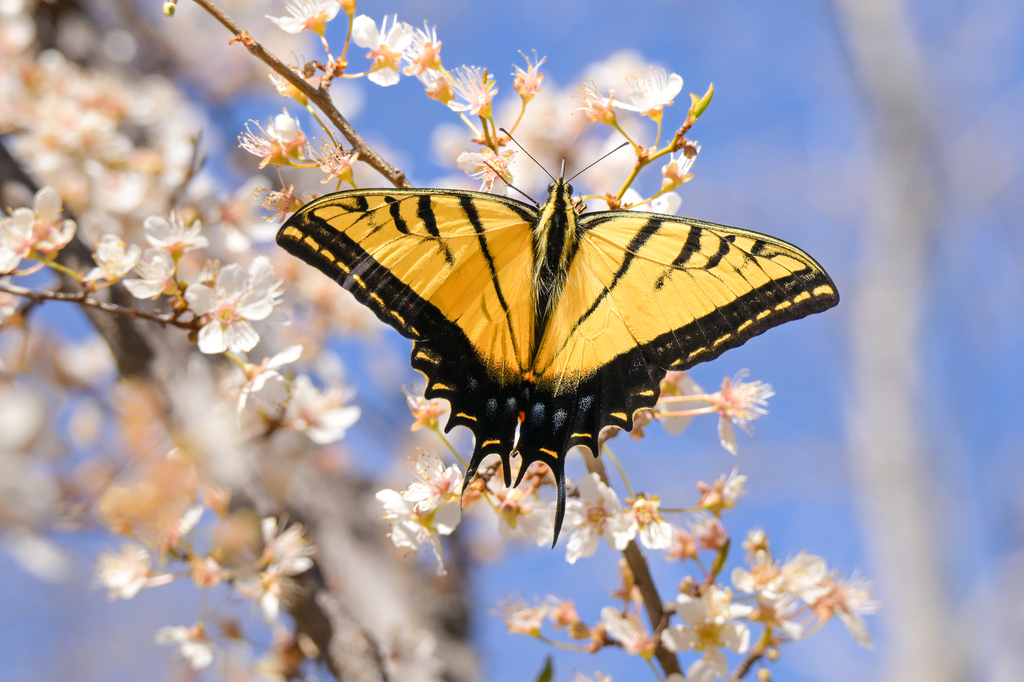
(c) Becca, some rights reserved (CC BY) · licence
Family: Papilionidae · Class: Insecta · Order: Lepidoptera
Papilio multicaudata (Two-tailed Swallowtail) is a California animal in the Papilionidae family.
The Two-tailed Swallowtail is North America's largest butterfly, with females reaching wingspans of 127-140 mm (5.0-5.5 inches) and males measuring 89-127 mm (3.5-5.0 inches). The forewings are pale yellow with black borders and distinctive black tiger-like stripes extending inward from the wing edges. The hindwings feature two prominent black tails, giving the species its common name, along with blue and orange eyespots near the tail margins. Males typically display more vibrant coloration than females, with deeper yellow ground color and more pronounced black markings. This species ranges across western North America from British Columbia south through Mexico, extending east to central Nebraska and central Texas. In California, Two-tailed Swallowtails occur primarily in mountainous regions and foothills of the Sierra Nevada, Cascade Range, and coastal mountains. The species is most commonly encountered at elevations between 300-2,400 meters (1,000-8,000 feet), though populations extend to higher elevations in suitable habitat. Two-tailed Swallowtails inhabit riparian woodlands, canyon bottoms, mountain meadows, and mixed coniferous forests where host plants are present. Adults are frequently observed along streams, creeks, and in areas with abundant flowering plants that provide nectar sources. The species shows particular affinity for areas with scattered trees and open spaces that facilitate flight and basking behavior. Larvae feed exclusively on leaves of ash (Fraxinus), hop tree (Ptelea), and chokecherry (Prunus). Females deposit single eggs on host plant leaves, typically on the upper surface. The caterpillars are green with yellow and black stripes and possess distinctive eyespots that serve as predator deterrents. Development includes four larval instars before pupation. Adults emerge in late spring through early fall, with peak flight activity occurring from May through August. The species produces one generation annually in northern portions of its range and may have partial second broods in warmer southern areas. Adults feed on nectar from various flowers including lilac, butterfly bush, lantana, and native wildflowers. Two-tailed Swallowtails exhibit strong territorial behavior, with males establishing and defending perching sites on hilltops and ridges. Mating occurs after elaborate courtship flights, during which males pursue females through aerial displays. Adults are strong fliers capable of soaring and gliding, often observed at considerable heights above the canopy. The Two-tailed Swallowtail is not federally or state-listed and appears to maintain stable populations throughout most of its range. However, localized populations may face pressure from habitat loss due to urban development, particularly in riparian corridors where host plants naturally occur. Climate change may affect the species' elevational distribution and phenology, potentially altering the synchronization between adult emergence and host plant availability. Conservation of riparian habitats and native ash, hop tree, and chokecherry populations supports the continued presence of this species across California's diverse mountain ecosystems.
Classification
Class: Insecta · Order: Lepidoptera · Family: Papilionidae
Frequently asked questions
How is Papilio multicaudata classified?
Papilio multicaudata belongs to class Insecta, order Lepidoptera, family Papilionidae.
What family does Papilio multicaudata belong to?
Papilio multicaudata is in the Papilionidae family.
What is Papilio multicaudata?
The Two-tailed Swallowtail is North America's largest butterfly, with females reaching wingspans of 127-140 mm (5.0-5.5 inches) and males measuring 89-127 mm (3.5-5.0 inches).
Is Papilio multicaudata found in California?
Yes. Papilio multicaudata is recorded in California in The California Species Project's catalogue.
Related species
Other California species in the same genus, family, or bioregion.
Data from The California Species Project — 14,000+ California species with verified data from CNPS, CDFW, USFWS, and more.