Papilio polyxenes
Black Swallowtail
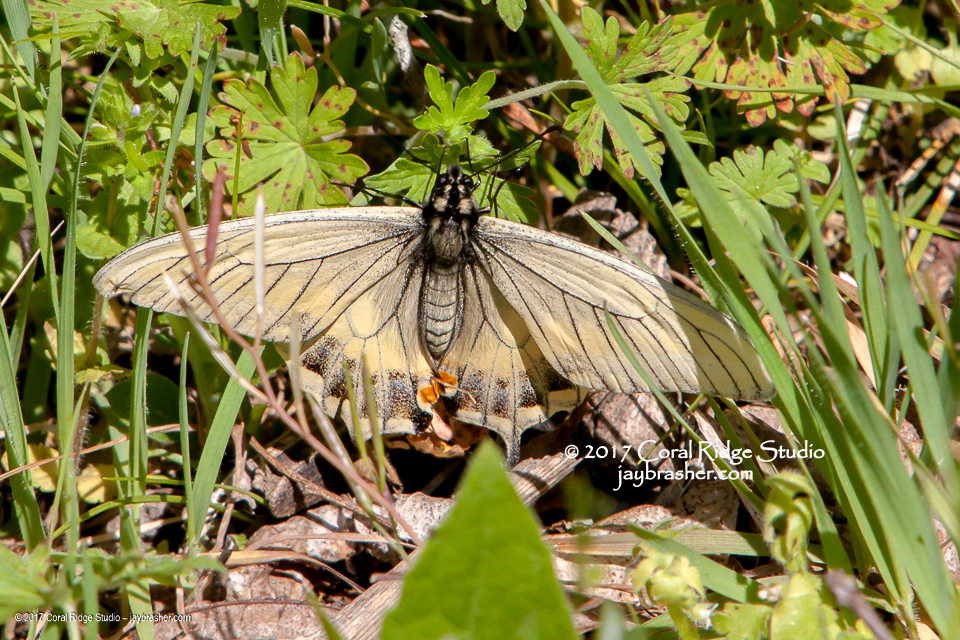
(c) Jay Brasher, some rights reserved (CC BY) · licence
Family: Papilionidae · Class: Insecta · Order: Lepidoptera
Papilio polyxenes (Black Swallowtail) is a California animal in the Papilionidae family.
The Black Swallowtail is a medium-sized butterfly with a wingspan ranging from 86 to 108 mm (3.4 to 4.3 inches). Males display black wings with two rows of yellow spots along the wing margins and a distinctive band of yellow spots across the forewings. The hindwings feature prominent blue scaling between the yellow spot rows and orange eyespots with black centers near the anal angle. Females are darker with reduced yellow markings, more extensive blue hindwing scaling, and larger orange eyespots. Both sexes possess characteristic swallowtail projections on the hindwings. The species occurs throughout most of the eastern United States, extending north into Quebec and west into southern Saskatchewan, Colorado, and southeastern California. The range extends south into northern South America. In the desert Southwest, the subspecies coloro is present, which shows adaptations to arid conditions including reduced size and modified coloration patterns. Black Swallowtails inhabit a variety of open environments including fields, meadows, prairies, suburban gardens, roadsides, and agricultural areas. The species thrives in disturbed habitats where host plants are abundant. Adults are commonly observed in areas with native and cultivated members of the parsley family. The subspecies coloro occupies desert washes, canyon bottoms, and oasis areas in the Sonoran and Mojave deserts. Larvae feed exclusively on plants in the parsley family (Apiaceae), including Queen Anne's lace (Daucus carota), cultivated carrots, celery, dill, fennel, and parsley. Occasionally, plants in the citrus family (Rutaceae) serve as alternate hosts. Caterpillars are green with black bands containing yellow or orange spots and can extend orange osmeterium when threatened. Adults nectar on various flowers including milkweeds, clover, and garden plants. The species produces two to three broods annually in most regions, with continuous brooding possible in southern areas. Mating occurs from April through October depending on latitude. Females deposit single pale yellow eggs on host plant leaves. Development from egg to adult requires approximately 30 to 35 days under optimal conditions. Pupae overwinter in northern populations, attached to plant stems or structures near host plants. Black Swallowtails are not federally or state-listed and maintain stable populations across most of their range. The species has adapted well to human-modified landscapes and benefits from cultivation of host plants in gardens and agricultural settings. Urban and suburban development can provide suitable habitat when apiaceous plants are present. Climate change may affect northern range limits, potentially allowing expansion into previously unsuitable areas. The desert subspecies coloro may face localized pressures from habitat modification and water source alterations, but overall population trends remain stable.
Classification
Class: Insecta · Order: Lepidoptera · Family: Papilionidae
Frequently asked questions
How is Papilio polyxenes classified?
Papilio polyxenes belongs to class Insecta, order Lepidoptera, family Papilionidae.
What family does Papilio polyxenes belong to?
Papilio polyxenes is in the Papilionidae family.
What is Papilio polyxenes?
The Black Swallowtail is a medium-sized butterfly with a wingspan ranging from 86 to 108 mm (3.4 to 4.3 inches).
Is Papilio polyxenes found in California?
Yes. Papilio polyxenes is recorded in California in The California Species Project's catalogue.
Related species
Other California species in the same genus, family, or bioregion.
Data from The California Species Project — 14,000+ California species with verified data from CNPS, CDFW, USFWS, and more.