Papilio rutulus
Western Tiger Swallowtail
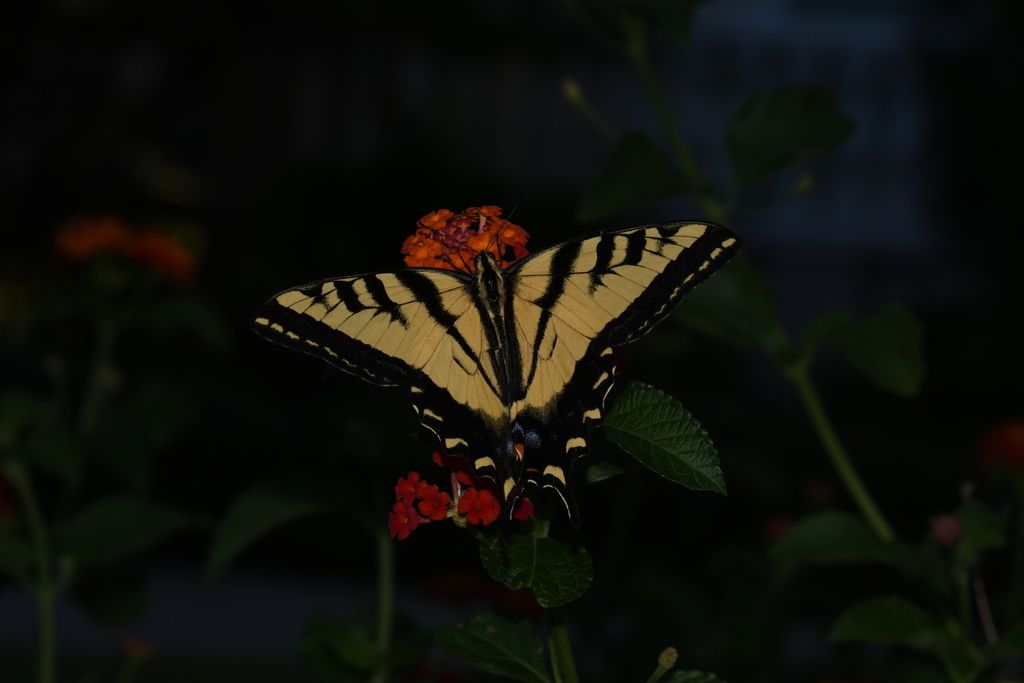
(c) Hawk T., some rights reserved (CC BY) · licence
Family: Papilionidae · Class: Insecta · Order: Lepidoptera
Papilio rutulus (Western Tiger Swallowtail) is a California animal in the Papilionidae family.
The Western Tiger Swallowtail is a large butterfly with a wingspan ranging from 70 to 110 millimeters (2.8 to 4.3 inches). Males display bright yellow wings with distinctive black stripes radiating from the wing bases, creating the tiger-like pattern for which the species is named. Females exhibit two color forms: a yellow form similar to males and a dark morph that mimics the toxic Pipevine Swallowtail. Both sexes possess characteristic blue scaling along the hindwing margins and orange eyespots near the wing tips. The hindwings feature prominent black tails approximately 8 to 12 millimeters in length. The Western Tiger Swallowtail ranges across western North America from British Columbia south to southern New Mexico and Baja California, extending eastward to western South Dakota and southeast Colorado. The species occasionally appears as a rare stray in central Nebraska. In California, it occurs throughout most of the state except for the most arid desert regions, from sea level to approximately 2,400 meters (7,900 feet) elevation. This species inhabits riparian areas, canyon bottoms, parks, gardens, and woodland edges where host plants are present. Adults frequent areas near streams, rivers, and other water sources where cottonwoods and willows grow. The species shows a preference for partially shaded environments and is commonly observed in foothills and montane regions during summer months. Larval development occurs on leaves of cottonwood and aspen (Populus species), willows (Salix species), wild cherry (Prunus species), and ash (Fraxinus species). Females deposit single pale green eggs on host plant leaves, typically on the upper leaf surface. Caterpillars are green with prominent eyespots and feed primarily at night. The species produces one to three broods annually depending on latitude and elevation, with flight periods extending from March through October in warmer regions. Adults are strong fliers and males engage in hilltopping behavior, congregating on ridgetops and peaks to locate mates. Both sexes visit flowers for nectar, showing preferences for lilac, butterfly bush, and native wildflowers. The Western Tiger Swallowtail currently holds no federal or state conservation listing and appears to maintain stable populations throughout most of its range. The species adapts well to human-modified landscapes and benefits from ornamental plantings of host trees in urban and suburban environments. However, localized populations may face pressure from habitat loss due to development along riparian corridors and water diversions that affect host plant communities. Climate change potentially threatens montane populations through altered precipitation patterns and increased drought conditions. The species' broad host plant range and adaptability to various habitats contribute to its overall resilience, though continued monitoring of populations in fragmented habitats remains important for long-term conservation.
Classification
Class: Insecta · Order: Lepidoptera · Family: Papilionidae
Frequently asked questions
How is Papilio rutulus classified?
Papilio rutulus belongs to class Insecta, order Lepidoptera, family Papilionidae.
What family does Papilio rutulus belong to?
Papilio rutulus is in the Papilionidae family.
What is Papilio rutulus?
The Western Tiger Swallowtail is a large butterfly with a wingspan ranging from 70 to 110 millimeters (2.8 to 4.3 inches).
Is Papilio rutulus found in California?
Yes. Papilio rutulus is recorded in California in The California Species Project's catalogue.
Related species
Other California species in the same genus, family, or bioregion.
Data from The California Species Project — 14,000+ California species with verified data from CNPS, CDFW, USFWS, and more.