Parabagrotis formalis
Western Parabagrotis
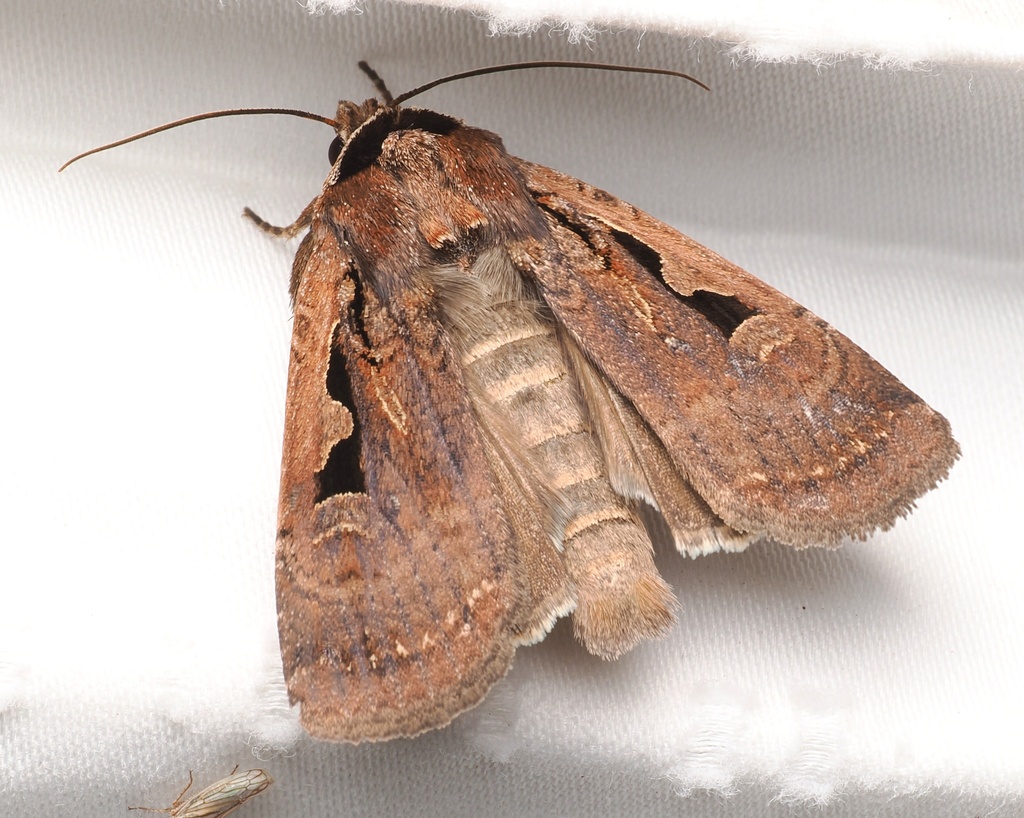
(c) Alan Rockefeller, some rights reserved (CC BY) · licence
Family: Noctuidae · Class: Insecta · Order: Lepidoptera
Parabagrotis formalis (Western Parabagrotis) is a California animal in the Noctuidae family.
The Western Parabagrotis is a small noctuid moth in the family Noctuidae, subfamily Noctuinae. Adults have a forewing length of 15 to 18 mm (BugGuide). This variable species exhibits several distinct forms with patterns ranging from pale buff and pale gray to reddish brown and blackish brown coloration. The species can be reliably identified by its distinctive bicolored prothoracic collar, where the basal half is black and the apical half is pale buff or gray (BugGuide). Three basic forms occur: a washed-out form with minimal pattern, intermediate forms, and darker variants. The forewings display typical noctuid markings including reniform and orbicular spots, though these vary considerably in prominence across different forms. Parabagrotis formalis occurs in western North America, with documented populations in California, Idaho, Montana, and other western states. In California, the species has been recorded from various locations including coastal areas. The moth appears to have a relatively broad distribution across diverse western habitats, from coastal regions to mountainous areas. Specimens have been collected from locations ranging from sea level coastal sites to higher elevation mountain campgrounds. The species inhabits diverse habitat types across its range. In California, it occurs in coastal environments as well as inland areas. Collection records indicate the moth can be found in both lowland and montane habitats, suggesting considerable ecological flexibility. The species appears to utilize areas with mixed vegetation types that support its larval host plants. Larval host plants include members of the grass family Poaceae and the grape family Vitaceae, with Vitis (grape) specifically documented as a host genus (Moth Photographers Group). The larvae likely feed on various native and possibly introduced plant species within these families. Adult moths are attracted to artificial lights and can be collected using standard moth trapping techniques. Flight period data from collection records suggest the species is active during summer months, with specimens recorded from May through September across its range. Parabagrotis formalis lacks formal conservation status listings at federal or state levels. The species appears to maintain stable populations across its western range, with regular collection records from multiple states. However, like many moth species, comprehensive population monitoring data are limited. The moth's apparent ability to utilize diverse habitats and multiple host plant families may contribute to its persistence across varied landscapes. Taxonomically, the species was formerly placed in the genus Rhynchagrotis and was previously considered a synonym of Parabagrotis exsertistigma before being elevated to full species status (Moth Photographers Group). The species can be distinguished from the closely related Parabagrotis insularis by the presence of its characteristic black thoracic collar, which is absent in P. insularis. Detailed ecological studies of this species remain limited. The above information synthesizes available data from taxonomic databases and collection records. Additional research on population trends, detailed habitat requirements, and conservation needs would enhance understanding of this western moth species.
Classification
Class: Insecta · Order: Lepidoptera · Family: Noctuidae
Frequently asked questions
How is Parabagrotis formalis classified?
Parabagrotis formalis belongs to class Insecta, order Lepidoptera, family Noctuidae.
What family does Parabagrotis formalis belong to?
Parabagrotis formalis is in the Noctuidae family.
What is Parabagrotis formalis?
The Western Parabagrotis is a small noctuid moth in the family Noctuidae, subfamily Noctuinae.
Is Parabagrotis formalis found in California?
Yes. Parabagrotis formalis is recorded in California in The California Species Project's catalogue.
Related species
Other California species in the same genus, family, or bioregion.
Data from The California Species Project — 14,000+ California species with verified data from CNPS, CDFW, USFWS, and more.