Parabuteo unicinctus
Harris's Hawk
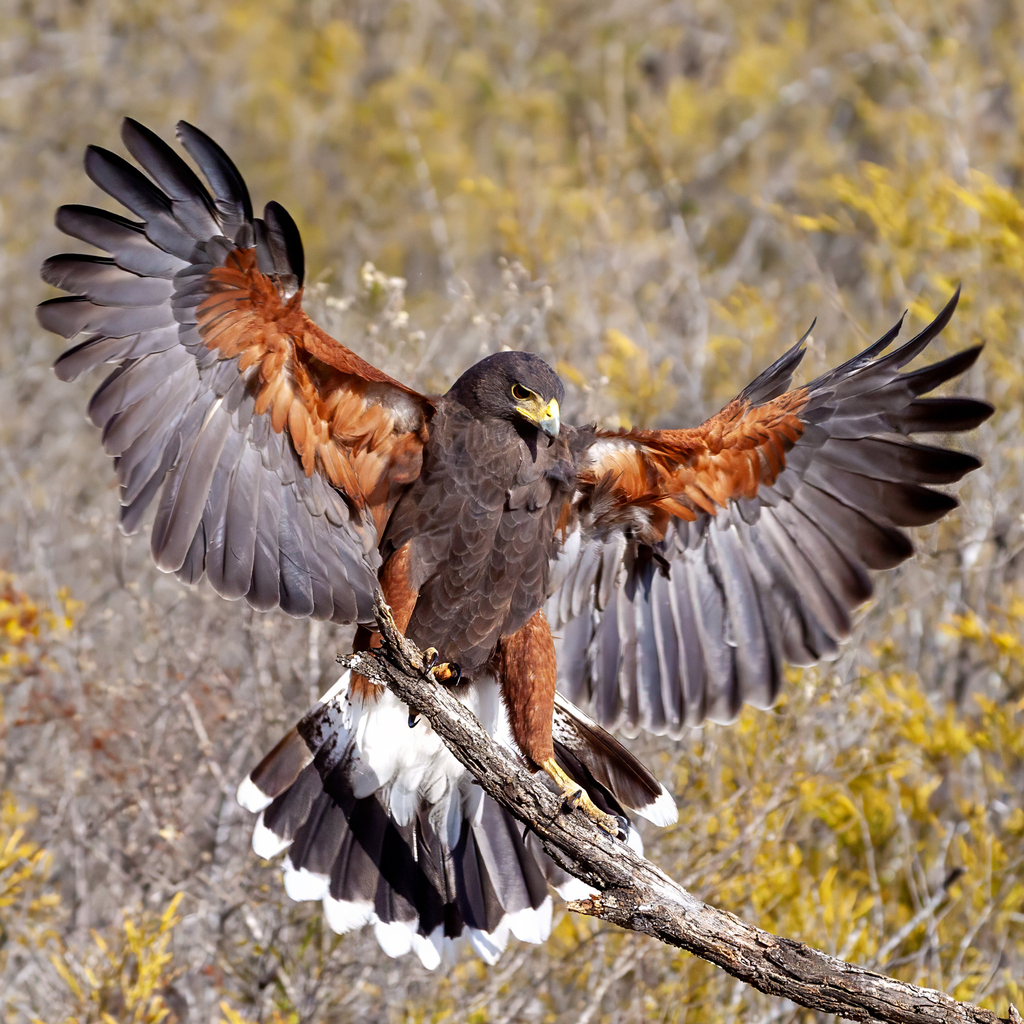
(c) Dan Vickers, some rights reserved (CC BY) · licence
Family: Accipitridae · Class: Aves · Order: Accipitriformes
Conservation status: WL · G5 S1
Parabuteo unicinctus (Harris's Hawk) is a California animal in the Accipitridae family.
Harris's Hawk is a medium-sized raptor with distinctive dark brown plumage and prominent white markings. Adults measure 46 to 59 cm (18 to 23 inches) in length with a wingspan of 103 to 119 cm (41 to 47 inches). Males weigh 500 to 700 grams (1.1 to 1.5 pounds), while females are larger at 700 to 1,200 grams (1.5 to 2.6 pounds). The species displays rich chocolate-brown body plumage with bright chestnut-red shoulder patches and leg feathers. The tail is black with a white base and white terminal band, creating a distinctive pattern visible in flight. Juveniles show more mottled brown plumage with streaked underparts and lack the adults' vivid chestnut markings. In California, Harris's Hawk occurs primarily in the southeastern desert regions, including the Colorado River valley and portions of Imperial, Riverside, and San Bernardino counties. The species reaches the northern limit of its range in southern California, with the core North American population extending through Arizona, New Mexico, and Texas into Mexico. California represents marginal habitat at the periphery of the species' distribution. The species inhabits arid and semi-arid environments, favoring desert scrubland, riparian corridors along desert waterways, and areas with scattered trees or tall cacti for nesting. In California, Harris's Hawks are most commonly found in Sonoran Desert habitat below 1,200 meters (4,000 feet) elevation. They require open areas for hunting combined with elevated perches and nesting sites, typically utilizing palo verde, mesquite, ironwood trees, or large saguaro cacti. Harris's Hawk exhibits unique cooperative hunting behavior, with groups of two to six individuals working together to capture prey. This social hunting strategy allows them to take larger prey than most raptors of similar size, including jackrabbits, ground squirrels, and desert cottontails. The diet also includes birds, reptiles, and occasionally fish. Breeding occurs from February through August in California, with peak activity in spring. The species practices cooperative breeding, where non-breeding adults assist with nest construction, incubation, and feeding young. Nests are built in forks of trees or cacti, constructed of sticks and lined with softer materials. Females typically lay 2 to 4 white or pale blue eggs, incubated for 31 to 36 days. Harris's Hawk is designated as a Watch List species by the California Department of Fish and Wildlife, reflecting concerns about its limited distribution and small population size within the state. The species maintains a stable global population with a ranking of G5, but California's S1 ranking indicates it is critically imperiled at the state level. Primary threats in California include habitat loss from urban development, agricultural conversion, and water diversions that degrade riparian corridors. The species' dependence on large territories and specific desert habitat makes it vulnerable to fragmentation. Climate change may further stress populations through altered precipitation patterns and increased temperatures in already extreme desert environments.
Classification
Class: Aves · Order: Accipitriformes · Family: Accipitridae
Conservation status
WL · G5 S1
Frequently asked questions
How is Parabuteo unicinctus classified?
Parabuteo unicinctus belongs to class Aves, order Accipitriformes, family Accipitridae.
What family does Parabuteo unicinctus belong to?
Parabuteo unicinctus is in the Accipitridae family.
Is Parabuteo unicinctus protected or of conservation concern?
Parabuteo unicinctus carries the following status: WL · G5 S1.
What is Parabuteo unicinctus?
Harris's Hawk is a medium-sized raptor with distinctive dark brown plumage and prominent white markings.
Is Parabuteo unicinctus found in California?
Yes. Parabuteo unicinctus is recorded in California in The California Species Project's catalogue.
Related species
Other California species in the same genus, family, or bioregion.
Data from The California Species Project — 14,000+ California species with verified data from CNPS, CDFW, USFWS, and more.