Paradejeania rutilioides
Spiny Tachina Fly
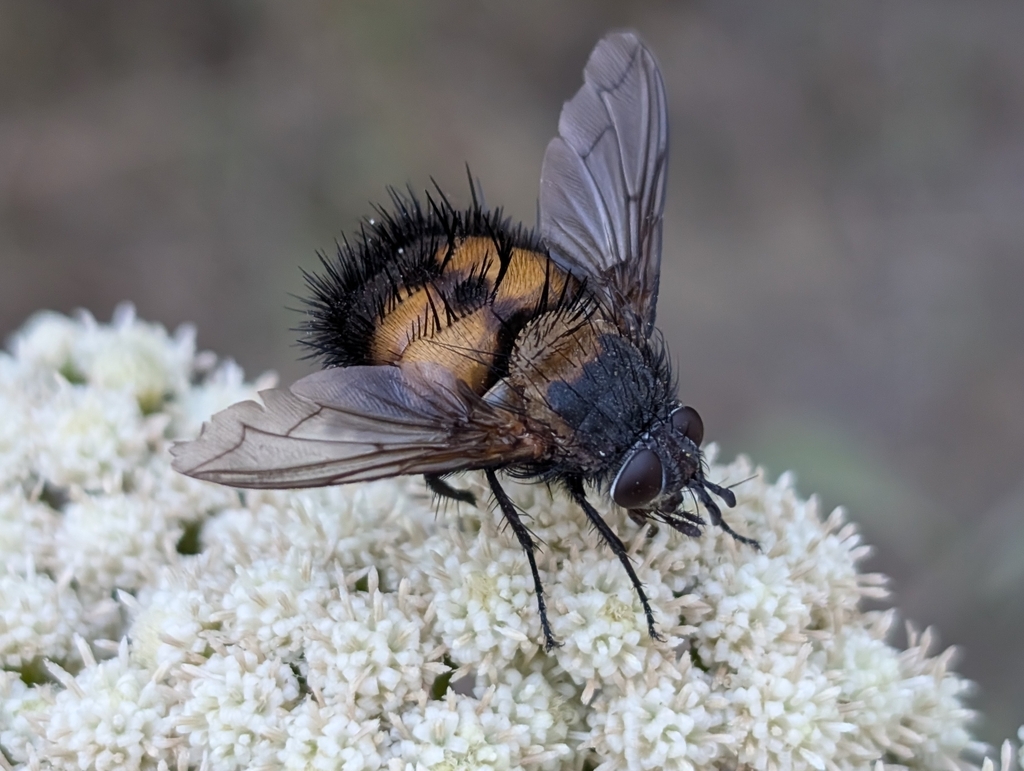
(c) Ken-ichi Ueda, some rights reserved (CC BY) · licence
Family: Tachinidae · Class: Insecta · Order: Diptera
Paradejeania rutilioides (Spiny Tachina Fly) is a California animal in the Tachinidae family.
Paradejeania rutilioides, commonly known as the Spiny Tachina Fly, is a parasitoid fly in the family Tachinidae. Adults are medium-sized flies with distinctive spiny bristles (setae) covering the thorax and abdomen, giving the species its common name. The species exhibits two recognized subspecies: P. r. rutilioides and P. r. nigrescens, which can be distinguished by abdominal coloration patterns (BugGuide 2005). The nominate subspecies displays a mainly yellowish fifth abdominal tergite without a continuous median black stripe, while P. r. nigrescens shows a blackish fifth tergite with a median black vitta. Paradejeania rutilioides has a broad distribution across western North America, ranging from Colorado and British Columbia south to Central America (BugGuide 2005). The species occurs throughout much of California, particularly in coastal and montane regions where suitable host species are present. This extensive range reflects the fly's adaptability to diverse climatic conditions and elevational gradients. The species inhabits a variety of ecosystems where its lepidopteran hosts occur, including coastal scrub, chaparral, oak woodlands, and mixed coniferous forests. Adults are commonly observed on flowering plants, particularly late-blooming members of the Asteraceae family, where they feed on nectar (BugGuide 2005). They have also been documented visiting flowers of Rhus species (Anacardiaceae) and Melilotus (Fabaceae), indicating opportunistic nectar-feeding behavior across multiple plant families. As a parasitoid species, P. rutilioides exhibits specialized reproductive behavior typical of tachinid flies. Females locate suitable lepidopteran hosts and deposit eggs or larvae directly on or near the host caterpillars. The tachinid larvae develop internally within the host, eventually killing it before pupating. Research has documented Hemihyalea edwardsii (Packard), commonly known as Edwards' Glassy-wing, as a confirmed host species in central coastal California (Hsu & Powell 1992). This arctiid moth caterpillar serves as the larval development site for the parasitoid, with the tachinid larvae consuming the host from within during their development phase. Adult flies are most active during warmer months when both nectar sources and host species are available. Males and females engage in mating behaviors near host habitats, with females subsequently searching for appropriate caterpillars for oviposition. The species likely has multiple generations per year in warmer regions, synchronized with the availability of host lepidopteran species. Paradejeania rutilioides currently lacks federal or state conservation status listings. As a native parasitoid species, it plays an important ecological role in natural pest control systems, helping regulate populations of its lepidopteran hosts. The species' broad distribution and apparent adaptability to various habitats suggest stable populations, though specific population data are not available. Conservation of native plant communities that support both the fly's nectar sources and its lepidopteran hosts remains important for maintaining healthy populations of this beneficial parasitoid species.
Classification
Class: Insecta · Order: Diptera · Family: Tachinidae
Frequently asked questions
How is Paradejeania rutilioides classified?
Paradejeania rutilioides belongs to class Insecta, order Diptera, family Tachinidae.
What family does Paradejeania rutilioides belong to?
Paradejeania rutilioides is in the Tachinidae family.
What is Paradejeania rutilioides?
Paradejeania rutilioides, commonly known as the Spiny Tachina Fly, is a parasitoid fly in the family Tachinidae.
Is Paradejeania rutilioides found in California?
Yes. Paradejeania rutilioides is recorded in California in The California Species Project's catalogue.
Related species
Other California species in the same genus, family, or bioregion.
Data from The California Species Project — 14,000+ California species with verified data from CNPS, CDFW, USFWS, and more.