Paranthrene robiniae
Western Poplar Clearwing Moth
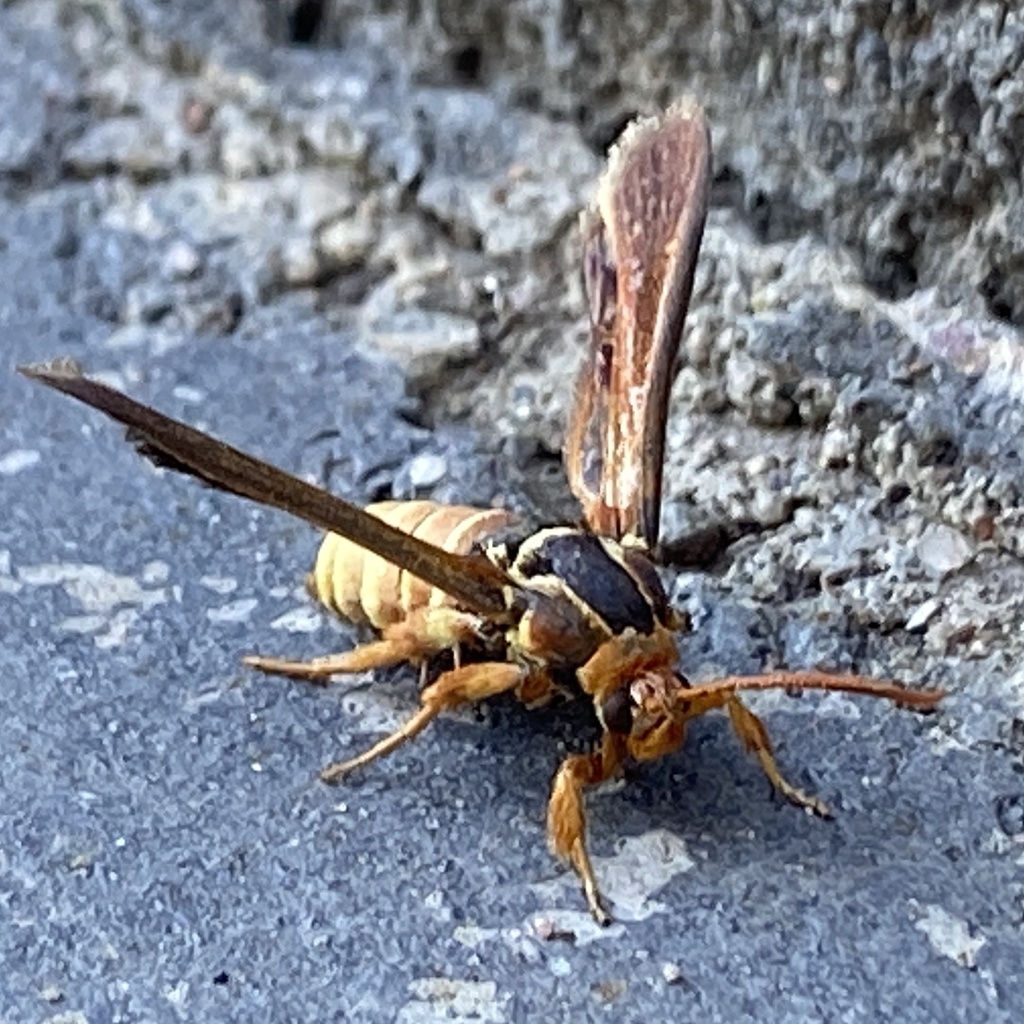
(c) F. LaBry, some rights reserved (CC BY) · licence
Family: Sesiidae · Class: Insecta · Order: Lepidoptera
Paranthrene robiniae (Western Poplar Clearwing Moth) is a California animal in the Sesiidae family.
The Western Poplar Clearwing Moth is a day-flying clearwing moth in the family Sesiidae, distinguished by its wasp-like appearance and transparent wing patches. Adults have a wingspan of 25 to 35 mm (1.0 to 1.4 inches), with a robust, dark-colored body marked by yellow or orange bands across the abdomen. The forewings are predominantly opaque with metallic blue-black scaling, while the hindwings feature large transparent areas bordered by dark veins. Males are typically smaller than females and possess more prominent yellow markings on the thorax and abdomen. This species ranges from Alaska along the Pacific coast to southern California, extending inland to the desert Southwest and throughout the Rocky Mountains, with eastern populations reaching North Dakota and Kansas. In California, the species occurs in riparian zones from sea level to approximately 2,400 meters (7,900 feet) elevation, particularly in the Sierra Nevada foothills, Central Valley riparian corridors, and montane areas where host plants are abundant. Western Poplar Clearwing Moths inhabit riparian woodlands, streamside forests, and urban areas where poplars and willows grow. Adults are most commonly found near stands of their host plants, including various Populus species (cottonwoods and aspens) and Salix species (willows). The species adapts well to disturbed habitats and is frequently encountered in parks, residential areas with ornamental poplars, and agricultural edges adjacent to waterways. Adults are active during daylight hours from May through August, with peak flight occurring in June and July. Mating typically occurs on or near host plants, where females deposit eggs singly in bark crevices or at the base of trees. Larvae are wood borers that develop within the trunk and major branches of host trees, creating extensive galleries in the cambium and outer sapwood. The larval stage lasts one to two years, depending on climate and tree condition. Pupation occurs within the larval tunnel, with emerging adults leaving characteristic round exit holes approximately 6 mm in diameter in the bark. The species feeds on tree sap and nectar as adults, while larvae consume cambium and phloem tissues. Natural enemies include woodpeckers, parasitoid wasps, and various fungal pathogens that attack larvae within their galleries. The Western Poplar Clearwing Moth is not federally or state listed and appears to maintain stable populations throughout its range. The species benefits from the widespread cultivation of ornamental poplars and the preservation of riparian corridors. However, removal of native cottonwood forests and extensive urban development along waterways may locally reduce suitable habitat. The moth's ability to utilize both native and non-native Populus species, including hybrid poplars commonly planted in landscaping, likely contributes to its continued presence across diverse environments. Climate change impacts on riparian ecosystems and host plant distribution could affect future population dynamics, though current populations show no evidence of significant decline.
Classification
Class: Insecta · Order: Lepidoptera · Family: Sesiidae
Frequently asked questions
How is Paranthrene robiniae classified?
Paranthrene robiniae belongs to class Insecta, order Lepidoptera, family Sesiidae.
What family does Paranthrene robiniae belong to?
Paranthrene robiniae is in the Sesiidae family.
What is Paranthrene robiniae?
The Western Poplar Clearwing Moth is a day-flying clearwing moth in the family Sesiidae, distinguished by its wasp-like appearance and transparent wing patches.
Is Paranthrene robiniae found in California?
Yes. Paranthrene robiniae is recorded in California in The California Species Project's catalogue.
Related species
Other California species in the same genus, family, or bioregion.
Data from The California Species Project — 14,000+ California species with verified data from CNPS, CDFW, USFWS, and more.