Parasteatoda tepidariorum
Common House Spider
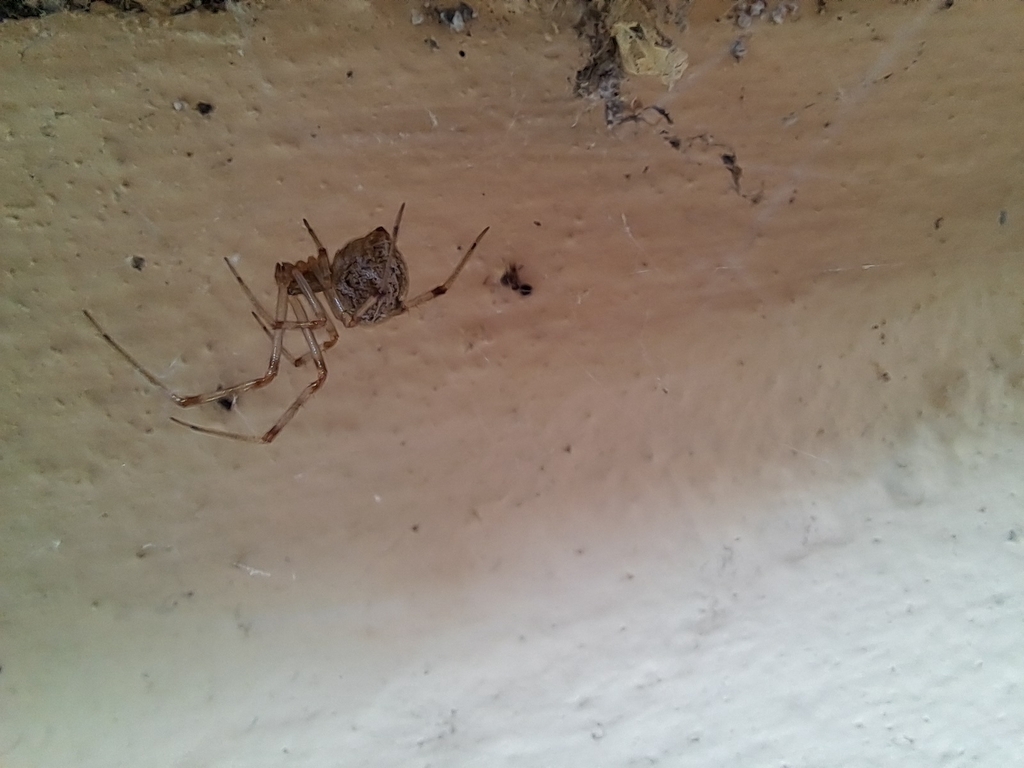
(c) Fikret Arda Düzgünses, some rights reserved (CC BY) · licence
Family: Theridiidae · Class: Arachnida · Order: Araneae
Parasteatoda tepidariorum (Common House Spider) is a California animal in the Theridiidae family.
The common house spider is a small cobweb spider in the family Theridiidae. Females measure 5 to 6 mm in body length, while males are smaller at 3.8 to 4.7 mm. The body coloration varies from yellowish-brown to dark brown or grayish, often with darker chevron-like markings on the abdomen. The legs are relatively long and thin, typically banded with alternating light and dark coloration. Females possess a bulbous, rounded abdomen, while males have a more elongated body shape with enlarged pedipalps used for mating. Parasteatoda tepidariorum has achieved a cosmopolitan distribution and is found throughout the world, including across North America from southern Canada to Mexico (Bradley 2012). In California, this species occurs statewide in both urban and natural environments. The species is less common in the center of the continent but maintains stable populations along both coasts (Bradley 2012). Common house spiders occupy diverse habitats ranging from natural environments to human-modified structures. They construct irregular cobwebs in protected locations including building corners, window frames, garages, sheds, and outdoor structures. In natural settings, they build webs under rock overhangs, in tree bark crevices, and among vegetation. The species shows significant adaptability to various microhabitats and elevations, from sea level to mountainous regions. These spiders are opportunistic predators that capture prey in their three-dimensional cobwebs. The irregular web structure consists of sticky capture spirals and non-sticky structural threads that effectively trap flying and crawling insects. Common prey items include flies, mosquitoes, ants, beetles, and other small arthropods. Mating occurs when males locate females by following pheromone trails and vibrating courtship signals on the female's web. After mating, females produce distinctive tan, teardrop-shaped egg cases that are completely diagnostic of the species (Bradley 2012). Females may produce up to four egg cases during their lifetime, with each containing 100 to 400 eggs. Young spiders remain clustered together for some time after emergence before dispersing to establish individual territories. In southern regions, adults are active year-round, while in northern areas, activity peaks during warmer months. Individual spiders may live more than one year (Bradley 2012). The common house spider holds no special conservation status at federal, state, or international levels. As a cosmopolitan species with broad habitat tolerance and high reproductive capacity, P. tepidariorum maintains stable populations throughout its range. The species benefits from human activity through the creation of suitable nesting sites in buildings and structures. No specific threats have been identified for this widespread and adaptable arachnid. The species plays a beneficial ecological role by controlling populations of pest insects in both natural and anthropogenic environments.
Classification
Class: Arachnida · Order: Araneae · Family: Theridiidae
Frequently asked questions
How is Parasteatoda tepidariorum classified?
Parasteatoda tepidariorum belongs to class Arachnida, order Araneae, family Theridiidae.
What family does Parasteatoda tepidariorum belong to?
Parasteatoda tepidariorum is in the Theridiidae family.
What is Parasteatoda tepidariorum?
The common house spider is a small cobweb spider in the family Theridiidae.
Is Parasteatoda tepidariorum found in California?
Yes. Parasteatoda tepidariorum is recorded in California in The California Species Project's catalogue.
Related species
Other California species in the same genus, family, or bioregion.
Data from The California Species Project — 14,000+ California species with verified data from CNPS, CDFW, USFWS, and more.