Parastrellus hesperus
Canyon Bat
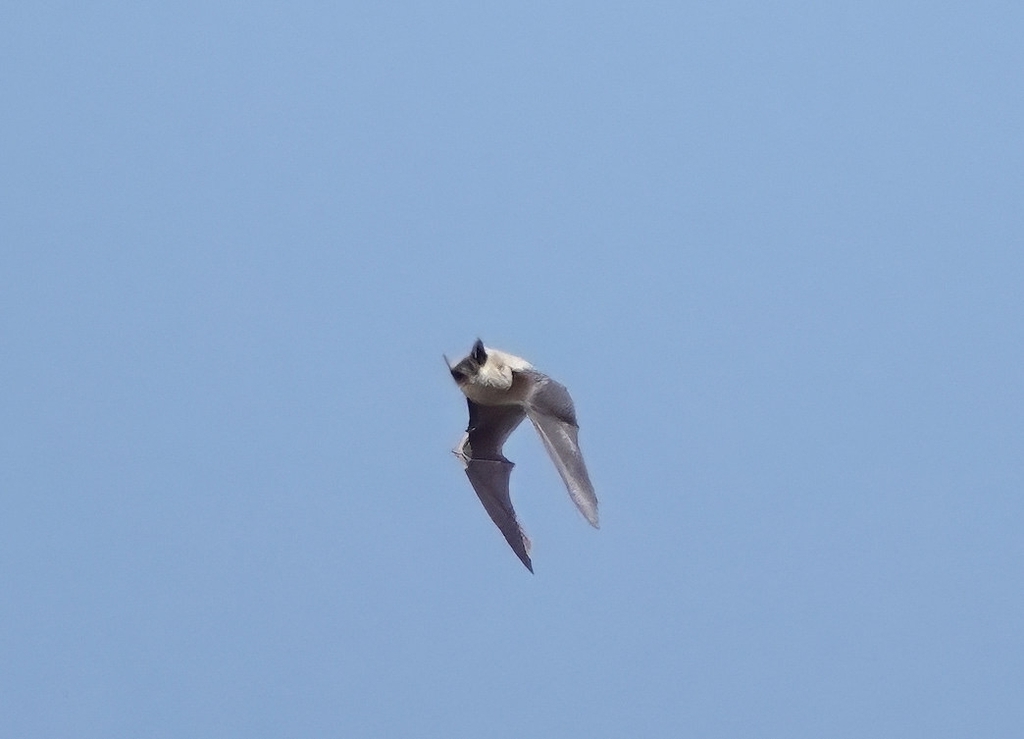
(c) Bob Miller, some rights reserved (CC BY) · licence
Family: Vespertilionidae · Class: Mammalia · Order: Chiroptera
Parastrellus hesperus (Canyon Bat) is a California animal in the Vespertilionidae family.
The canyon bat is North America's smallest bat species, weighing 3 to 6 grams (0.1 to 0.2 ounces) with a wingspan of 190 to 230 millimeters (7.5 to 9.1 inches). Adults measure 65 to 85 millimeters (2.6 to 3.3 inches) in total length, with the tail comprising nearly half the body length. The fur is pale yellow to light brown dorsally, with lighter, nearly white ventral coloration. The ears are relatively large and broad, and the tragus is blunt and curved. Wings are broad relative to body size, and the interfemoral membrane extends to the tip of the tail. Canyon bats range throughout the western United States and northwestern Mexico. In California, the species occurs from sea level to approximately 2,000 meters (6,500 feet) elevation, distributed across the state except for the northwestern coastal region and the Central Valley floor. The species is found in desert regions, oak woodlands, chaparral, and riparian areas throughout southern California, the Sierra Nevada foothills, and inland valleys. This species inhabits arid and semi-arid environments, showing strong association with rocky outcrops, cliffs, and canyon walls. Canyon bats roost in rock crevices, building crevices, bridges, and occasionally in tree hollows. Day roosts are typically in narrow horizontal or vertical cracks that provide protection from temperature extremes. Night roosts are often in more open areas such as porches, carports, and building overhangs. The species demonstrates high roost site fidelity, often returning to the same crevices repeatedly. Canyon bats emerge early in the evening, often beginning foraging activities before sunset when light levels are still relatively high. Flight patterns are characterized by slow, fluttering wingbeats with frequent gliding phases. The species forages primarily over water sources, in washes, and along cliff faces, capturing small flying insects including moths, beetles, flies, and flying ants. Echolocation calls are high-frequency, typically ranging from 40 to 55 kilohertz. Mating occurs in fall, with delayed fertilization typical of temperate zone bats. Females give birth to a single pup in late spring or early summer, usually May through July. Young bats achieve flight capability at approximately three weeks of age. The canyon bat is not currently listed under federal or state endangered species acts. The species appears to maintain stable populations throughout most of its range, though specific population estimates are not available. Urban development and habitat modification present localized threats, particularly the loss of suitable roosting sites through building demolition and cliff face modification. Climate change may affect prey availability and alter roosting microclimate conditions. Water source availability is critical for this desert-adapted species, making water management practices relevant to long-term conservation. The species' adaptability to human-modified environments, including use of buildings and bridges for roosting, may provide some resilience to habitat changes.
Classification
Class: Mammalia · Order: Chiroptera · Family: Vespertilionidae
Frequently asked questions
How is Parastrellus hesperus classified?
Parastrellus hesperus belongs to class Mammalia, order Chiroptera, family Vespertilionidae.
What family does Parastrellus hesperus belong to?
Parastrellus hesperus is in the Vespertilionidae family.
What is Parastrellus hesperus?
The canyon bat is North America's smallest bat species, weighing 3 to 6 grams (0.1 to 0.2 ounces) with a wingspan of 190 to 230 millimeters (7.5 to 9.1 inches).
Is Parastrellus hesperus found in California?
Yes. Parastrellus hesperus is recorded in California in The California Species Project's catalogue.
Related species
Other California species in the same genus, family, or bioregion.
Data from The California Species Project — 14,000+ California species with verified data from CNPS, CDFW, USFWS, and more.