Parkesia motacilla
Louisiana Waterthrush
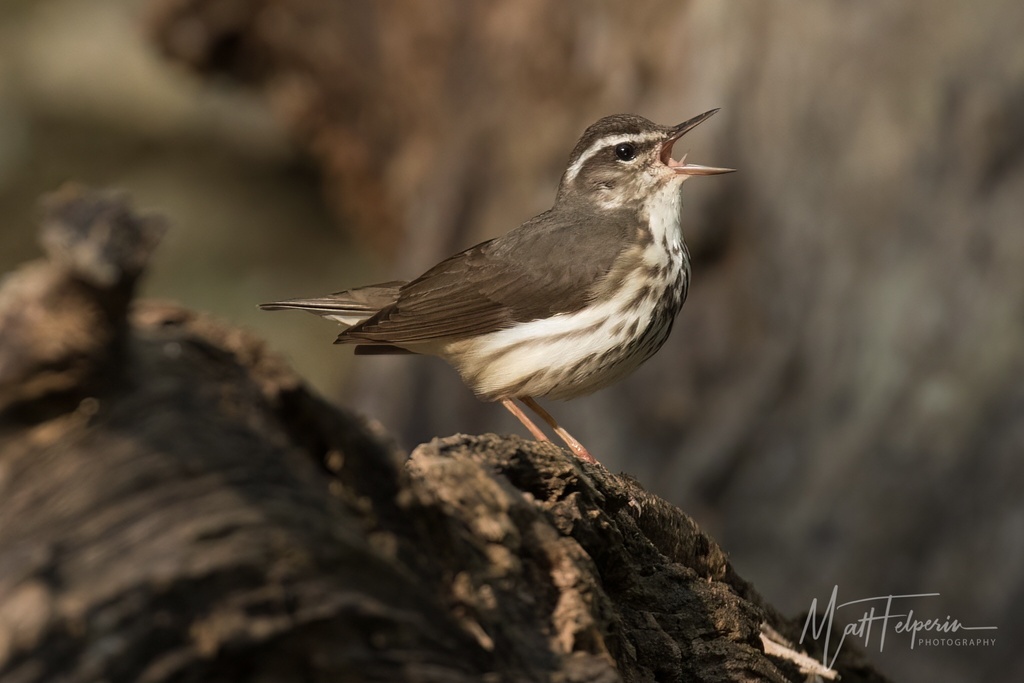
(c) Matt Felperin, some rights reserved (CC BY) · licence
Family: Parulidae · Class: Aves · Order: Passeriformes
Parkesia motacilla (Louisiana Waterthrush) is a California animal in the Parulidae family.
The Louisiana Waterthrush is a medium-sized warbler measuring 14 to 16 cm (5.5 to 6.3 inches) in length with a wingspan of 21 to 25 cm (8.3 to 9.8 inches). Adults weigh 18 to 23 grams. The species displays olive-brown upperparts and white underparts with dark brown streaking on the breast and flanks. A prominent white eyebrow stripe extends from the bill to the nape, contrasting with a dark eyeline. The bill is long and slightly decurved, adapted for probing crevices and substrate. Legs are bright pink to orange, distinguishing it from the similar Northern Waterthrush, which has yellowish legs and a less pronounced eyebrow stripe. The Louisiana Waterthrush breeds primarily in the eastern United States, from southern New England west to eastern Kansas and south to northern Georgia and eastern Texas. The species winters in Central America, from Mexico south through Panama, and in the Caribbean islands. In California, the Louisiana Waterthrush is an extremely rare vagrant, with fewer than 10 documented records. Most California sightings occur during spring migration from April to May along the coast and in riparian corridors. This species requires mature forested watersheds with clear, fast-flowing streams and rocky substrates. Breeding habitat consists of deciduous or mixed forests with streams featuring pools, riffles, and exposed rocks or logs. The species shows strong fidelity to high-quality aquatic habitats, typically selecting areas with canopy cover exceeding 70 percent and minimal human disturbance. In wintering areas, Louisiana Waterthrush occupy similar habitats including mountain streams and forest edges near water sources. Louisiana Waterthrush are primarily insectivorous, feeding on aquatic and terrestrial invertebrates including mayfly larvae, caddisfly larvae, beetles, spiders, and small crustaceans. The species forages by walking along stream edges, probing under rocks and in leaf litter, and occasionally catching prey from the water surface. Breeding occurs from April through July, with females constructing cup-shaped nests in stream bank crevices, root masses, or under overhanging rocks. Clutch size ranges from 4 to 6 eggs, with an incubation period of 12 to 14 days. The species is among the earliest warblers to begin spring migration, departing wintering grounds in March. The Louisiana Waterthrush is not federally listed but faces population pressures throughout its range. Breeding Bird Survey data indicates stable populations overall, though regional declines have occurred due to stream degradation, mountaintop removal mining, and forest fragmentation. The species serves as an indicator of aquatic ecosystem health, as it requires high-quality stream habitats. Climate change poses additional threats through altered precipitation patterns and increased frequency of extreme weather events affecting stream flow regimes. Conservation efforts focus on protecting riparian corridors and maintaining water quality in breeding watersheds.
Classification
Class: Aves · Order: Passeriformes · Family: Parulidae
Frequently asked questions
How is Parkesia motacilla classified?
Parkesia motacilla belongs to class Aves, order Passeriformes, family Parulidae.
What family does Parkesia motacilla belong to?
Parkesia motacilla is in the Parulidae family.
What is Parkesia motacilla?
The Louisiana Waterthrush is a medium-sized warbler measuring 14 to 16 cm (5.5 to 6.3 inches) in length with a wingspan of 21 to 25 cm (8.3 to 9.8 inches).
Is Parkesia motacilla found in California?
Yes. Parkesia motacilla is recorded in California in The California Species Project's catalogue.
Related species
Other California species in the same genus, family, or bioregion.
Data from The California Species Project — 14,000+ California species with verified data from CNPS, CDFW, USFWS, and more.