Parnassius behrii
Sierra Nevada Parnassian
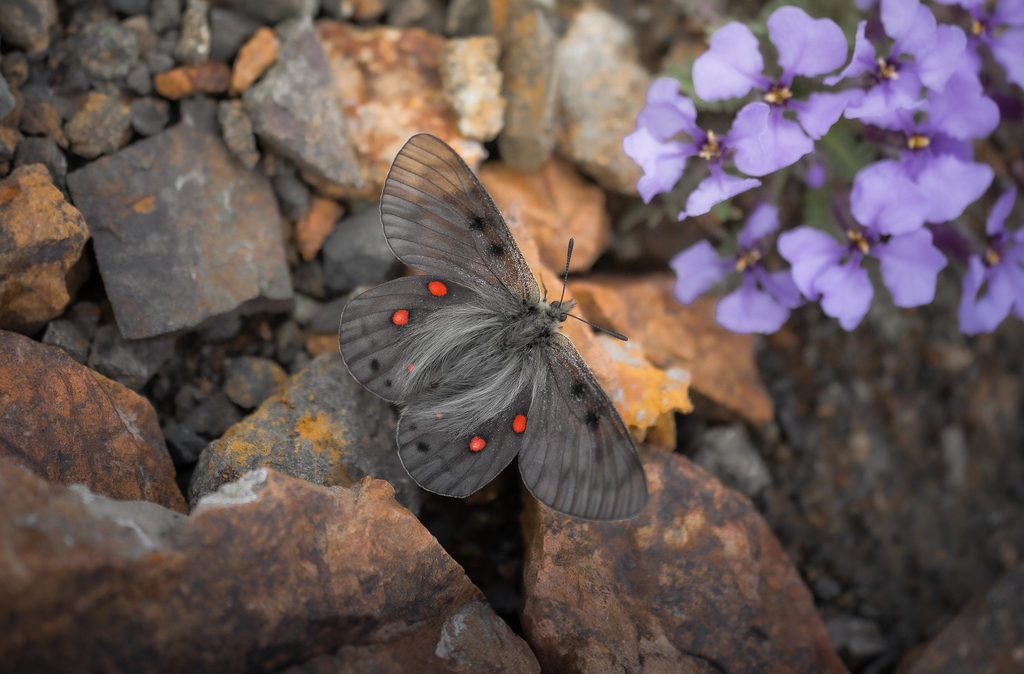
(c) james_qiii, some rights reserved (CC BY) · licence
Family: Papilionidae · Class: Insecta · Order: Lepidoptera
Parnassius behrii (Sierra Nevada Parnassian) is a California animal in the Papilionidae family.
The Sierra Nevada Parnassian is a medium-sized butterfly endemic to the high-elevation regions of the Sierra Nevada mountain range in California. Adults have a wingspan of 50 to 70 mm (2.0 to 2.8 inches), with white wings marked by distinctive black spots and red eyespots. The forewings display prominent black marginal bands and scattered black spots, while the hindwings feature characteristic red or orange eyespots with black centers. Females are typically larger than males and often show more extensive black markings. The body is densely covered with pale scales, and the antennae are black with white clubs. This species occurs exclusively in the Sierra Nevada of California, with populations documented from approximately Tulare County north to Alpine County. The butterfly inhabits high-elevation environments typically between 1,800 and 3,700 meters (6,000 to 12,000 feet) in elevation. Historical records indicate the species was more widely distributed throughout suitable habitat in the Sierra Nevada, though current population status and specific locality information remains limited. Sierra Nevada Parnassians occupy alpine and subalpine meadows, rocky slopes, and forest clearings where their host plants occur. The species requires areas with abundant stonecrop (Sedum species) in the Crassulaceae family, which serves as the exclusive larval food source. Adults are typically found in open, sunny locations near seeps, streams, or moist areas where Sedum grows on rocky substrates or in thin soils. The habitat is characterized by short growing seasons and extreme temperature fluctuations typical of high-elevation environments. Adults emerge from late June through August, with peak flight activity occurring in July. Males patrol territories near host plant patches, seeking females for mating. After mating, females deposit single eggs on or near Sedum plants. Larvae develop slowly due to the short mountain growing season, often requiring two years to complete development. Caterpillars feed exclusively on stonecrop foliage and overwinter in early instars, resuming feeding the following spring. The species exhibits a univoltine life cycle, producing one generation per year. Adults nectar on various alpine wildflowers including paintbrush, penstemon, and asters. The Sierra Nevada Parnassian lacks formal state or federal listing status, though limited survey data makes population assessment challenging. The species faces potential threats from climate change, which may alter the distribution and abundance of host plants at high elevations. Habitat degradation from recreational activities, livestock grazing, and development in montane areas may impact local populations. The butterfly's restricted range and specialized habitat requirements make it potentially vulnerable to environmental changes. Additional surveys are needed to assess current population trends and distribution throughout the Sierra Nevada range.
Classification
Class: Insecta · Order: Lepidoptera · Family: Papilionidae
Frequently asked questions
How is Parnassius behrii classified?
Parnassius behrii belongs to class Insecta, order Lepidoptera, family Papilionidae.
What family does Parnassius behrii belong to?
Parnassius behrii is in the Papilionidae family.
What is Parnassius behrii?
The Sierra Nevada Parnassian is a medium-sized butterfly endemic to the high-elevation regions of the Sierra Nevada mountain range in California.
Is Parnassius behrii found in California?
Yes. Parnassius behrii is recorded in California in The California Species Project's catalogue.
Related species
Other California species in the same genus, family, or bioregion.
Data from The California Species Project — 14,000+ California species with verified data from CNPS, CDFW, USFWS, and more.