Parnassius clodius
Clodius Parnassian
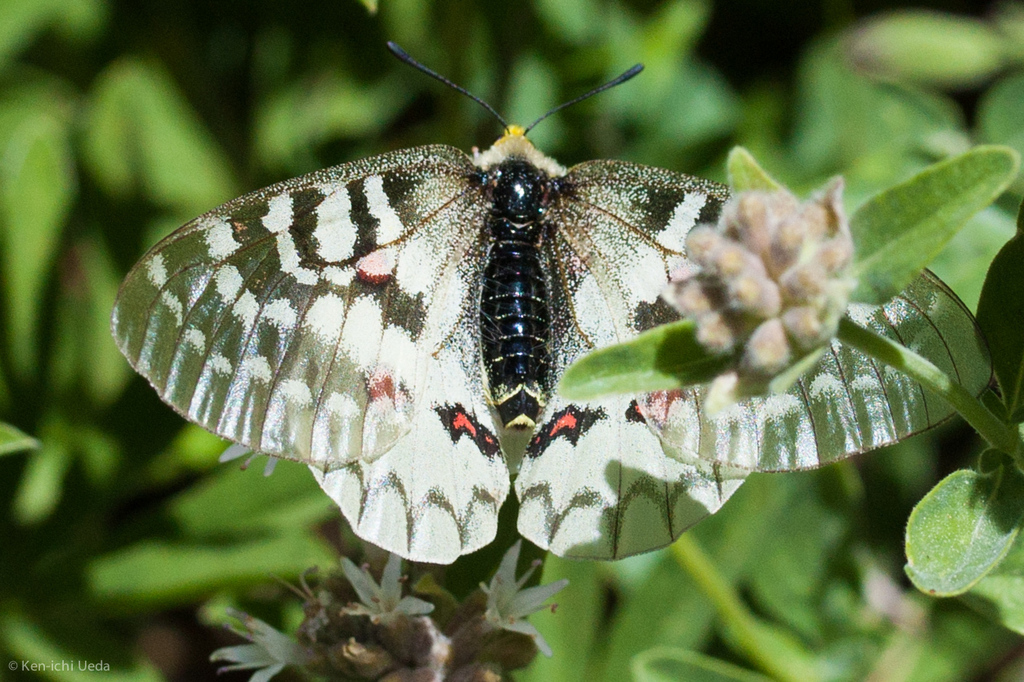
(c) Ken-ichi Ueda, some rights reserved (CC BY) · licence
Family: Papilionidae · Class: Insecta · Order: Lepidoptera
Parnassius clodius (Clodius Parnassian) is a California animal in the Papilionidae family.
The Clodius Parnassian is a distinctive white butterfly with a wingspan ranging from 50 to 80 mm (2.0 to 3.1 inches). The forewings are primarily white with black marginal spots and variable black markings along the wing borders. Males typically display more extensive black markings than females. The hindwings are white with prominent red or orange eyespots, usually two per wing, though the number and intensity can vary geographically. Unlike many other butterflies, both sexes lack scaling on portions of their wings, creating translucent or semi-transparent areas. Females develop a waxy sphragis or mating plug after copulation, which appears as a yellowish-white structure at the tip of the abdomen. The Clodius Parnassian occurs throughout western Canada and the western United States, with populations documented from British Columbia south to California, and from the Pacific Coast east to the Rocky Mountains. In California, the species is found primarily in mountainous regions of the Sierra Nevada, Cascade Range, and coastal mountains. Populations occur at elevations typically ranging from 300 to 3,400 meters (1,000 to 11,200 feet), though elevation ranges vary significantly across the species' distribution. This species inhabits diverse montane environments including coniferous forests, alpine meadows, forest clearings, and areas along streams and seeps where host plants occur. The butterfly requires proximity to plants in the bleeding heart family (Fumariaceae), specifically Dicentra uniflora, D. formosa, and D. pauciflora. Habitats typically feature partial shade to full sun exposure with adequate moisture to support host plant growth. The species shows strong site fidelity, often returning to the same locations year after year. Clodius Parnassians are univoltine, producing one generation per year. Adults typically emerge from late May through August, depending on elevation and local climate conditions. Flight periods are generally shorter at higher elevations. Males are protandrous, emerging before females and actively patrolling territories in search of mates. After mating, females seek appropriate host plants for oviposition. Eggs are laid singly on or near host plants and overwinter in this stage. Larvae feed exclusively on bleeding heart species, developing through five instars before pupating. The chrysalis stage typically lasts two to three weeks. The species faces various conservation challenges across its range. Habitat fragmentation from development, logging, and recreational activities affects population connectivity. Climate change poses threats through altered precipitation patterns and temperature regimes that may affect host plant distribution and phenology. Some populations have experienced declines due to habitat loss, though the species maintains relatively stable populations in protected areas. The Clodius Parnassian is not currently listed under federal or state endangered species legislation, but local populations may be vulnerable to extirpation from habitat degradation and environmental changes.
Classification
Class: Insecta · Order: Lepidoptera · Family: Papilionidae
Frequently asked questions
How is Parnassius clodius classified?
Parnassius clodius belongs to class Insecta, order Lepidoptera, family Papilionidae.
What family does Parnassius clodius belong to?
Parnassius clodius is in the Papilionidae family.
What is Parnassius clodius?
The Clodius Parnassian is a distinctive white butterfly with a wingspan ranging from 50 to 80 mm (2.0 to 3.1 inches).
Is Parnassius clodius found in California?
Yes. Parnassius clodius is recorded in California in The California Species Project's catalogue.
Related species
Other California species in the same genus, family, or bioregion.
Data from The California Species Project — 14,000+ California species with verified data from CNPS, CDFW, USFWS, and more.