Parnassius smintheus
Rocky Mountain Parnassian
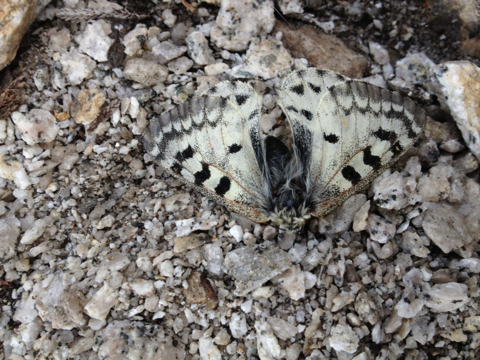
(c) Justin, some rights reserved (CC BY) · licence
Family: Papilionidae · Class: Insecta · Order: Lepidoptera
Parnassius smintheus (Rocky Mountain Parnassian) is a California animal in the Papilionidae family.
The Rocky Mountain Parnassian is a medium-sized butterfly with distinctive white wings marked by black spots and orange-red eyespots. Adults have a wingspan of 50 to 70 mm (2.0 to 2.8 inches). Males display white forewings with black marginal spots and typically two black spots on each wing, while the hindwings feature prominent orange-red eyespots with black centers. Females are similar but often larger with more extensive black markings. The body is covered in dense white to grayish hairs, and the antennae are black with white bands. Unlike other swallowtails, Parnassius species lack tails on their hindwings. The Rocky Mountain Parnassian ranges from New Mexico north along the Rocky Mountains and into southwest Alaska. In California, the species occurs in the Sierra Nevada and northern mountain ranges, typically at elevations between 1,500 and 3,500 meters (4,900 to 11,500 feet). Populations are generally restricted to high-elevation meadows and slopes where host plants are abundant. The species' distribution is closely tied to the presence of suitable Sedum species and appropriate climatic conditions. This butterfly inhabits alpine and subalpine meadows, rocky slopes, and open areas within montane forests. Adults are found in areas with abundant wildflowers that provide nectar sources, including lupines, paintbrush, and asters. The species prefers well-drained soils where many species of stonecrop (Sedum) in the Crassulaceae family can establish. These host plants typically grow in rocky, sandy, or gravelly substrates with good drainage and full sun exposure. Rocky Mountain Parnassians have a single generation per year, with adults typically flying from July through September, depending on elevation and local conditions. Mating occurs shortly after emergence, and females deposit eggs singly on or near host plants. Larvae feed exclusively on Sedum species, developing slowly over multiple seasons. The species overwinters as partially developed larvae within the egg, resuming development the following spring. Pupation occurs in a loose cocoon among leaf litter or rocks. Adults are relatively weak fliers and tend to remain close to suitable habitat, making them poor dispersers between isolated populations. The Rocky Mountain Parnassian is not federally listed but faces conservation challenges due to habitat fragmentation and climate change. High-elevation populations are particularly vulnerable to warming temperatures, which may force suitable habitat upslope beyond the species' dispersal capabilities. Recreational activities, livestock grazing, and development in mountain areas can degrade habitat quality. The species' dependence on specific host plants and limited dispersal ability make local populations susceptible to extirpation. Some regional populations have experienced declines, particularly at lower elevations where habitat has been lost or degraded. Conservation efforts focus on habitat protection and monitoring of population trends across the species' range.
Classification
Class: Insecta · Order: Lepidoptera · Family: Papilionidae
Frequently asked questions
How is Parnassius smintheus classified?
Parnassius smintheus belongs to class Insecta, order Lepidoptera, family Papilionidae.
What family does Parnassius smintheus belong to?
Parnassius smintheus is in the Papilionidae family.
What is Parnassius smintheus?
The Rocky Mountain Parnassian is a medium-sized butterfly with distinctive white wings marked by black spots and orange-red eyespots.
Is Parnassius smintheus found in California?
Yes. Parnassius smintheus is recorded in California in The California Species Project's catalogue.
Related species
Other California species in the same genus, family, or bioregion.
Data from The California Species Project — 14,000+ California species with verified data from CNPS, CDFW, USFWS, and more.