Paruroctonus silvestrii
California common scorpion
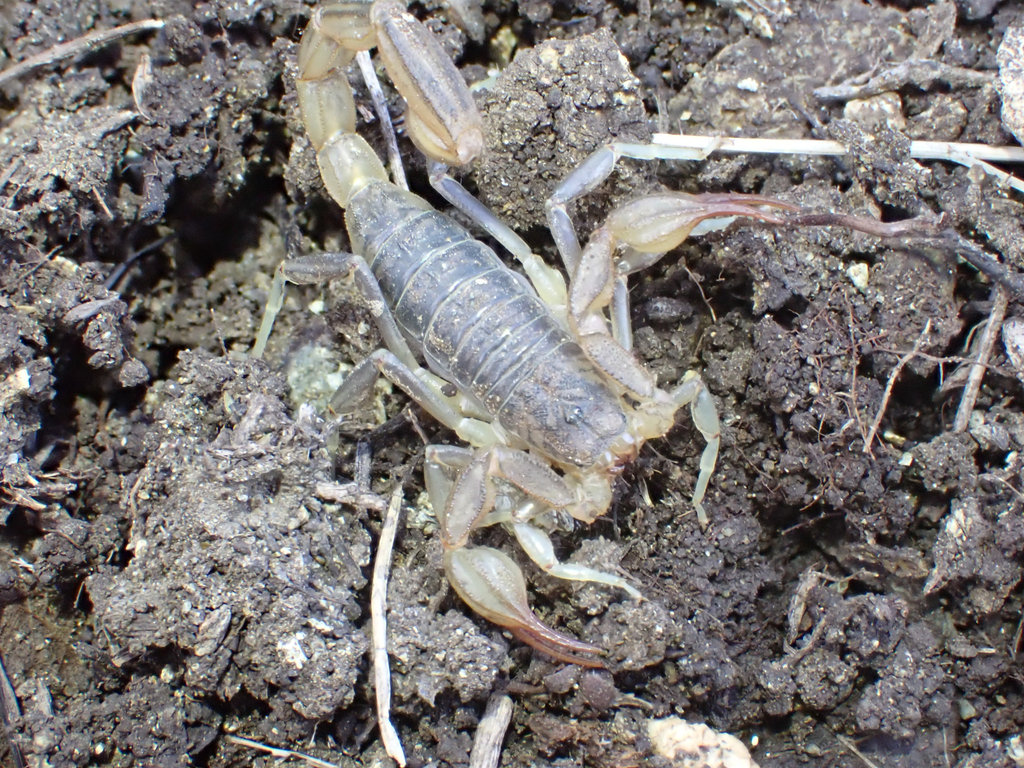
(c) Trevor Van Loon, some rights reserved (CC BY) · licence
Family: Vaejovidae · Class: Arachnida · Order: Scorpiones
Paruroctonus silvestrii (California common scorpion) is a California animal in the Vaejovidae family.
The California common scorpion is a medium-sized arachnid measuring approximately 25 to 40 mm (1.0 to 1.6 inches) in total length. The body exhibits a typical scorpion morphology with eight legs, prominent pincers (chelae), and a segmented tail terminating in a venomous stinger. The coloration is generally yellowish-brown to tan with darker markings, and the species displays relatively slender pincers compared to some other scorpion species. Like all scorpions, it fluoresces under ultraviolet light, appearing bright blue-green when illuminated with a blacklight. Paruroctonus silvestrii occurs throughout much of California, with documented populations extending from coastal areas to inland regions. BugGuide observations confirm its presence in Santa Clara County, Los Angeles County, and San Diego County (BugGuide). The species has been recorded from sea level to moderate elevations in the California mountains. Its distribution may extend beyond California's borders into adjacent southwestern states, though the core population remains within California. The species inhabits diverse habitats including coastal areas, grasslands, chaparral, oak woodlands, and urban environments. Observations indicate the species utilizes rocky areas, areas under logs and stones, and dry habitats along roadsides and trails. BugGuide records document activity in both natural preserves like Long Ridge Open Space Preserve and developed areas near urban centers (BugGuide). The species demonstrates considerable habitat flexibility, occurring in both natural and human-modified landscapes throughout its range. California common scorpions are nocturnal predators that emerge after dark to hunt small arthropods including insects, spiders, and other invertebrates. They use their pincers to capture prey and inject venom through their tail stinger to subdue victims. During daylight hours, they seek shelter under rocks, logs, debris, or in burrows they excavate in sandy or loose soil. The species is active throughout much of the year in California's mild climate, with peak activity during warmer months. Reproduction follows typical scorpion patterns, with females carrying young on their backs after birth until the first molt. Paruroctonus silvestrii does not currently hold any federal or state conservation status listings. The species appears relatively common and widespread throughout its California range, adapting well to both natural and human-modified habitats. While individual populations may face localized pressures from habitat development, the species' adaptability to various habitat types and its broad distribution suggest stable overall population status. The species' presence in protected areas like state parks and open space preserves provides some habitat security. Climate change effects on California's ecosystems may influence future distribution patterns, though the species' ecological flexibility suggests resilience to moderate environmental changes. Due to limited detailed ecological research on this species, much of our understanding comes from naturalist observations and general scorpion biology. Additional scientific study would enhance knowledge of specific habitat requirements, population dynamics, and ecological relationships within California's diverse ecosystems.
Classification
Class: Arachnida · Order: Scorpiones · Family: Vaejovidae
Frequently asked questions
How is Paruroctonus silvestrii classified?
Paruroctonus silvestrii belongs to class Arachnida, order Scorpiones, family Vaejovidae.
What family does Paruroctonus silvestrii belong to?
Paruroctonus silvestrii is in the Vaejovidae family.
What is Paruroctonus silvestrii?
The California common scorpion is a medium-sized arachnid measuring approximately 25 to 40 mm (1.0 to 1.6 inches) in total length.
Is Paruroctonus silvestrii found in California?
Yes. Paruroctonus silvestrii is recorded in California in The California Species Project's catalogue.
Related species
Other California species in the same genus, family, or bioregion.
Data from The California Species Project — 14,000+ California species with verified data from CNPS, CDFW, USFWS, and more.