Passer domesticus
House Sparrow
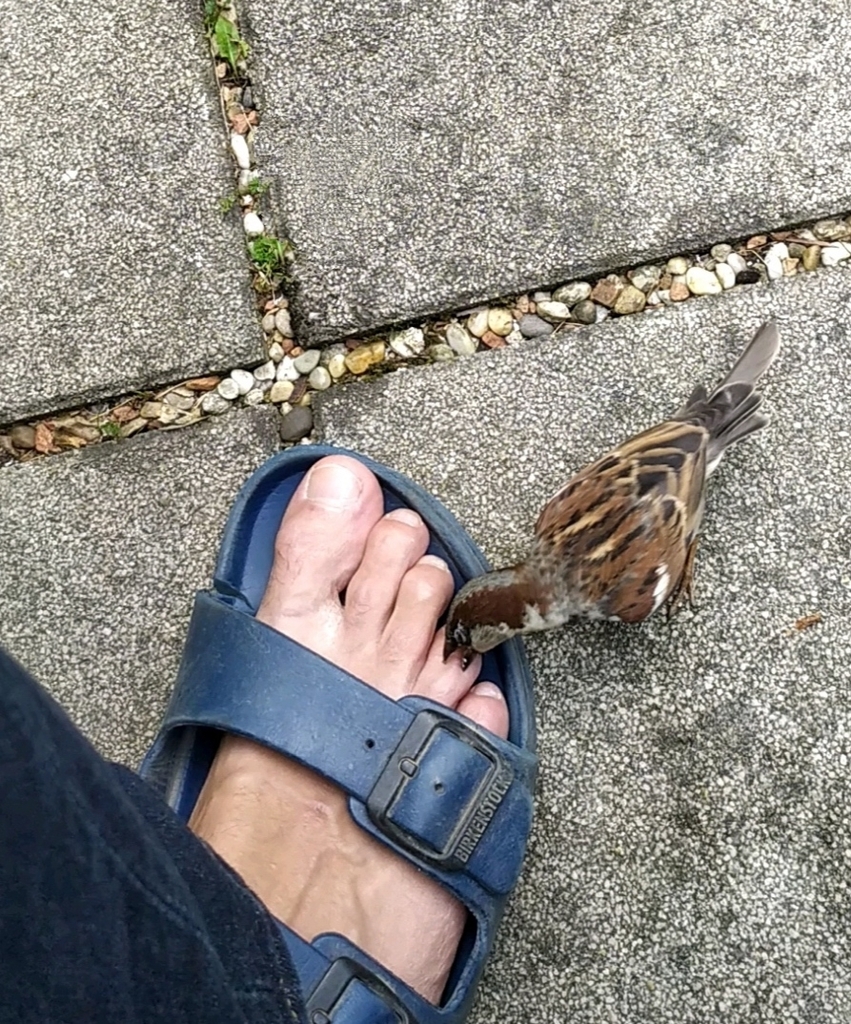
(c) carnifex, some rights reserved (CC BY) · licence
Family: Passeridae · Class: Aves · Order: Passeriformes
Passer domesticus (House Sparrow) is a California animal in the Passeridae family.
The House Sparrow is a small, compact songbird measuring 14 to 18 centimeters (5.5 to 7.1 inches) in length with a wingspan of 19 to 25 centimeters (7.5 to 9.8 inches). Adult males weigh 24 to 39.5 grams, while females are slightly smaller at 22 to 32 grams. Males display distinctive breeding plumage with a gray crown, black bib extending from throat to upper chest, chestnut nape, and white cheeks. Females and juveniles are brownish-gray above with pale underparts, lacking the male's distinctive markings. Both sexes have conical, seed-cracking bills and short, square tails. The House Sparrow is not native to North America but was introduced from Europe in the 1850s. The species now occurs throughout California from sea level to approximately 2,000 meters (6,500 feet) elevation, with populations established in urban areas, agricultural regions, and developed landscapes across all counties. Historical range expansion was rapid following initial introductions in New York, with populations reaching California by the 1870s through both natural dispersal and additional introductions. House Sparrows are closely associated with human habitation and modified environments. They thrive in urban and suburban areas, agricultural lands, parks, and residential neighborhoods. The species requires access to grain or seed sources and suitable nesting sites, typically selecting cavities in buildings, nest boxes, or dense vegetation. They avoid extensive forested areas and natural habitats with minimal human presence. Nesting occurs in roof eaves, wall cavities, traffic signals, and occasionally in shrubs or trees. House Sparrows are granivorous, feeding primarily on seeds, grains, and plant matter, though they supplement their diet with insects, particularly during the breeding season when feeding nestlings. The species is highly social, forming flocks outside the breeding season and often feeding in groups. Breeding occurs from March through August in California, with pairs producing two to four broods annually. Females construct dome-shaped nests of grass, feathers, and debris, laying three to six eggs per clutch. Incubation lasts 10 to 14 days, and nestlings fledge after 14 to 16 days. The House Sparrow holds no conservation listing status in California or federally, as it is a non-native species. Population trends have shown significant declines across North America since the 1960s, with causes including urbanization changes, reduced availability of nesting sites in modern construction, decreased grain sources due to agricultural practices, and increased predation from domestic cats. According to the North American Breeding Bird Survey, House Sparrow populations have declined by approximately 84% since 1966. Despite these declines, the species remains common in suitable habitat throughout California and is not considered a conservation concern. The International Union for Conservation of Nature lists the global population as Least Concern due to the species' widespread distribution and large global population.
Classification
Class: Aves · Order: Passeriformes · Family: Passeridae
Frequently asked questions
How is Passer domesticus classified?
Passer domesticus belongs to class Aves, order Passeriformes, family Passeridae.
What family does Passer domesticus belong to?
Passer domesticus is in the Passeridae family.
What is Passer domesticus?
The House Sparrow is a small, compact songbird measuring 14 to 18 centimeters (5.5 to 7.1 inches) in length with a wingspan of 19 to 25 centimeters (7.5 to 9.8 inches).
Is Passer domesticus found in California?
Yes. Passer domesticus is recorded in California in The California Species Project's catalogue.
More California species
This species has no close relatives in our California data — here are other species to explore.
Data from The California Species Project — 14,000+ California species with verified data from CNPS, CDFW, USFWS, and more.