Passerculus sandwichensis
Savannah Sparrow
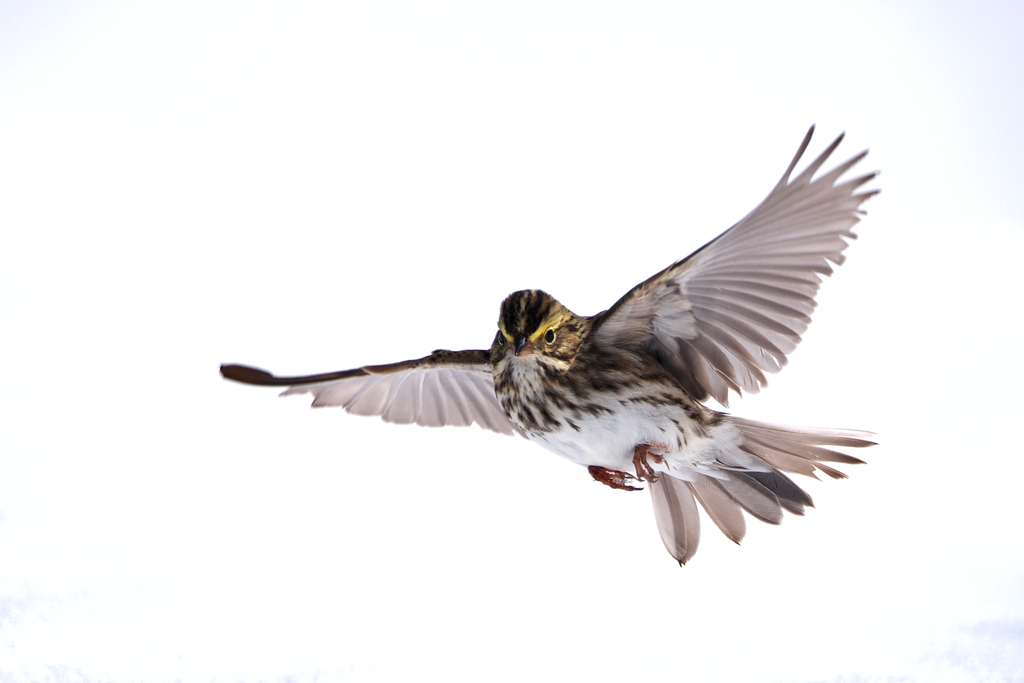
no rights reserved · CC0
Family: Passerellidae · Class: Aves · Order: Passeriformes
Passerculus sandwichensis (Savannah Sparrow) is a California animal in the Passerellidae family.
The Savannah Sparrow is a small, streaky songbird measuring 11-17 cm (4.3-6.7 inches) in length with a wingspan of 18-25 cm (7.1-9.8 inches). Adults weigh 13-28 grams. The species displays brown and buff upperparts heavily streaked with dark brown or black, and whitish underparts with dark streaking on the breast and flanks. The head shows a distinctive pale median crown stripe bordered by dark lateral stripes, and many individuals exhibit a yellowish wash above the eye (supercilium). The tail is notched and relatively short compared to other sparrows. Sexual dimorphism is minimal, though males may appear slightly larger during breeding season. The Savannah Sparrow has one of the most extensive breeding ranges of any North American songbird, extending from Alaska and northern Canada south to central Mexico. In California, the species occurs throughout the state from sea level to 3,050 meters (10,000 feet) elevation. The subspecies P. s. beldingi, known as Belding's Savannah Sparrow, is endemic to salt marshes along the Pacific coast from Santa Barbara County to Baja California. Other subspecies occupy different regions within the state, with populations in the Central Valley, coastal areas, mountain meadows, and desert regions. Savannah Sparrows inhabit open grasslands, prairies, agricultural fields, coastal salt marshes, wet meadows, and tundra. The species shows notable habitat flexibility, occupying both freshwater and saltwater marsh environments, short-grass prairies, hayfields, and even airport grasslands. Belding's Savannah Sparrow specifically requires salt marsh habitat with pickleweed (Salicornia), cordgrass (Spartina), and other halophytic vegetation. Elevation preferences vary by subspecies, from coastal marshes at sea level to alpine meadows above 2,400 meters (7,900 feet). The species feeds primarily on seeds, particularly those of grasses and forbs, supplemented with insects during breeding season. Common prey includes beetles, caterpillars, flies, and spiders, which provide essential protein for nestlings. Savannah Sparrows typically forage on the ground, using a scratching motion to uncover food items. Breeding occurs from April through August, with peak activity in May and June. Females construct cup-shaped nests on the ground, often concealed in grass tufts or low vegetation. Clutch size ranges from 2-6 eggs, typically 3-5, with an incubation period of 10-13 days. Young fledge after 8-11 days but remain dependent on parents for several additional weeks. Most Savannah Sparrow populations are not federally listed, though Belding's Savannah Sparrow has faced conservation concerns due to salt marsh habitat loss. According to the California Department of Fish and Wildlife, coastal salt marsh populations have declined due to urban development, habitat fragmentation, and sea level rise. The species experienced population reductions of approximately 50% in some California coastal areas between 1980 and 2010. Climate change poses additional threats through altered precipitation patterns affecting breeding habitat and potential sea level impacts on coastal subspecies. Conservation efforts focus on salt marsh restoration, habitat protection, and monitoring of sensitive subspecies populations.
Classification
Class: Aves · Order: Passeriformes · Family: Passerellidae
Frequently asked questions
How is Passerculus sandwichensis classified?
Passerculus sandwichensis belongs to class Aves, order Passeriformes, family Passerellidae.
What family does Passerculus sandwichensis belong to?
Passerculus sandwichensis is in the Passerellidae family.
What is Passerculus sandwichensis?
The Savannah Sparrow is a small, streaky songbird measuring 11-17 cm (4.3-6.7 inches) in length with a wingspan of 18-25 cm (7.1-9.8 inches).
Is Passerculus sandwichensis found in California?
Yes. Passerculus sandwichensis is recorded in California in The California Species Project's catalogue.
Related species
Other California species in the same genus, family, or bioregion.
Data from The California Species Project — 14,000+ California species with verified data from CNPS, CDFW, USFWS, and more.