Passerculus sandwichensis beldingi
Belding’s savannah sparrow
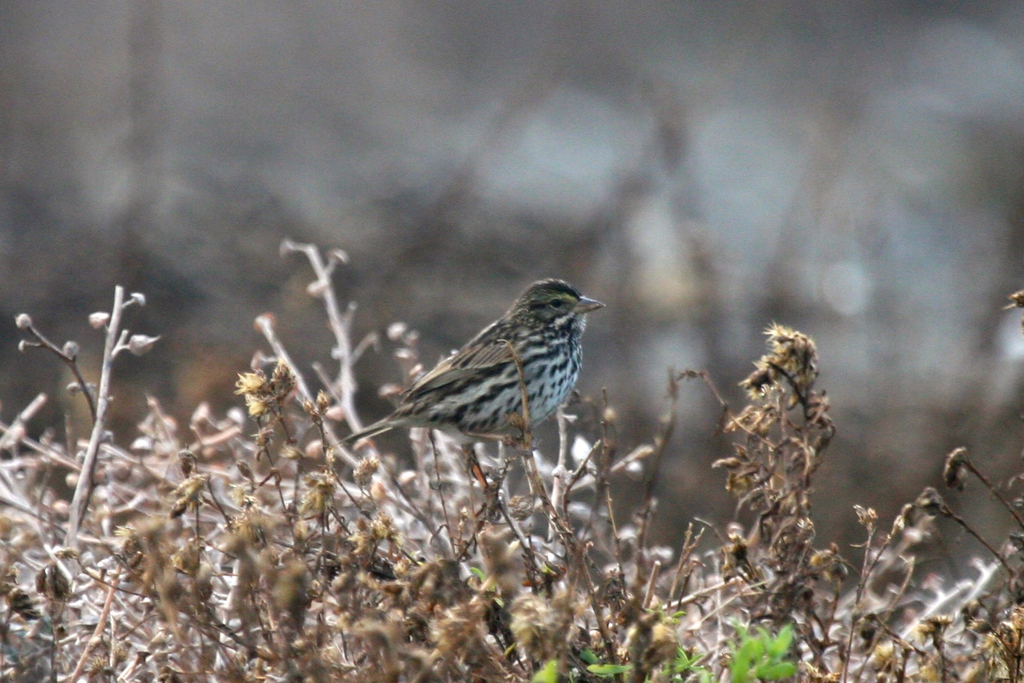
(c) Cole Wolf, some rights reserved (CC BY) · licence
Family: Passerellidae · Class: Aves · Order: Passeriformes
Conservation status: SE · G5T3 S3
Passerculus sandwichensis beldingi (Belding’s savannah sparrow) is a California animal in the Passerellidae family.
Belding's savannah sparrow (Passerculus sandwichensis beldingi) is a small subspecies of savannah sparrow endemic to coastal salt marshes of southern California and northern Baja California, Mexico. Adults measure approximately 12-15 cm (4.7-5.9 inches) in length with brownish-gray upperparts streaked with darker markings and pale underparts with fine breast streaking. The subspecies is distinguished from other savannah sparrow populations by its larger bill, adapted for foraging in salt marsh environments, and darker overall plumage coloration. The subspecies occurs exclusively in coastal salt marshes from Point Conception in Santa Barbara County south to northern Baja California, Mexico. Key populations are found at locations including Goleta Slough, Carpinteria Salt Marsh, Ballona Wetlands, Upper Newport Bay, and Tijuana River National Estuarine Research Reserve. According to NatureServe, the total population consists of a few thousand pairs, with populations showing some increase during the 1980s. Belding's savannah sparrows are year-round residents of coastal salt marshes, showing strong habitat specialization for pickleweed (Salicornia) dominated communities. The subspecies primarily inhabits mid- to upper-littoral zones of salt marshes, preferring areas with moderate vegetation height and density. According to research by Powell and Collier (1998), territory sizes average 447 square meters, with variation depending on habitat quality and marsh configuration. The birds require both nesting areas in higher marsh zones and foraging areas in lower intertidal zones. Breeding occurs from March through August, with peak nesting activity in April and May. Females construct cup-shaped nests low to the ground within dense pickleweed or other salt marsh vegetation. Clutch size typically ranges from 2-4 eggs, with an incubation period of approximately 12-13 days. According to Powell and Collier (1998), reproductive success varies significantly with habitat quality, with birds in large, connected marsh patches showing higher nesting success (65% of territories producing more than 5 young) compared to small, isolated patches. The subspecies is primarily granivorous, feeding on seeds of salt marsh plants, particularly pickleweed, with diet supplemented by small invertebrates during breeding season. Belding's savannah sparrow is listed as endangered by the State of California. The subspecies faces significant conservation challenges from habitat loss and fragmentation due to coastal development, with over 90% of historical salt marsh habitat eliminated in southern California. Current threats include continued habitat loss, degradation from pollution and altered hydrology, sea level rise associated with climate change, and predation pressure in fragmented habitats. The highly fragmented nature of remaining salt marsh habitat may negatively influence reproductive success and population connectivity. Conservation efforts focus on habitat restoration, protection of existing marshes, and management of water levels to maintain suitable breeding conditions.
Classification
Class: Aves · Order: Passeriformes · Family: Passerellidae
Conservation status
SE · G5T3 S3
Frequently asked questions
How is Passerculus sandwichensis beldingi classified?
Passerculus sandwichensis beldingi belongs to class Aves, order Passeriformes, family Passerellidae.
What family does Passerculus sandwichensis beldingi belong to?
Passerculus sandwichensis beldingi is in the Passerellidae family.
Is Passerculus sandwichensis beldingi protected or of conservation concern?
Passerculus sandwichensis beldingi carries the following status: SE · G5T3 S3.
What is Passerculus sandwichensis beldingi?
Belding's savannah sparrow (Passerculus sandwichensis beldingi) is a small subspecies of savannah sparrow endemic to coastal salt marshes of southern California and northern Baja California, Mexico.
Is Passerculus sandwichensis beldingi found in California?
Yes. Passerculus sandwichensis beldingi is recorded in California in The California Species Project's catalogue.
Related species
Other California species in the same genus, family, or bioregion.
Data from The California Species Project — 14,000+ California species with verified data from CNPS, CDFW, USFWS, and more.