Passerculus sandwichensis rostratus
Large-billed Savannah Sparrow
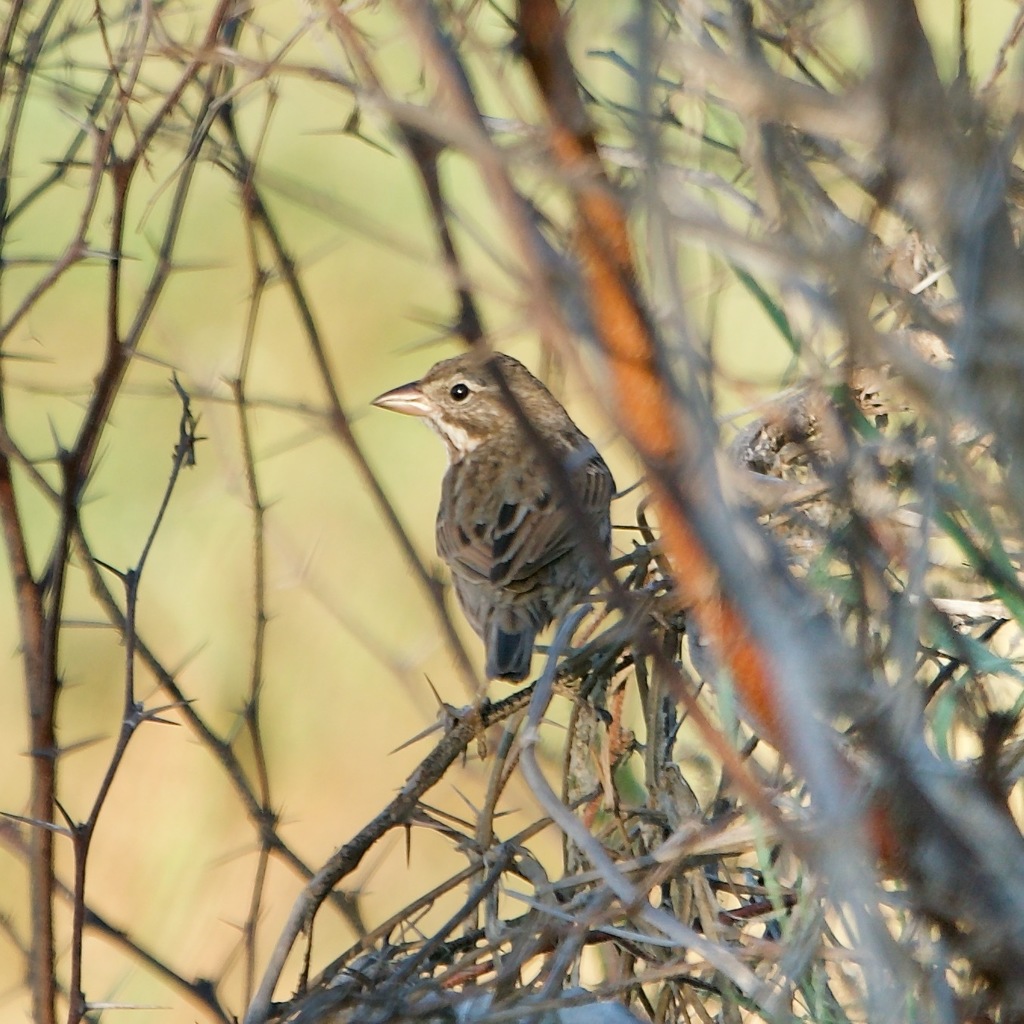
(c) Bill Levine, some rights reserved (CC BY) · licence
Family: Passerellidae · Class: Aves · Order: Passeriformes
Conservation status: G5T2T3Q S2
Passerculus sandwichensis rostratus (Large-billed Savannah Sparrow) is a California animal in the Passerellidae family.
The Large-billed Savannah Sparrow is a subspecies of Savannah Sparrow distinguished primarily by its proportionally larger bill compared to other subspecies. This sparrow measures approximately 5.5 inches (14 cm) in length and displays typical savannah sparrow plumage characteristics including streaked brown upperparts and a whitish breast with dark streaking. The subspecies can be differentiated from the closely related Belding's Savannah Sparrow by subtle morphological differences, though genetic studies have revealed taxonomic complexities within the sandwichensis complex (Zink et al. 1991). Historically, the Large-billed Savannah Sparrow occurred along coastal salt marshes of southern California and Baja California, Mexico. According to historical distribution records, this subspecies was documented along the east and west shores of the Gulf of California region. Current range information indicates severely restricted distribution, with the subspecies facing significant range contraction from historical levels. The subspecies was included in early California avian surveys by Grinnell and Miller (1944), indicating its presence in the state's coastal marsh systems. The Large-billed Savannah Sparrow inhabits coastal salt marshes and adjacent halophytic vegetation communities. Like other salt marsh-adapted savannah sparrows, this subspecies requires dense pickleweed (Salicornia) stands for nesting and foraging. The birds utilize both low and mid-marsh zones, selecting areas with adequate vegetation cover for nest placement and invertebrate prey abundance. Tidal influence and salinity gradients within marsh systems appear to be important habitat components for maintaining suitable conditions. Breeding behavior follows typical savannah sparrow patterns, with males establishing territories through song and display behaviors. The subspecies constructs ground nests concealed within marsh vegetation, typically laying 3-5 eggs per clutch. Diet consists primarily of small invertebrates during breeding season, including amphipods, marine worms, and insects, supplemented by seeds during non-breeding periods. Foraging occurs both within pickleweed stands and along mudflat edges during low tide periods. The Large-billed Savannah Sparrow faces critical conservation challenges. The subspecies carries a Global/State Rank of G5T2T3Q S2, indicating very high concern for its long-term persistence in California. Primary threats include coastal development, habitat conversion, sea level rise, and altered hydrology in remaining marsh systems. Unlike the Belding's Savannah Sparrow, which maintains stable populations in some locations, the Large-billed Savannah Sparrow appears to have experienced more severe population declines. The subspecies lacks federal protection under the Endangered Species Act as of December 2025, despite its precarious status. Climate change poses additional threats through increased storm intensity, altered precipitation patterns, and accelerated sea level rise affecting coastal marsh habitats. Conservation efforts require habitat restoration, protection of remaining salt marsh systems, and adaptive management strategies to address climate-related impacts. The taxonomic uncertainty surrounding this subspecies, as indicated by the 'Q' qualifier in its conservation rank, suggests that additional genetic research may be needed to clarify its systematic status and inform conservation priorities.
Classification
Class: Aves · Order: Passeriformes · Family: Passerellidae
Conservation status
G5T2T3Q S2
Frequently asked questions
How is Passerculus sandwichensis rostratus classified?
Passerculus sandwichensis rostratus belongs to class Aves, order Passeriformes, family Passerellidae.
What family does Passerculus sandwichensis rostratus belong to?
Passerculus sandwichensis rostratus is in the Passerellidae family.
Is Passerculus sandwichensis rostratus protected or of conservation concern?
Passerculus sandwichensis rostratus carries the following status: G5T2T3Q S2.
What is Passerculus sandwichensis rostratus?
The Large-billed Savannah Sparrow is a subspecies of Savannah Sparrow distinguished primarily by its proportionally larger bill compared to other subspecies.
Is Passerculus sandwichensis rostratus found in California?
Yes. Passerculus sandwichensis rostratus is recorded in California in The California Species Project's catalogue.
Related species
Other California species in the same genus, family, or bioregion.
Data from The California Species Project — 14,000+ California species with verified data from CNPS, CDFW, USFWS, and more.