Passerella iliaca
Fox Sparrow
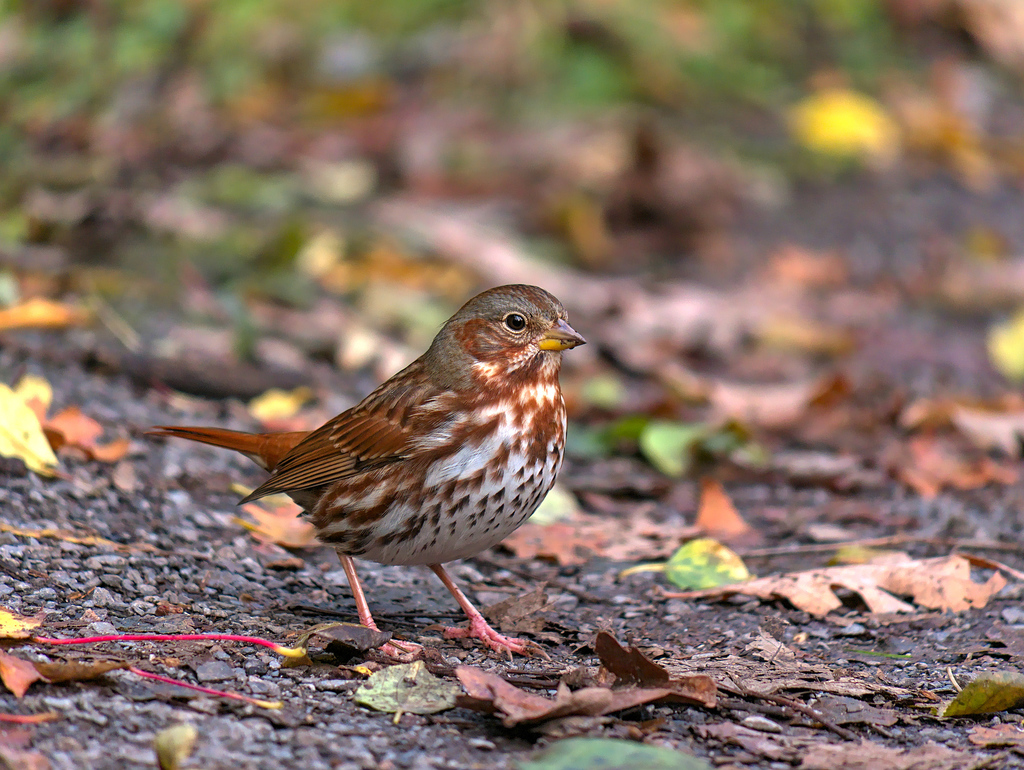
(c) Blake Ross, some rights reserved (CC BY) · licence
Family: Passerellidae · Class: Aves · Order: Passeriformes
Passerella iliaca (Fox Sparrow) is a California animal in the Passerellidae family.
The Fox Sparrow is a medium-sized songbird measuring 15 to 19 cm (5.9 to 7.5 inches) in length with a wingspan of 26 to 28 cm (10.2 to 11.0 inches). Adults weigh 26 to 44 grams (0.9 to 1.6 ounces), making them among the largest North American sparrows. The species exhibits considerable geographic variation across its range, with four distinct subspecies groups recognized. Birds display rusty-red to brownish upperparts with heavy dark streaking on white to grayish underparts. The breast markings often converge into a central spot, and the tail shows rusty coloration. The bill is robust and conical, adapted for seed processing and ground foraging. Fox Sparrows breed across boreal and montane forests from Alaska through western and central Canada, extending south through the western United States. In California, breeding populations occur in the Sierra Nevada, Cascade Range, and northern Coast Range, typically at elevations from 1,200 to 3,400 meters (3,937 to 11,155 feet). The species also breeds in suitable habitat in the Klamath Mountains and Warner Mountains. During winter, populations migrate to lower elevations and more southern latitudes, with many individuals moving to brushy habitats throughout California's foothills and coastal areas. Breeding habitat consists of dense coniferous and mixed forests, particularly areas with thick understory vegetation including willow, alder, and berry-producing shrubs. The species favors forest edges, clearings, and areas with fallen logs and dense brush piles. During migration and winter, Fox Sparrows utilize chaparral, riparian thickets, parks, and suburban areas with dense shrub cover. They show strong preference for areas with leaf litter and organic debris for foraging. Fox Sparrows employ a distinctive double-scratch foraging technique, jumping forward and then rapidly scratching backward with both feet to uncover food items beneath leaf litter and soil. Their diet consists primarily of seeds, berries, and insects, with seasonal variation in proportions. During breeding season, protein-rich arthropods become increasingly important for nestling development. The species constructs cup-shaped nests 0.3 to 4.6 meters (1 to 15 feet) above ground in dense shrubs or low tree branches. Females lay 3 to 5 pale green to bluish eggs marked with brown spots. Incubation lasts 12 to 14 days, with nestlings fledging after 9 to 11 days. The Fox Sparrow is not federally or state listed and maintains stable populations across most of its range. According to the North American Breeding Bird Survey, populations have remained relatively stable since 1966, with some regional variations. Climate change poses potential long-term challenges through altered precipitation patterns and shifting vegetation zones in montane breeding areas. Habitat loss from logging and development affects some local populations, but the species' adaptability to various forest types and elevations provides resilience. Winter habitat degradation in chaparral and riparian areas represents a more significant conservation concern in California.
Classification
Class: Aves · Order: Passeriformes · Family: Passerellidae
Frequently asked questions
How is Passerella iliaca classified?
Passerella iliaca belongs to class Aves, order Passeriformes, family Passerellidae.
What family does Passerella iliaca belong to?
Passerella iliaca is in the Passerellidae family.
What is Passerella iliaca?
The Fox Sparrow is a medium-sized songbird measuring 15 to 19 cm (5.9 to 7.5 inches) in length with a wingspan of 26 to 28 cm (10.2 to 11.0 inches).
Is Passerella iliaca found in California?
Yes. Passerella iliaca is recorded in California in The California Species Project's catalogue.
Related species
Other California species in the same genus, family, or bioregion.
Data from The California Species Project — 14,000+ California species with verified data from CNPS, CDFW, USFWS, and more.