Passerina amoena
Lazuli Bunting
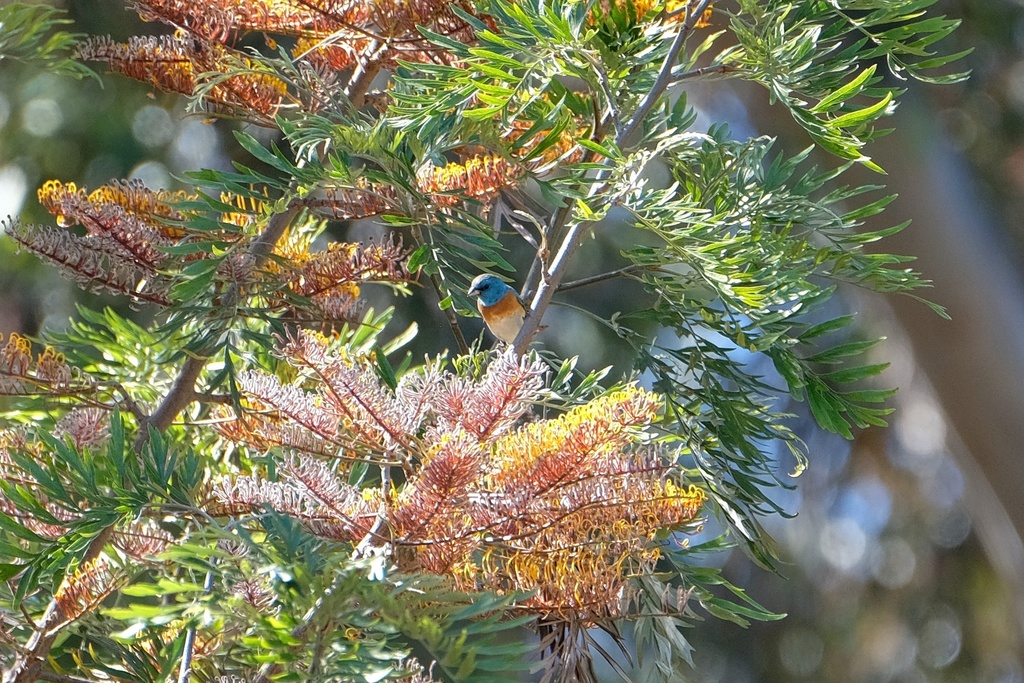
(c) Madeleine Claire, some rights reserved (CC BY) · licence
Family: Cardinalidae · Class: Aves · Order: Passeriformes
Passerina amoena (Lazuli Bunting) is a California animal in the Cardinalidae family.
The Lazuli Bunting is a medium-sized songbird measuring 13 to 14 cm (5.1 to 5.5 inches) in length with a wingspan of 22 to 24 cm (8.7 to 9.4 inches). Adult males display distinctive blue upperparts extending from the head through the back and wings, with a rusty orange breast band and white belly. The blue coloration is most vibrant during breeding season, with the head and nape showing brilliant turquoise-blue. Females and juveniles are brown above with buff-colored underparts and faint streaking on the breast. Males in non-breeding plumage resemble females but retain traces of blue on the wings and tail. The Lazuli Bunting breeds throughout western North America, from southern British Columbia and Alberta south to Baja California and northern Mexico. In California, the species occurs in suitable habitat from sea level to approximately 2,440 meters (8,000 feet) elevation. Breeding populations are found throughout most of the state, with highest densities in foothill and montane regions. The species is a neotropical migrant, wintering primarily in western Mexico from Sonora to Oaxaca. This species inhabits open woodlands, brushy areas, chaparral, riparian zones, and forest edges. Preferred breeding habitat includes areas with scattered trees or tall shrubs for nesting sites combined with open areas for foraging. Common habitat types include oak woodlands, mixed coniferous forests with clearings, streamside vegetation, and shrubland communities. The species adapts to human-modified landscapes including parks, gardens, and agricultural areas with appropriate vegetation structure. Lazuli Buntings are primarily granivorous, feeding on seeds from grasses, forbs, and shrubs. During breeding season, insects comprise a significant portion of the diet, particularly for feeding nestlings. Common prey includes caterpillars, beetles, aphids, and flies. Males establish territories through song and aggressive displays, typically arriving on breeding grounds from late April through May. Nesting occurs from May through August, with females constructing cup-shaped nests in shrubs or low trees, typically 0.6 to 2.4 meters (2 to 8 feet) above ground. Clutch size ranges from three to four eggs, which are incubated for 12 to 13 days. Young fledge approximately 10 to 12 days after hatching. The species typically produces one to two broods per season. The Lazuli Bunting is not federally or state listed and maintains stable populations across most of its range. The North American Breeding Bird Survey indicates relatively stable population trends from 1966 to 2019, with some regional variation. Primary threats include habitat loss from urban development, intensive agriculture, and altered fire regimes. Climate change may affect breeding ranges and migration timing. The species benefits from habitat management that maintains diverse shrubland communities and forest edge environments. Conservation efforts focus on preserving riparian corridors and managing grazing and fire to maintain appropriate vegetation structure.
Classification
Class: Aves · Order: Passeriformes · Family: Cardinalidae
Frequently asked questions
How is Passerina amoena classified?
Passerina amoena belongs to class Aves, order Passeriformes, family Cardinalidae.
What family does Passerina amoena belong to?
Passerina amoena is in the Cardinalidae family.
What is Passerina amoena?
The Lazuli Bunting is a medium-sized songbird measuring 13 to 14 cm (5.1 to 5.5 inches) in length with a wingspan of 22 to 24 cm (8.7 to 9.4 inches).
Is Passerina amoena found in California?
Yes. Passerina amoena is recorded in California in The California Species Project's catalogue.
Related species
Other California species in the same genus, family, or bioregion.
Data from The California Species Project — 14,000+ California species with verified data from CNPS, CDFW, USFWS, and more.