Passerina caerulea
Blue Grosbeak
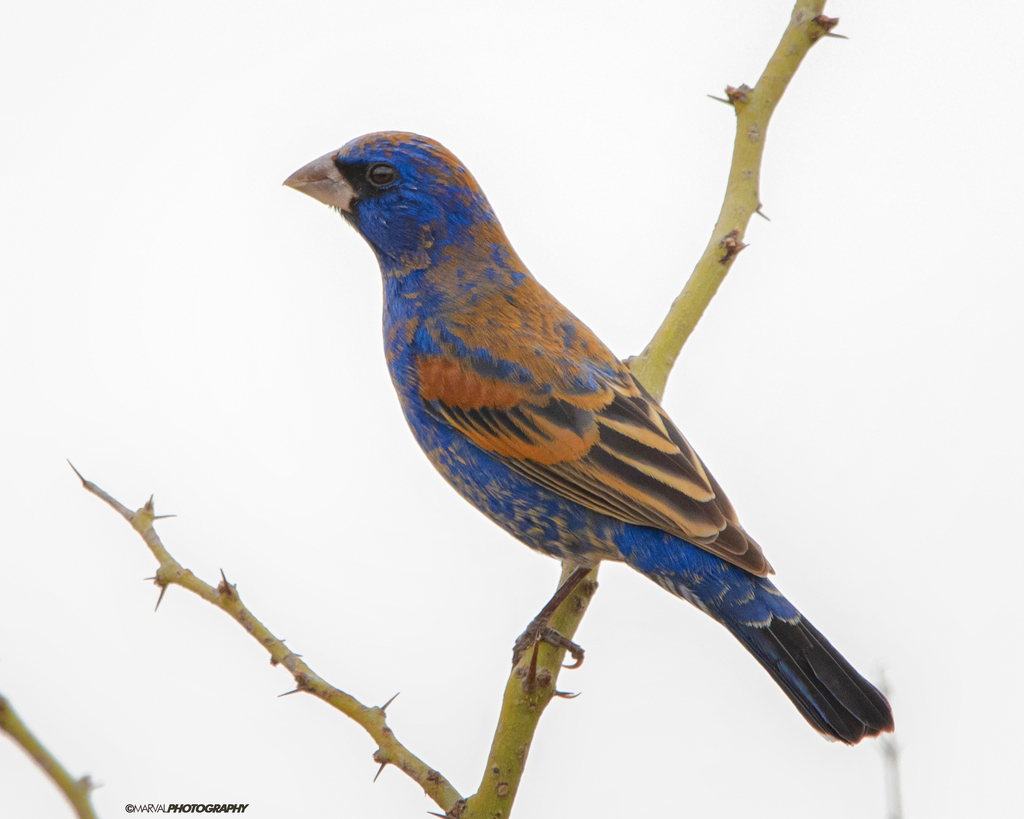
(c) MarvalPhotography19, some rights reserved (CC BY) · licence
Family: Cardinalidae · Class: Aves · Order: Passeriformes
Passerina caerulea (Blue Grosbeak) is a California animal in the Cardinalidae family.
The Blue Grosbeak is a medium-sized songbird measuring 15 to 19 cm (5.9 to 7.5 inches) in length with a wingspan of 26 to 29 cm (10.2 to 11.4 inches). Adult males display deep blue plumage with chestnut wing bars and shoulder patches, while females and juveniles are predominantly brown with buff-colored wing bars. Both sexes possess the characteristic large, conical bill typical of grosbeaks, which is silver-gray to black in color. Males may show some brown feathering during fall and winter molts. Blue Grosbeaks breed across much of the southern and central United States, with their range extending from California eastward to the Atlantic Coast and from southern Canada to northern Mexico. In California, the species occurs primarily in the Central Valley, foothills of the Sierra Nevada, and coastal ranges, with scattered populations in suitable habitat throughout much of the state below 1,500 meters (4,900 feet) elevation. The species is migratory, wintering primarily in Mexico and Central America from October through March. The species inhabits semi-open areas including riparian woodlands, brushy fields, woodland edges, and agricultural areas with scattered trees and shrubs. Blue Grosbeaks show preference for areas with dense low vegetation interspersed with open spaces, often near water sources. They commonly utilize hedgerows, overgrown fence lines, and early successional habitats. Nesting occurs in dense shrubs or small trees, typically 1 to 4 meters (3 to 13 feet) above ground. Blue Grosbeaks are primarily granivorous, feeding on seeds from grasses, forbs, and shrubs, though they supplement their diet with insects, particularly during breeding season when feeding young. Common food sources include seeds from sunflowers, dandelions, and various grass species, along with beetles, caterpillars, and other arthropods. Breeding occurs from April through August, with females constructing cup-shaped nests of grasses, rootlets, and plant fibers. Clutch size ranges from 2 to 5 eggs, with an average of 3 to 4 eggs per clutch. Incubation lasts 11 to 12 days, performed exclusively by females. Multiple broods per season are common in suitable habitat. The Blue Grosbeak is not federally or state listed and maintains stable populations across most of its range. According to the North American Breeding Bird Survey, populations have shown slight increases in recent decades, though regional variations exist. Primary threats include habitat loss due to agricultural intensification, urban development, and conversion of riparian areas. The species benefits from habitat management practices that maintain edge environments and diverse plant communities. Climate change may affect migration timing and breeding range boundaries, though current population trends suggest the species is adapting to changing conditions. Conservation efforts focus on maintaining diverse agricultural landscapes and protecting riparian corridors.
Classification
Class: Aves · Order: Passeriformes · Family: Cardinalidae
Frequently asked questions
How is Passerina caerulea classified?
Passerina caerulea belongs to class Aves, order Passeriformes, family Cardinalidae.
What family does Passerina caerulea belong to?
Passerina caerulea is in the Cardinalidae family.
What is Passerina caerulea?
The Blue Grosbeak is a medium-sized songbird measuring 15 to 19 cm (5.9 to 7.5 inches) in length with a wingspan of 26 to 29 cm (10.2 to 11.4 inches).
Is Passerina caerulea found in California?
Yes. Passerina caerulea is recorded in California in The California Species Project's catalogue.
Related species
Other California species in the same genus, family, or bioregion.
Data from The California Species Project — 14,000+ California species with verified data from CNPS, CDFW, USFWS, and more.