Passerina cyanea
Indigo Bunting
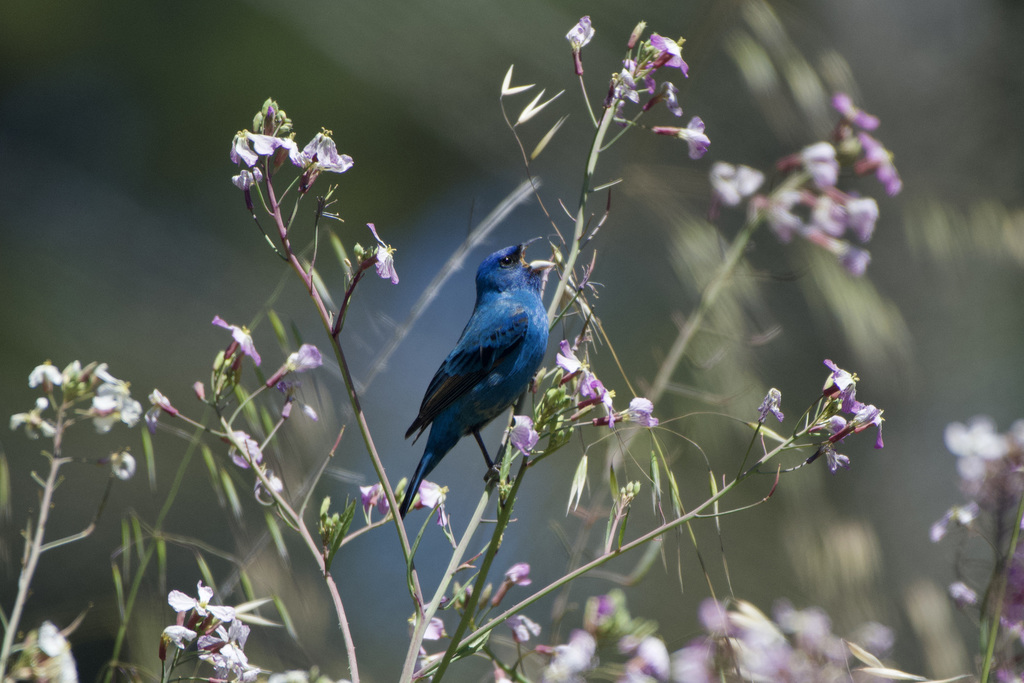
no rights reserved · CC0
Family: Cardinalidae · Class: Aves · Order: Passeriformes
Passerina cyanea (Indigo Bunting) is a California animal in the Cardinalidae family.
The Indigo Bunting is a small songbird measuring 11.5 to 13 cm (4.5 to 5.1 inches) in length with a wingspan of 18 to 23 cm (7.1 to 9.1 inches). Adult males during breeding season display brilliant blue plumage across the head, back, and underparts, appearing almost iridescent in sunlight. The blue coloration results from light refraction rather than pigmentation, causing males to appear darker or blackish in poor lighting conditions. Breeding males have blackish wings and tail with blue edging. Non-breeding males and females are brown with subtle streaking on the breast and flanks, though males may retain some blue on wings and tail. Females show faint wingbars and a pale throat. Both sexes have a straight, pointed bill adapted for seed consumption. Indigo Buntings breed across eastern North America from southern Canada to the Gulf Coast states and as far west as the Great Plains. In California, the species occurs primarily as a migrant and occasional breeder in the eastern and northeastern portions of the state, including areas of the Cascade Range, Sierra Nevada foothills, and eastern deserts during migration. Small breeding populations have been documented in riparian areas of the Central Valley and coastal regions. The species winters from southern Florida through Central America to northern South America. Breeding habitat consists of brushy areas, woodland edges, clearings, and early successional forest. The species shows preference for areas with scattered trees and dense understory vegetation, including old fields reverting to forest, power line corridors, and forest gaps created by logging or natural disturbance. Breeding pairs typically select sites with shrub cover between 1 to 3 meters in height. During migration, Indigo Buntings utilize a broader range of habitats including desert oases, parks, and agricultural areas. Indigo Buntings are primarily granivorous, feeding on seeds of grasses, forbs, and trees. During breeding season, adults supplement their diet with insects including caterpillars, aphids, and beetles, which provide essential protein for nestlings. Males establish territories through persistent singing from exposed perches, typically delivering 100 to 200 songs per hour during peak breeding activity. Females construct cup-shaped nests in dense shrubs or low trees, usually 0.3 to 3 meters above ground. Clutch size ranges from 2 to 4 eggs, with incubation lasting 11 to 14 days. Nestlings fledge after 8 to 10 days but remain dependent on parents for an additional 2 to 3 weeks. The species commonly produces two broods per season in suitable habitat. The Indigo Bunting maintains stable populations across most of its range and is not federally listed. According to the North American Breeding Bird Survey, populations declined by approximately 0.7% annually between 1966 and 2019, though regional trends vary considerably. Primary threats include habitat loss from agricultural intensification, forest fragmentation, and urban development. Climate change may affect migration timing and breeding range distribution. The species benefits from forest management practices that create edge habitat and early successional areas.
Classification
Class: Aves · Order: Passeriformes · Family: Cardinalidae
Frequently asked questions
How is Passerina cyanea classified?
Passerina cyanea belongs to class Aves, order Passeriformes, family Cardinalidae.
What family does Passerina cyanea belong to?
Passerina cyanea is in the Cardinalidae family.
What is Passerina cyanea?
The Indigo Bunting is a small songbird measuring 11.5 to 13 cm (4.5 to 5.1 inches) in length with a wingspan of 18 to 23 cm (7.1 to 9.1 inches).
Is Passerina cyanea found in California?
Yes. Passerina cyanea is recorded in California in The California Species Project's catalogue.
Related species
Other California species in the same genus, family, or bioregion.
Data from The California Species Project — 14,000+ California species with verified data from CNPS, CDFW, USFWS, and more.