Passerina versicolor
Varied Bunting
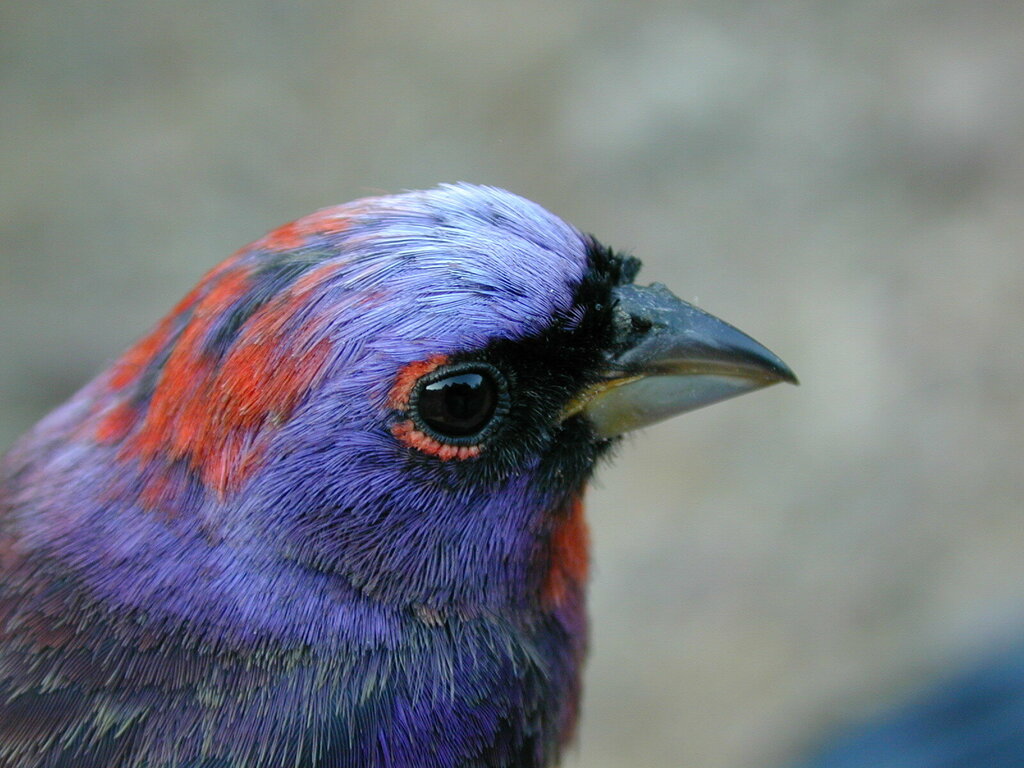
(c) Cole Wolf, some rights reserved (CC BY) · licence
Family: Cardinalidae · Class: Aves · Order: Passeriformes
Passerina versicolor (Varied Bunting) is a California animal in the Cardinalidae family.
The Varied Bunting is a small songbird in the cardinal family (Cardinalidae) measuring 11.5 to 14 cm (4.5 to 5.5 inches) in length with a wingspan of approximately 21 cm (8.3 inches). Adult males in breeding plumage display a distinctive dark purplish-blue head and nape, bright red hindneck patch, and purplish-blue rump. The back and wings are brownish-red, while the underparts are purplish-blue. The conical bill is gray-black. Outside breeding season, males resemble females with brownish-gray plumage above and pale buff below. Females are uniformly brownish-gray with slightly paler underparts and lack the male's colorful breeding plumage. Juveniles resemble adult females but show more streaking on the underparts. The Varied Bunting's range extends from southern Arizona, New Mexico, and extreme southern Texas south through Mexico to Guatemala. In California, the species is considered casual to rare, with sporadic records primarily from desert regions near the Arizona border, including the Colorado River valley and southeastern Imperial County. Most California observations occur during spring and fall migration periods, with occasional summer records suggesting possible breeding attempts. This species inhabits arid and semi-arid environments, favoring desert scrublands, mesquite bosques, and riparian areas with dense shrub cover. In suitable habitat, Varied Buntings occur from sea level to approximately 1,800 meters (5,900 feet) elevation. They show preference for areas with scattered thorny shrubs, particularly mesquite, palo verde, and desert broom, along washes and canyon bottoms where vegetation is denser than surrounding desert. Varied Buntings are primarily granivorous, feeding on seeds from grasses, forbs, and shrubs. During breeding season, they supplement their diet with insects including beetles, caterpillars, and moths, which provide essential protein for growing nestlings. Males establish territories in late March through April, singing from prominent perches within dense shrub cover. The breeding season extends from April through August, with females constructing cup-shaped nests 0.3 to 2.4 meters (1 to 8 feet) above ground in thorny shrubs. Clutch size ranges from three to four pale blue or greenish-white eggs, which are incubated for 12 to 13 days. Fledglings leave the nest after 10 to 11 days but remain dependent on adults for several additional weeks. The Varied Bunting is not federally listed and maintains stable populations throughout most of its core range in Mexico and the southwestern United States. However, habitat loss due to urban development, agricultural conversion, and water diversions poses localized threats. In California, the species' extreme rarity makes it of special interest to birders and researchers. Climate change may affect the species' distribution by altering precipitation patterns and vegetation communities in desert ecosystems. The North American Breeding Bird Survey indicates relatively stable long-term population trends, though data are limited due to the species' restricted range and habitat preferences.
Classification
Class: Aves · Order: Passeriformes · Family: Cardinalidae
Frequently asked questions
How is Passerina versicolor classified?
Passerina versicolor belongs to class Aves, order Passeriformes, family Cardinalidae.
What family does Passerina versicolor belong to?
Passerina versicolor is in the Cardinalidae family.
What is Passerina versicolor?
The Varied Bunting is a small songbird in the cardinal family (Cardinalidae) measuring 11.5 to 14 cm (4.5 to 5.5 inches) in length with a wingspan of approximately 21 cm (8.3 inches).
Is Passerina versicolor found in California?
Yes. Passerina versicolor is recorded in California in The California Species Project's catalogue.
Related species
Other California species in the same genus, family, or bioregion.
Data from The California Species Project — 14,000+ California species with verified data from CNPS, CDFW, USFWS, and more.