Patagioenas fasciata
Band-tailed Pigeon
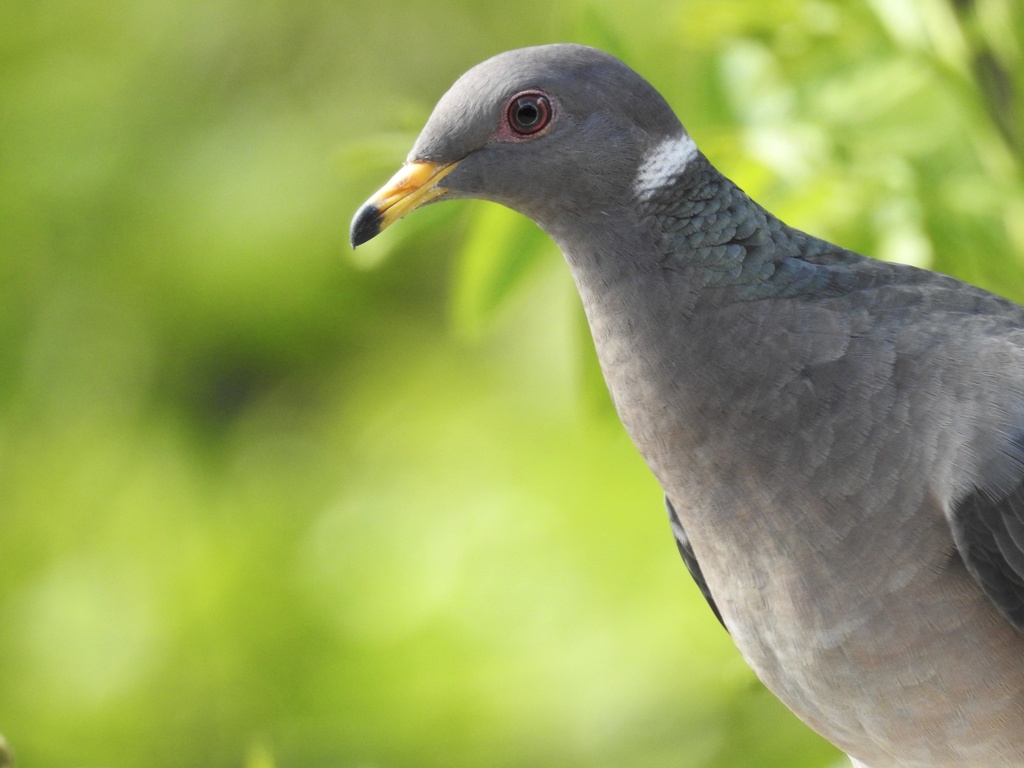
(c) Kristiina Hurme, some rights reserved (CC BY) · licence
Family: Columbidae · Class: Aves · Order: Columbiformes
Patagioenas fasciata (Band-tailed Pigeon) is a California animal in the Columbidae family.
The Band-tailed Pigeon is a large native pigeon species found throughout western North America, including California. Adults measure 33 to 40 cm (13 to 16 inches) in length with a wingspan of 66 cm (26 inches) and weigh between 225 to 515 grams. The species exhibits a distinctive blue-gray plumage with a darker head and neck. A prominent white crescent marks the nape of the neck, and a narrow dark band extends across the pale gray tail, giving the species its common name. The bill is yellow with a dark tip, and the feet are yellow. Males and females appear similar, though males may be slightly larger. Historically, Band-tailed Pigeons ranged throughout the Pacific Coast states and into the Rocky Mountains. In California, they occur from sea level to elevations exceeding 3,000 meters (9,800 feet) in both coastal and interior mountain ranges. The species inhabits the Sierra Nevada, Cascade Range, Coast Ranges, and mountains of southern California. Populations also extend into Baja California, Mexico. Northern populations are migratory, while southern California birds may be year-round residents. Band-tailed Pigeons prefer mature coniferous and mixed forests, particularly those dominated by Douglas-fir, ponderosa pine, and oak woodlands. They utilize oak-pine associations, riparian forests, and areas with abundant mast-producing trees. The species requires large trees for nesting and roosting, typically selecting sites 4 to 12 meters (13 to 40 feet) above ground. They frequent mineral springs and salt licks, which provide essential nutrients absent from their plant-based diet. The diet consists primarily of nuts, seeds, berries, and buds from various tree species including oak acorns, pine nuts, elderberries, and madrone berries. During breeding season, which extends from April through September, pairs construct flimsy platform nests of twigs in tree branches. Females typically lay a single white egg, rarely two. Both parents incubate eggs for 18 to 20 days and share feeding duties. Young fledge after 25 to 35 days but may remain dependent on parents for several additional weeks. The species can produce multiple broods annually under favorable conditions. Band-tailed Pigeons are highly social outside the breeding season, forming flocks that may number in the hundreds during migration and winter. They exhibit strong site fidelity to mineral springs and traditional roosting areas. The species produces a distinctive low, owl-like hooting call that carries considerable distances through forest canopies. As of December 2025, Band-tailed Pigeons are not federally or state-listed as threatened or endangered. However, populations have experienced regional declines due to habitat loss from logging, urban development, and fire suppression that alters forest structure. The species faces additional pressure from hunting, with Pacific Flyway populations managed under specific harvest frameworks. Climate change may affect future distribution patterns by altering suitable forest habitat at various elevations.
Classification
Class: Aves · Order: Columbiformes · Family: Columbidae
Frequently asked questions
How is Patagioenas fasciata classified?
Patagioenas fasciata belongs to class Aves, order Columbiformes, family Columbidae.
What family does Patagioenas fasciata belong to?
Patagioenas fasciata is in the Columbidae family.
What is Patagioenas fasciata?
The Band-tailed Pigeon is a large native pigeon species found throughout western North America, including California.
Is Patagioenas fasciata found in California?
Yes. Patagioenas fasciata is recorded in California in The California Species Project's catalogue.
Related species
Other California species in the same genus, family, or bioregion.
Data from The California Species Project — 14,000+ California species with verified data from CNPS, CDFW, USFWS, and more.