Pekania frenata ssp. xanthogenys
Fisher - West Coast DPS
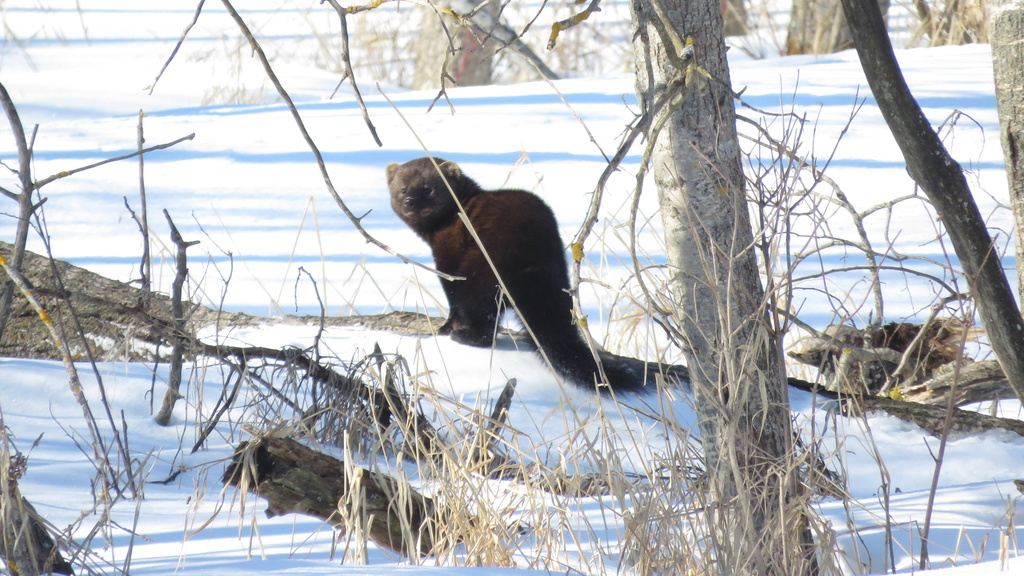
(c) Dan MacNeal, some rights reserved (CC BY) · licence
Family: Mustelidae · Class: Mammalia · Order: Carnivora
Conservation status: ST · G5T2T3Q S2S3
Pekania frenata ssp. xanthogenys (Fisher - West Coast DPS) is a California animal in the Mustelidae family.
The Fisher - West Coast DPS (Pekania pennanti) is a medium-sized carnivorous mammal in the weasel family (Mustelidae). Adults typically measure 90-120 cm (35-47 inches) in total length, including a bushy tail of 30-42 cm (12-17 inches), and weigh 1.5-5.5 kg (3.3-12.1 pounds), with males considerably larger than females. The species displays dark brown to blackish fur with lighter coloration on the head and shoulders, and dense, water-repellent pelage adapted for wet forest conditions. The West Coast DPS historically occurred in coniferous forests from British Columbia south through Washington, Oregon, and California. Current populations are fragmented into two distinct segments: the Northern California/Southern Oregon DPS and the Southern Sierra Nevada DPS. In California, fishers now occupy portions of the Sierra Nevada, Cascade Range, and coastal ranges, with populations in Humboldt, Del Norte, Siskiyou, and other northern counties, as well as isolated populations in the southern Sierra Nevada from Yosemite National Park south to the Greenhorn Mountains. Fishers require mature and old-growth coniferous forests with high canopy cover, abundant snags, and large woody debris. According to the U.S. Fish and Wildlife Service, they are most often found in forested areas with large tree canopy cover containing a mix of conifer and California black oak trees (USFWS 2020). The species uses tree cavities in large trees for denning and resting sites, particularly in forests with canopy cover exceeding 60%. Elevation ranges vary by region, but generally occur from sea level to 2,400 meters (7,900 feet) in mountainous areas. Fishers are primarily solitary, except during mating season. They are opportunistic predators with a diet consisting of small mammals including squirrels, rabbits, and porcupines, as well as birds, insects, and occasionally carrion and plant matter. The breeding period begins in late February and extends through April, with delayed implantation resulting in births the following spring after an 11-month gestation period. Females typically produce 1-4 kits in tree cavities or other protected sites. While fishers tend to use single dens, some females may utilize five or more den sites throughout a season. Home ranges vary considerably, with males occupying 10-24 hectares under normal conditions but expanding to 80-160 hectares when prey becomes scarce. The West Coast DPS faces significant conservation challenges, with California listing the species as threatened (ST ranking). The Southern Sierra Nevada DPS was federally listed as endangered in 2020 (USFWS 2020). Primary threats include habitat fragmentation due to timber harvest practices, urban development, and large-scale wildfires. The species has experienced substantial range reductions, with populations extirpated from much of Washington and significant declines throughout California and Oregon. Additional threats include mortality from rodenticides, vehicle strikes, and illegal trapping. Current population estimates suggest fewer than 300 individuals remain in the Southern Sierra Nevada, while Northern California/Southern Oregon populations are somewhat more stable but still vulnerable to habitat loss and fragmentation.
Classification
Class: Mammalia · Order: Carnivora · Family: Mustelidae
Conservation status
ST · G5T2T3Q S2S3
Frequently asked questions
How is Pekania frenata ssp. xanthogenys classified?
Pekania frenata ssp. xanthogenys belongs to class Mammalia, order Carnivora, family Mustelidae.
What family does Pekania frenata ssp. xanthogenys belong to?
Pekania frenata ssp. xanthogenys is in the Mustelidae family.
Is Pekania frenata ssp. xanthogenys protected or of conservation concern?
Pekania frenata ssp. xanthogenys carries the following status: ST · G5T2T3Q S2S3.
What is Pekania frenata ssp. xanthogenys?
The Fisher - West Coast DPS (Pekania pennanti) is a medium-sized carnivorous mammal in the weasel family (Mustelidae).
Is Pekania frenata ssp. xanthogenys found in California?
Yes. Pekania frenata ssp. xanthogenys is recorded in California in The California Species Project's catalogue.
Related species
Other California species in the same genus, family, or bioregion.
Data from The California Species Project — 14,000+ California species with verified data from CNPS, CDFW, USFWS, and more.