Pekania pennanti
Fisher
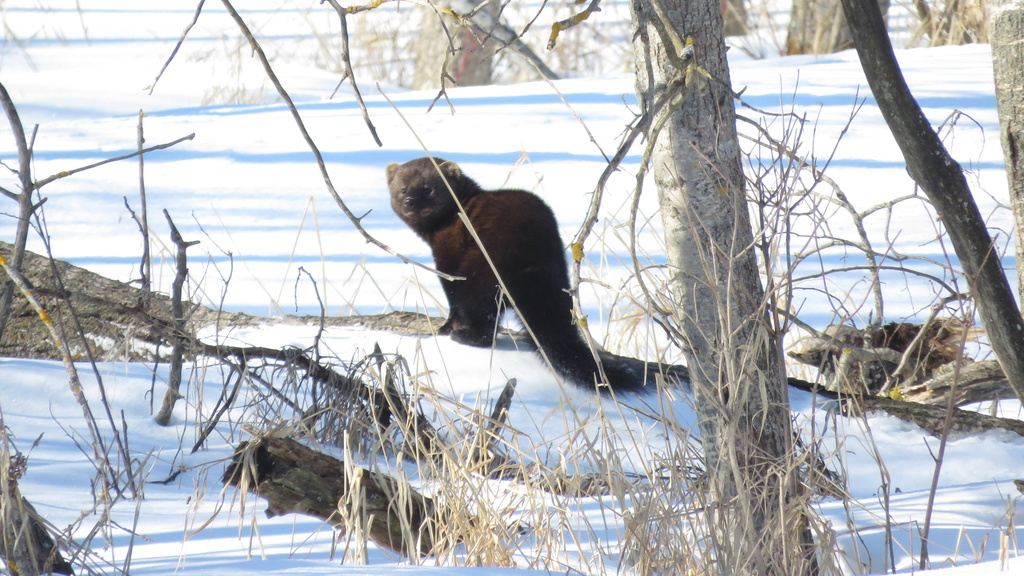
(c) Dan MacNeal, some rights reserved (CC BY) · licence
Family: Mustelidae · Class: Mammalia · Order: Carnivora
Conservation status: G5 S2S3
Pekania pennanti (Fisher) is a California animal in the Mustelidae family.
The fisher is a medium-sized carnivorous mammal in the weasel family (Mustelidae), subfamily Guloninae. Adults typically measure 75-120 cm (30-47 inches) in total length, including a bushy tail that comprises about one-third of their body length. Males are significantly larger than females, weighing 3.5-5.5 kg (8-12 pounds) compared to females at 2-2.5 kg (4-5.5 pounds). Fishers have dark brown to nearly black fur with occasional white patches on the chest, a broad head with a pointed snout, small rounded ears, and semi-retractable claws adapted for climbing. Fishers historically ranged from the southern Sierra Nevada to British Columbia, but their current distribution is fragmented. In California, they occur in two distinct populations: the Northern California/Southern Oregon Distinct Population Segment and the Southern Sierra Nevada Distinct Population Segment. The southern population has been documented in Mariposa, Madera, Fresno, Tulare, and Kern counties. The northern population extends from near Point Reyes National Park northward along the coast and inland to the Cascade Range. A translocation program initiated by the California Department of Fish and Wildlife has established a population in the northern Sierra Nevada and Southern Cascades. Fishers inhabit dense, mature coniferous and mixed-conifer forests with substantial canopy cover. They prefer old-growth forests dominated by large trees with cavities suitable for denning and resting sites. In the southern Sierra Nevada, they occupy mixed-conifer and ponderosa pine forests at elevations that do not accumulate persistent deep snow. Suitable habitat requires moderate to high canopy cover, adequate prey availability, and protection from severe weather. They are primarily found on federal lands managed by the U.S. Forest Service and National Park Service. Fishers are opportunistic hunters that primarily consume small mammals including squirrels, mice, and birds. Recent research has documented their consumption of fungi, expanding understanding of their dietary habits. They are semi-arboreal, spending considerable time in trees for foraging, denning, and resting. Females establish home ranges and give birth to 1-4 kits in tree cavities or other protected sites. Adults occupy distinct but sometimes overlapping home ranges, with males typically having larger territories than females. The Southern Sierra Nevada Distinct Population Segment was listed as endangered under the Endangered Species Act in 2020, with large-scale, high-severity wildfire identified as the primary threat. Historical population declines resulted from over-trapping and habitat loss, with California prohibiting fisher trapping in 1946. Despite this protection, populations continued declining due to habitat fragmentation, predator control efforts, and climate change effects. The current population in the southern Sierra Nevada is estimated to be small and vulnerable to catastrophic events. Conservation efforts include habitat management partnerships between the U.S. Forest Service and timber companies to reduce wildfire risk while preserving fisher habitat, and ongoing translocation programs to establish new populations in suitable habitat within their historical range.
Classification
Class: Mammalia · Order: Carnivora · Family: Mustelidae
Conservation status
G5 S2S3
Frequently asked questions
How is Pekania pennanti classified?
Pekania pennanti belongs to class Mammalia, order Carnivora, family Mustelidae.
What family does Pekania pennanti belong to?
Pekania pennanti is in the Mustelidae family.
Is Pekania pennanti protected or of conservation concern?
Pekania pennanti carries the following status: G5 S2S3.
What is Pekania pennanti?
The fisher is a medium-sized carnivorous mammal in the weasel family (Mustelidae), subfamily Guloninae.
Is Pekania pennanti found in California?
Yes. Pekania pennanti is recorded in California in The California Species Project's catalogue.
Related species
Other California species in the same genus, family, or bioregion.
Data from The California Species Project — 14,000+ California species with verified data from CNPS, CDFW, USFWS, and more.