Pekania pennanti pop. 2
Fisher - southern Sierra Nevada ESU
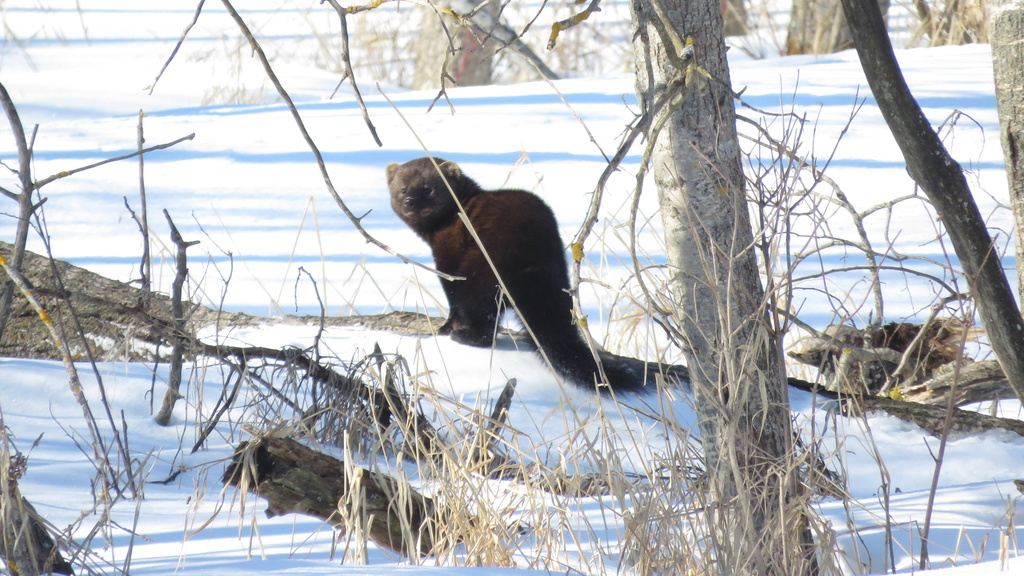
(c) Dan MacNeal, some rights reserved (CC BY) · licence
Family: Mustelidae · Class: Mammalia · Order: Carnivora
Conservation status: ST · Endangered · G5T1 S1
Pekania pennanti pop. 2 (Fisher - southern Sierra Nevada ESU) is a California animal in the Mustelidae family.
The fisher is a medium-sized carnivorous mammal in the weasel family (Mustelidae), with the southern Sierra Nevada evolutionarily significant unit representing a genetically distinct population segment. Adult fishers measure 47 to 75 centimeters (18.5 to 29.5 inches) in body length, with males typically larger than females. They possess dense, dark brown to black fur with occasional white patches on the chest, a broad head with a pointed snout, small rounded ears, and a long bushy tail. Their robust build and semi-retractable claws make them excellent climbers despite their terrestrial appearance. The southern Sierra Nevada ESU occurs exclusively in California's Sierra Nevada mountain range, specifically south of the Merced River as defined by the California Fish and Game Commission. According to the U.S. Fish and Wildlife Service, the species has been documented in Mariposa, Madera, Fresno, Tulare, and Kern counties. This population is genetically isolated from northern California populations, with evidence suggesting this separation predates European settlement. Fishers inhabit dense, mature mixed-conifer and ponderosa pine forests with substantial canopy cover. They prefer areas that contain a mix of conifer and California black oak trees, typically avoiding elevations with deep or persistent snow. Critical habitat features include large trees for denning and resting sites, moderate to high canopy cover, and adequate prey availability. Most occupied habitat occurs on federal lands managed by the U.S. Forest Service and National Park Service. As opportunistic carnivores, fishers primarily hunt squirrels, mice, and birds, with recent research indicating they also consume fungi (U.S. Fish and Wildlife Service). They are largely solitary animals that occupy distinct but sometimes overlapping home ranges. Fishers are skilled climbers and typically den in large tree cavities or hollow logs. Their reproductive cycle includes a prolonged gestation period due to delayed implantation, with females typically producing one to four kits annually. The southern Sierra Nevada fisher population was listed as federally endangered on June 15, 2020, and as state threatened by California on March 18, 2019. The current population is estimated at 100 to 500 individuals in the wild (U.S. Fish and Wildlife Service). Primary threats include large-scale, high-severity wildfires, which represent the greatest risk to the population. A catastrophic wildfire in 2017 resulted in significant habitat loss. Additional threats include habitat fragmentation, vehicle strikes, and the species' small population size, which increases vulnerability to stochastic events. The U.S. Forest Service has implemented forest plan amendments establishing a 1.5 million-acre Southern Sierra Fisher Conservation Area with specific management requirements to maintain and expand the population. The Southern Sierra Nevada Fisher Conservation Strategy provides collaborative, science-based guidance for recovery efforts involving federal, state, tribal, and private stakeholders.
Classification
Class: Mammalia · Order: Carnivora · Family: Mustelidae
Conservation status
ST · Endangered · G5T1 S1
Frequently asked questions
How is Pekania pennanti pop. 2 classified?
Pekania pennanti pop. 2 belongs to class Mammalia, order Carnivora, family Mustelidae.
What family does Pekania pennanti pop. 2 belong to?
Pekania pennanti pop. 2 is in the Mustelidae family.
Is Pekania pennanti pop. 2 protected or of conservation concern?
Pekania pennanti pop. 2 carries the following status: ST · Endangered · G5T1 S1.
What is Pekania pennanti pop. 2?
The fisher is a medium-sized carnivorous mammal in the weasel family (Mustelidae), with the southern Sierra Nevada evolutionarily significant unit representing a genetically distinct population segment.
Is Pekania pennanti pop. 2 found in California?
Yes. Pekania pennanti pop. 2 is recorded in California in The California Species Project's catalogue.
Related species
Other California species in the same genus, family, or bioregion.
Data from The California Species Project — 14,000+ California species with verified data from CNPS, CDFW, USFWS, and more.