Pelecanus erythrorhynchos
American White Pelican
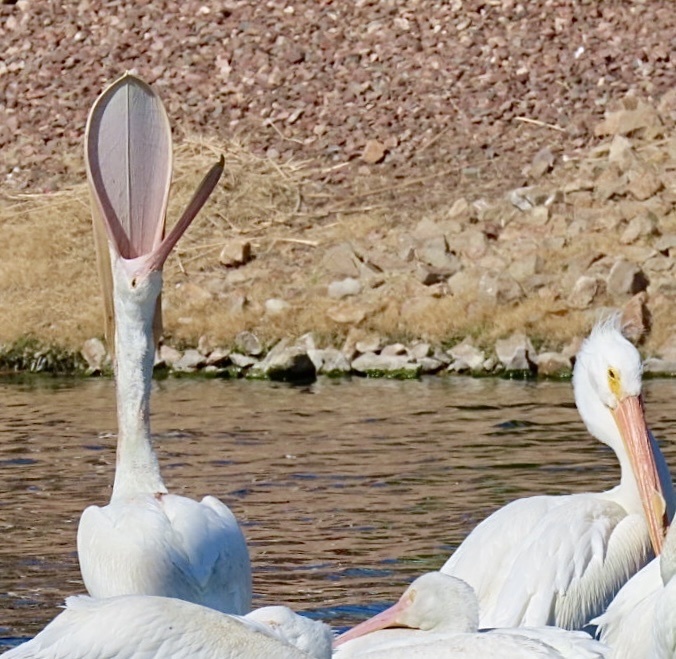
no rights reserved · CC0
Family: Pelecanidae · Class: Aves · Order: Pelecaniformes
Conservation status: G4 S1S2
Pelecanus erythrorhynchos (American White Pelican) is a California animal in the Pelecanidae family.
The American White Pelican is one of North America's largest waterbirds, measuring 127 to 165 cm (50 to 65 inches) in length with a wingspan reaching 2.4 to 2.9 meters (8 to 9.5 feet). Adults weigh 4 to 9 kg (9 to 20 pounds). The species displays predominantly white plumage with black flight feathers visible during flight. The massive bill measures 28 to 40 cm (11 to 16 inches) in length and features a distinctive orange-yellow coloration. During breeding season, adults develop a prominent fibrous plate on the upper mandible and bright orange facial skin and pouch. Historically, American White Pelicans nested at several locations in California, including Clear Lake, Tulare Lake, and sites in the Central Valley. Currently in California, the species is primarily a migrant and winter visitor, with the global rank of G4 indicating the species is apparently secure globally, while the state rank of S1S2 reflects its critically imperiled to imperiled status within California. Small breeding populations persist at Clear Lake in Lake County and occasionally at the Salton Sea in Imperial County. The species also occurs as a migrant throughout the Central Valley and coastal areas during spring and fall. American White Pelicans inhabit large lakes, reservoirs, marshes, and shallow coastal waters. They require extensive open water areas for feeding and secluded islands or shoreline areas for nesting. Breeding colonies are typically established on isolated islands in freshwater lakes at elevations ranging from below sea level to 1,800 meters (5,900 feet). Outside the breeding season, the species utilizes estuaries, coastal lagoons, and large rivers. Unlike Brown Pelicans, American White Pelicans feed by swimming on the surface and dipping their heads underwater to capture fish. They often feed cooperatively in groups, driving fish into shallow water. The diet consists primarily of fish including carp, suckers, shiners, and perch, typically measuring 10 to 30 cm (4 to 12 inches) in length. Breeding occurs from April through August, with pairs constructing shallow scrape nests on bare ground. Females lay one to three chalky white eggs, with an incubation period of 29 to 36 days. Young fledge at approximately 10 to 11 weeks. While not federally listed, American White Pelicans face several conservation challenges in California. Historical breeding sites have been lost due to habitat destruction and water diversions. Tulare Lake, once a major breeding area, was drained in the late 1800s. Current threats include water level fluctuations at remaining breeding sites, human disturbance, and pesticide contamination. The species' dependence on large aquatic systems makes it vulnerable to drought and water management practices. Climate change may further impact breeding success through altered precipitation patterns and increased frequency of extreme weather events affecting nesting colonies.
Classification
Class: Aves · Order: Pelecaniformes · Family: Pelecanidae
Conservation status
G4 S1S2
Frequently asked questions
How is Pelecanus erythrorhynchos classified?
Pelecanus erythrorhynchos belongs to class Aves, order Pelecaniformes, family Pelecanidae.
What family does Pelecanus erythrorhynchos belong to?
Pelecanus erythrorhynchos is in the Pelecanidae family.
Is Pelecanus erythrorhynchos protected or of conservation concern?
Pelecanus erythrorhynchos carries the following status: G4 S1S2.
What is Pelecanus erythrorhynchos?
The American White Pelican is one of North America's largest waterbirds, measuring 127 to 165 cm (50 to 65 inches) in length with a wingspan reaching 2.4 to 2.9 meters (8 to 9.5 feet).
Is Pelecanus erythrorhynchos found in California?
Yes. Pelecanus erythrorhynchos is recorded in California in The California Species Project's catalogue.
Related species
Other California species in the same genus, family, or bioregion.
Data from The California Species Project — 14,000+ California species with verified data from CNPS, CDFW, USFWS, and more.