Pelegrina aeneola
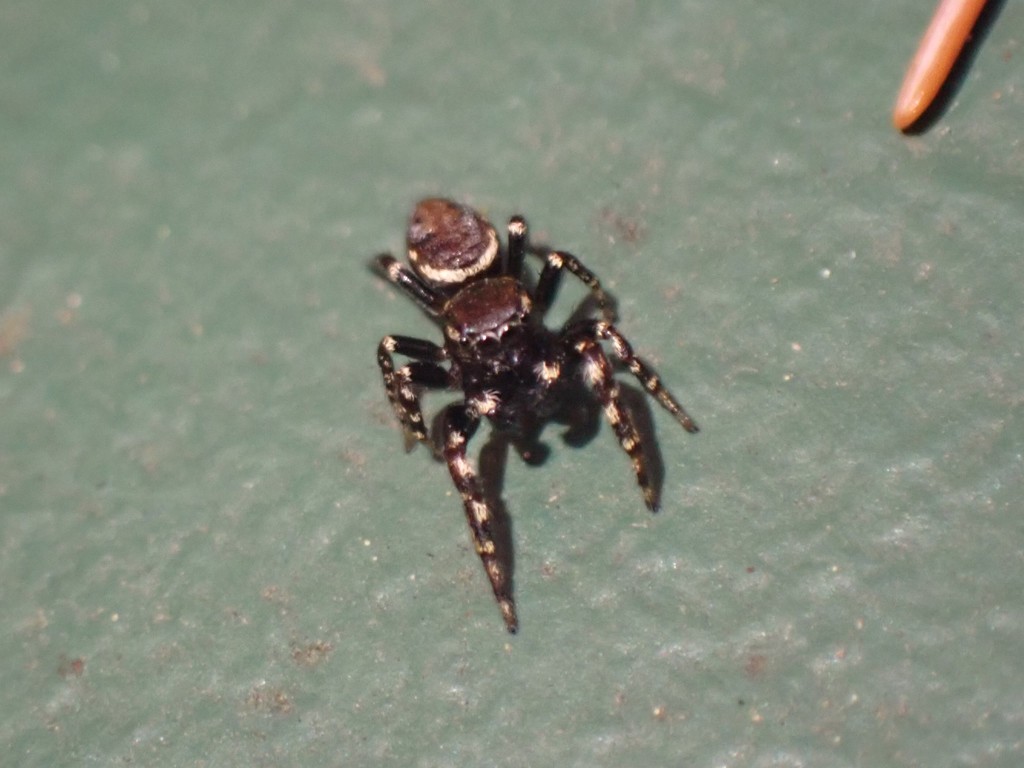
(c) giantcicada, some rights reserved (CC BY) · licence
Family: Salticidae · Class: Arachnida · Order: Araneae
Pelegrina aeneola is a California animal in the Salticidae family.
Pelegrina aeneola is a small jumping spider in the family Salticidae. Females measure approximately 5.5 mm in body length, while males are slightly smaller at 5 mm (BugGuide 2025). This species exhibits the typical compact, robust build characteristic of jumping spiders, with relatively short legs and prominent forward-facing eyes that provide excellent vision for hunting. Pelegrina aeneola occurs across western North America, with a range extending from the Dakotas westward to British Columbia and south to California and New Mexico (BugGuide 2025). Within California, the species has been documented in various counties including Mariposa County, where specimens have been collected in Yosemite Valley at elevations around 1,500 meters (BugGuide 2025). The species appears to have a broad elevational tolerance, occurring from valley floors to montane environments. This jumping spider inhabits diverse vegetation types rather than ground-level microhabitats. Pelegrina aeneola is particularly abundant on big sagebrush (Artemisia tridentata) and has been described as the most common spider species found on this shrub in western regions (BugGuide 2025). The species demonstrates adaptability to various plant communities, occurring on both native and cultivated vegetation. Its arboreal preferences distinguish it from many ground-dwelling jumping spider species. As a member of the Salticidae family, P. aeneola is an active visual predator that stalks prey rather than building webs. These spiders rely on their exceptional eyesight to locate and approach small arthropod prey, including flies, aphids, and other soft-bodied insects. Jumping spiders are known for their ability to leap several times their body length to capture prey or escape predators. The species likely follows typical salticid reproductive behavior, with males performing courtship displays involving leg waving and body movements to attract females. Mating occurs through direct sperm transfer, and females produce egg sacs that they guard until spiderlings emerge. Pelegrina aeneola has no federal or state conservation listing and appears to be a relatively common and widespread species throughout its range. The species' broad habitat tolerance and association with common western vegetation types like sagebrush suggest stable populations. However, like many arthropods, comprehensive population monitoring data are lacking. Habitat modification and loss of native plant communities could potentially impact local populations, particularly in areas where sagebrush ecosystems face conversion to agriculture or development. Climate change may affect the species' distribution, particularly at elevational or latitudinal range margins, though specific impacts have not been documented. The species' adaptability to various vegetation types may provide some resilience to environmental changes compared to more specialized arthropods.
Classification
Class: Arachnida · Order: Araneae · Family: Salticidae
Frequently asked questions
How is Pelegrina aeneola classified?
Pelegrina aeneola belongs to class Arachnida, order Araneae, family Salticidae.
What family does Pelegrina aeneola belong to?
Pelegrina aeneola is in the Salticidae family.
What is Pelegrina aeneola?
Pelegrina aeneola is a small jumping spider in the family Salticidae.
Is Pelegrina aeneola found in California?
Yes. Pelegrina aeneola is recorded in California in The California Species Project's catalogue.
Related species
Other California species in the same genus, family, or bioregion.
Data from The California Species Project — 14,000+ California species with verified data from CNPS, CDFW, USFWS, and more.