Pelocoris biimpressus
Amargosa Naucorid Bug
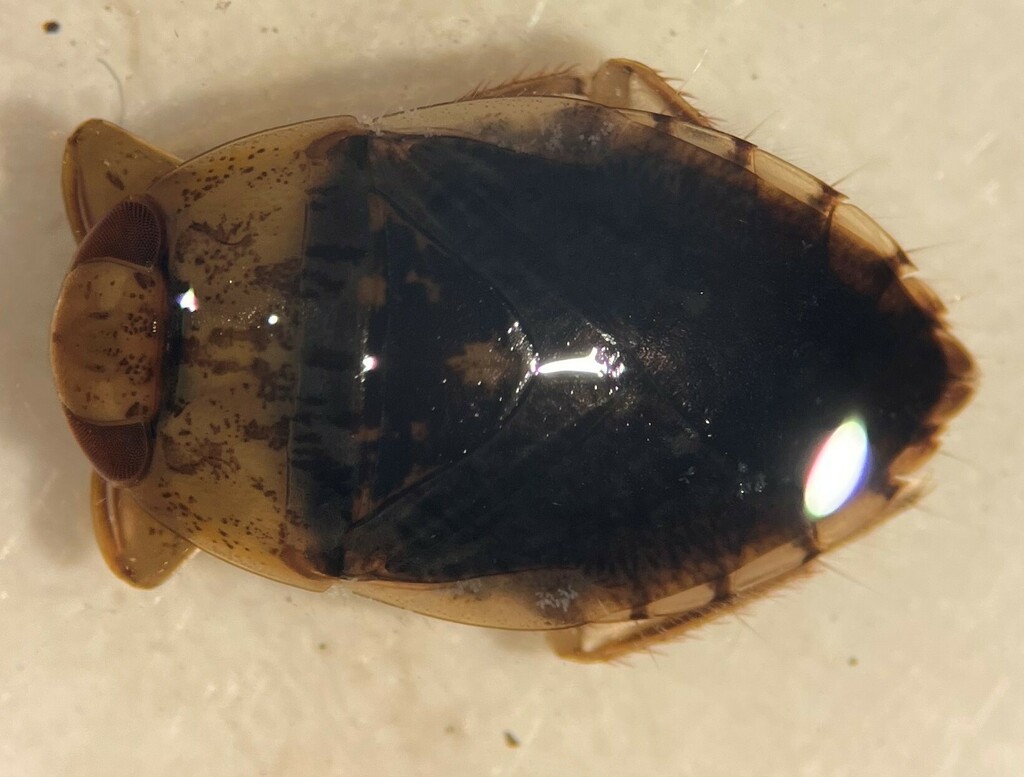
(c) Matthew Pintar, some rights reserved (CC BY) · licence
Family: Naucoridae · Class: Insecta · Order: Hemiptera
Conservation status: G1G3 S1S2
Pelocoris biimpressus (Amargosa Naucorid Bug) is a California animal in the Naucoridae family.
The Amargosa naucorid bug is a small aquatic insect in the family Naucoridae, measuring approximately 8-9 mm (0.31-0.35 inches) in length and 5 mm (0.2 inches) in width. This oval-shaped, flattened bug exhibits variable coloration ranging from blackish brown to yellow brown, and occasionally green or gray. The species possesses distinctive front legs modified into pincers, while the middle and hind legs are adapted for swimming. Although many naucorid species develop fully functional flight wings, actual flight behavior is rarely observed in this species (USFWS Recovery Plan 1996). Pelocoris biimpressus occurs in extremely restricted aquatic habitats within the southwestern United States. The species includes the subspecies P. b. shoshone, which is found in the Amargosa River system. The distribution encompasses scattered spring systems in southwestern Nevada and Death Valley, California, where it occupies an exceptionally limited range. Current population status remains unknown due to the species' secretive nature and restricted habitat requirements (USFWS Recovery Plan 1998). The species inhabits flowing spring waters that pass over rock and pebble substrates, typically in areas with aquatic vegetation. In suitable habitats, Amargosa naucorids are found among aquatic plants in pools and lower velocity stream reaches, often utilizing areas under overhanging banks associated with marshy environments. These microhabitats provide the specific flow conditions and substrate composition required for the species' survival (USFWS Recovery Plan 1996). As a predatory aquatic insect, the Amargosa naucorid feeds on various aquatic organisms including dragonfly larvae, midge larvae, mosquito larvae, water boatmen, and small mollusks. The species employs a specialized hunting strategy, swimming over and through substrate while carrying a small air bubble underwater to maximize diving time during foraging activities. Reproduction occurs during early spring and summer months, with females depositing demersal eggs that adhere directly to substrate surfaces during incubation. This reproductive strategy ties the species closely to stable substrate conditions (USFWS Recovery Plan 1998). The Amargosa naucorid bug faces significant conservation challenges due to its extremely restricted habitat range and specialized ecological requirements. Primary threats include habitat modification and loss of suitable spring environments. The species' vulnerability is heightened by its dependence on specific flow conditions and water quality parameters. Climate change poses additional risks through increased evaporation rates and increasingly arid conditions that may reduce groundwater recharge. The introduction of non-native species, particularly crayfish (Procambarus sp.), could pose immediate threats through competition and predation. Non-native plant species may also alter microhabitat features and reduce water availability. The small size and fragmented nature of suitable habitats make this species highly susceptible to local extirpation events (USFWS 2012).
Classification
Class: Insecta · Order: Hemiptera · Family: Naucoridae
Conservation status
G1G3 S1S2
Frequently asked questions
How is Pelocoris biimpressus classified?
Pelocoris biimpressus belongs to class Insecta, order Hemiptera, family Naucoridae.
What family does Pelocoris biimpressus belong to?
Pelocoris biimpressus is in the Naucoridae family.
Is Pelocoris biimpressus protected or of conservation concern?
Pelocoris biimpressus carries the following status: G1G3 S1S2.
What is Pelocoris biimpressus?
The Amargosa naucorid bug is a small aquatic insect in the family Naucoridae, measuring approximately 8-9 mm (0.31-0.35 inches) in length and 5 mm (0.2 inches) in width.
Is Pelocoris biimpressus found in California?
Yes. Pelocoris biimpressus is recorded in California in The California Species Project's catalogue.
Related species
Other California species in the same genus, family, or bioregion.
Data from The California Species Project — 14,000+ California species with verified data from CNPS, CDFW, USFWS, and more.