Pennisetia marginata
Raspberry Crown Borer Moth
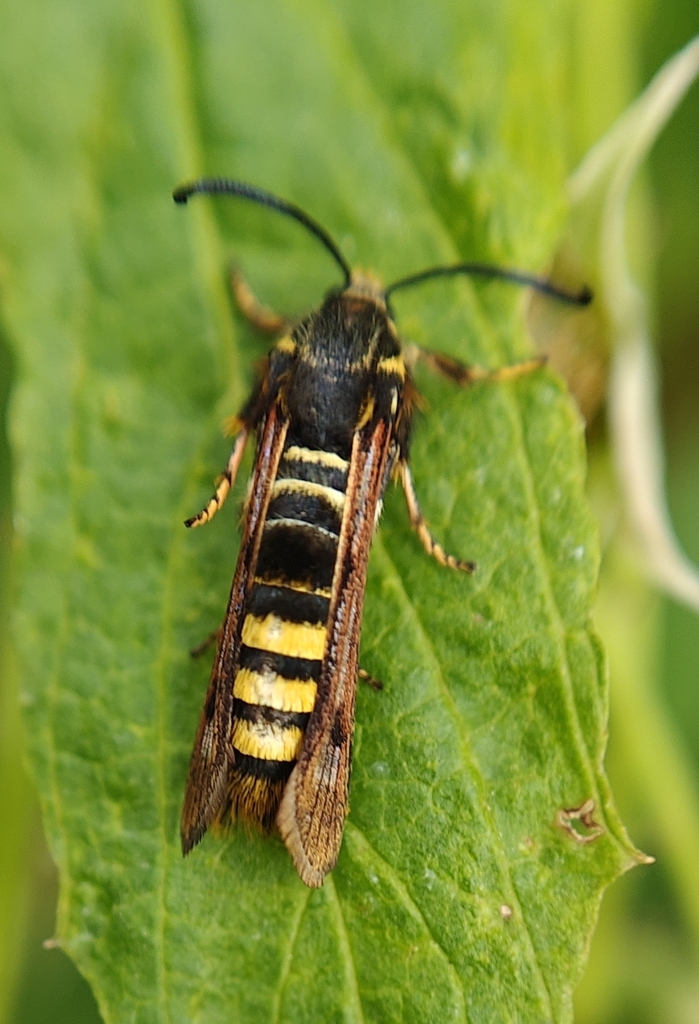
(c) Konrad Kałużyński, some rights reserved (CC BY) · licence
Family: Sesiidae · Class: Insecta · Order: Lepidoptera
Pennisetia marginata (Raspberry Crown Borer Moth) is a California animal in the Sesiidae family.
The Raspberry Crown Borer Moth (Pennisetia marginata) is a clearwing moth in the family Sesiidae that closely resembles a yellow jacket wasp in appearance. Adults exhibit sexual dimorphism in size, with males measuring 18-25 mm and females ranging 25-37 mm in wingspan (BugGuide). The body is predominantly black with yellow streaking and four or more narrow yellow bands around the abdomen. The legs are dull yellow, and the forewings display dark olive and reddish-brown coloration with a prominent dark discal bar. Males possess pectinate (feathered) antennae, while females have simple antennae (BugGuide). This species occurs from Newfoundland to North Carolina, extending west to Ontario, Missouri, and Mississippi. The distribution encompasses most of the United States and southern Canada, though records are fewer from the Rocky Mountains and Great Plains regions (BugGuide). The moth's range reflects its association with native and cultivated Rubus species throughout temperate North America. Raspberry Crown Borer Moths inhabit areas where their host plants grow, including forest edges, clearings, abandoned fields, and cultivated berry patches. Adults are active during daylight hours on or near raspberry and blackberry plants (Rubus species). The species shows a preference for disturbed habitats and edge environments where Rubus plants commonly establish. Adults fly from July through September, with peak activity during mid-summer months. The larvae are white to pinkish with brown heads and can reach 29-38 mm in length (BugGuide). Host plants belong exclusively to the family Rosaceae, genus Rubus, with larvae feeding on buds, roots, and stems (Moth Photographers Group). The species exhibits typical clearwing moth behavior, with adults active during warm, sunny days and often found visiting flowers or resting on host plants. The wasp-like appearance serves as Batesian mimicry, providing protection from predators. Larval feeding occurs within the crown and root system of raspberry and blackberry plants, where they bore through tissue and can cause significant damage to cultivated berry crops. The species completes its development within the host plant, pupating in the root crown area before adults emerge. This boring behavior has made P. marginata an economically important pest species in commercial berry production. The Raspberry Crown Borer Moth is not federally or state listed and appears to maintain stable populations throughout its range as of December 2025. The species benefits from both wild Rubus populations and extensive cultivation of raspberries and blackberries across North America. While considered a pest in agricultural settings, the moth plays a role in natural ecosystems and does not face significant conservation threats. Its broad distribution and association with common, widespread host plants suggest the species is not at risk. Agricultural management practices may locally impact populations, but the moth's ability to utilize both wild and cultivated Rubus species provides resilience against habitat loss.
Classification
Class: Insecta · Order: Lepidoptera · Family: Sesiidae
Frequently asked questions
How is Pennisetia marginata classified?
Pennisetia marginata belongs to class Insecta, order Lepidoptera, family Sesiidae.
What family does Pennisetia marginata belong to?
Pennisetia marginata is in the Sesiidae family.
What is Pennisetia marginata?
The Raspberry Crown Borer Moth (Pennisetia marginata) is a clearwing moth in the family Sesiidae that closely resembles a yellow jacket wasp in appearance.
Is Pennisetia marginata found in California?
Yes. Pennisetia marginata is recorded in California in The California Species Project's catalogue.
Related species
Other California species in the same genus, family, or bioregion.
Data from The California Species Project — 14,000+ California species with verified data from CNPS, CDFW, USFWS, and more.