Pentidotea resecata
Eelgrass Isopod
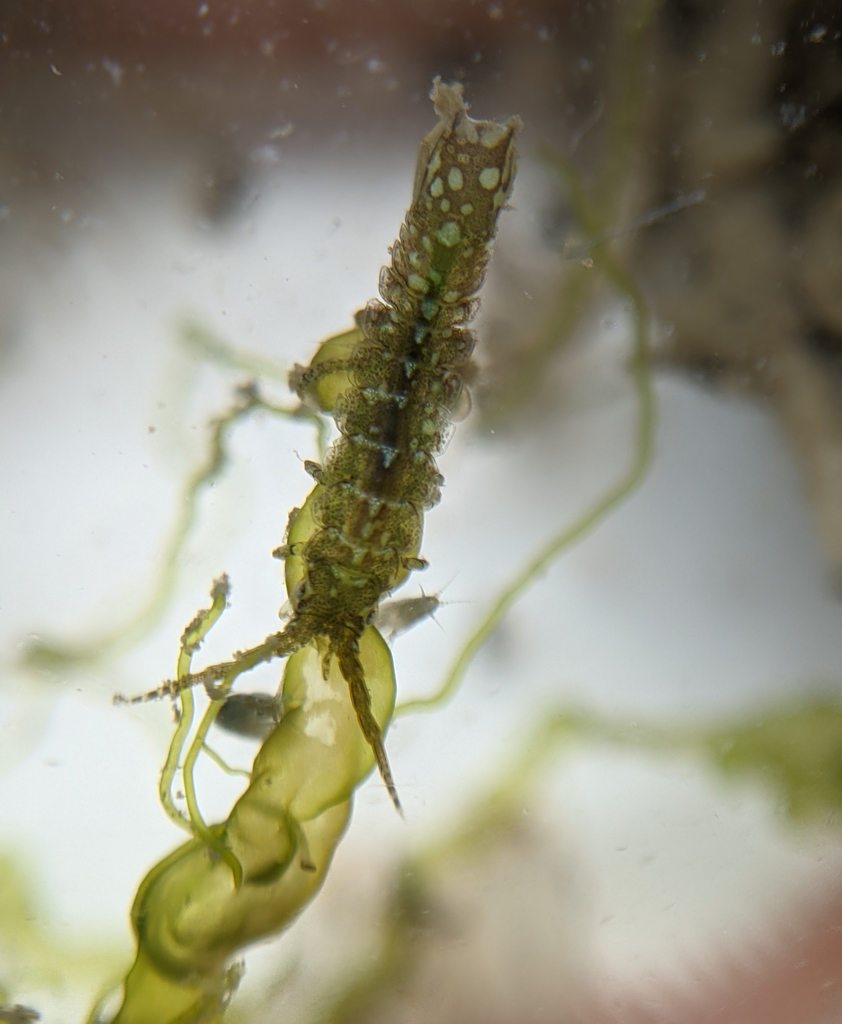
no rights reserved · CC0
Family: Idoteidae · Class: Malacostraca · Order: Isopoda
Pentidotea resecata (Eelgrass Isopod) is a California animal in the Idoteidae family.
Pentidotea resecata is a marine isopod crustacean in the family Idoteidae, commonly known as the eelgrass isopod. This small crustacean measures approximately 10-20 mm in length and exhibits the characteristic flattened, segmented body typical of isopods. The species displays cryptic coloration that allows it to blend with its algal habitat, typically appearing brown to green with mottled patterns that provide effective camouflage among marine vegetation. The eelgrass isopod occurs along the Pacific coast of North America, ranging from Alaska south to California. In California waters, the species is found in nearshore marine environments, particularly in association with kelp forests and eelgrass beds. According to California Department of Fish and Wildlife documentation, P. resecata has been recorded in various coastal locations throughout the state's marine waters. This species inhabits subtidal and intertidal zones, showing a strong preference for areas with dense marine vegetation. The eelgrass isopod is closely associated with kelp forests, where it lives among giant kelp (Macrocystis pyrifera) and bull kelp (Nereocystis luetkeana) fronds. It also occurs in eelgrass (Zostera marina) beds in estuarine environments. The species typically inhabits depths ranging from the low intertidal zone to approximately 20 meters, favoring areas with moderate water movement and complex three-dimensional habitat structure provided by marine macrophytes. Pentidotea resecata functions as an important herbivore in kelp forest ecosystems. The species feeds primarily on kelp and other marine algae, using specialized mouthparts to scrape algal material from plant surfaces. Research has documented that P. resecata can impact kelp health through its feeding activities, with some studies noting that intensive grazing by isopods and other small crustaceans can lead to kelp mortality by tunneling into holdfast structures (California Department of Fish and Wildlife). The species exhibits typical isopod reproductive behavior, with females carrying developing young in a ventral brood pouch. Reproduction likely occurs throughout the warmer months, though specific timing and breeding cycles have not been thoroughly documented. The eelgrass isopod does not currently hold federal or state conservation listing status. However, the species' dependence on kelp forest and eelgrass habitats makes it potentially vulnerable to habitat degradation and climate change impacts. California's kelp forests have experienced significant declines in recent decades due to warming ocean temperatures, sea urchin population explosions, and other anthropogenic stressors. As kelp forest ecosystems face increasing pressure from climate change and human activities, associated species like P. resecata may experience corresponding population impacts. The species serves as an indicator of kelp forest ecosystem health, and its abundance patterns may reflect broader changes in these critical marine habitats.
Classification
Class: Malacostraca · Order: Isopoda · Family: Idoteidae
Frequently asked questions
How is Pentidotea resecata classified?
Pentidotea resecata belongs to class Malacostraca, order Isopoda, family Idoteidae.
What family does Pentidotea resecata belong to?
Pentidotea resecata is in the Idoteidae family.
What is Pentidotea resecata?
Pentidotea resecata is a marine isopod crustacean in the family Idoteidae, commonly known as the eelgrass isopod.
Is Pentidotea resecata found in California?
Yes. Pentidotea resecata is recorded in California in The California Species Project's catalogue.
Related species
Other California species in the same genus, family, or bioregion.
Data from The California Species Project — 14,000+ California species with verified data from CNPS, CDFW, USFWS, and more.