Percina macrolepida
Bigscale logperch
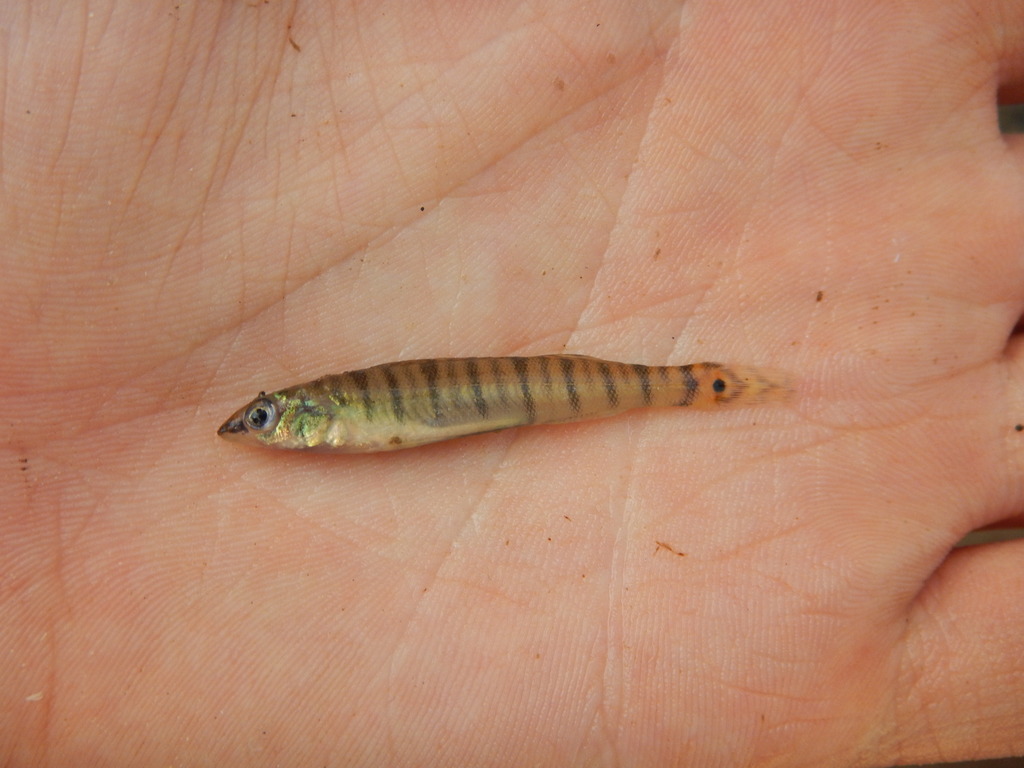
(c) Fishes of Texas team, some rights reserved (CC BY-SA) · licence
Family: Percidae · Class: Actinopterygii · Order: Perciformes
Percina macrolepida (Bigscale logperch) is a California animal in the Percidae family.
The bigscale logperch is a medium-sized freshwater fish belonging to the darter family Percidae. Adults typically measure 80 to 120 mm (3.1 to 4.7 inches) in total length, with a maximum recorded length of approximately 140 mm (5.5 inches). The species is characterized by a robust, elongated body with a slightly compressed profile and a distinctly pointed snout. The dorsal surface displays a series of 7 to 9 dark vertical bars or saddles that extend partway down the sides. Between these bars, the body exhibits a mottled pattern of brown, olive, and yellow coloration. The ventral surface is typically pale yellow to white. The species' common name derives from its relatively large scales compared to other logperch species, with lateral line scale counts ranging from 81 to 95. Historically, the bigscale logperch occurred in the Arkansas, Red, and Ouachita river systems across portions of Arkansas, Louisiana, Oklahoma, and Texas. The species inhabited large rivers and their major tributaries within these drainages. In California, this species is not native and has no established populations, though it may occasionally appear in species databases due to taxonomic or distributional references. The bigscale logperch typically inhabits large rivers with moderate to swift currents over sand, gravel, or rocky substrates. Adults prefer deeper pools and runs, often found at depths of 1 to 4 meters (3.3 to 13.1 feet). Juveniles utilize shallower areas with slower currents, frequently associated with submerged vegetation or woody debris. Water temperatures in occupied habitats typically range from 15 to 28°C (59 to 82°F) during the active season. This species exhibits benthic feeding behavior, using its pointed snout to probe substrate crevices for invertebrate prey. The diet consists primarily of aquatic insect larvae, particularly chironomids, mayflies, and caddisflies, supplemented by small crustaceans and mollusks. Bigscale logperch reach sexual maturity at approximately 2 to 3 years of age. Spawning occurs from April through June when water temperatures reach 18 to 22°C (64 to 72°F). Females deposit 200 to 800 adhesive eggs in shallow gravel nests constructed by males, who provide parental care by guarding the nest site. The bigscale logperch has experienced significant population declines throughout its native range due to habitat modification, dam construction, and water quality degradation. River channelization and gravel mining have eliminated suitable spawning substrates in many areas. The species is considered vulnerable to extirpation in portions of its historical range, though it maintains stable populations in some protected river segments. Conservation efforts focus on habitat restoration and maintenance of natural flow regimes in occupied watersheds.
Classification
Class: Actinopterygii · Order: Perciformes · Family: Percidae
Frequently asked questions
How is Percina macrolepida classified?
Percina macrolepida belongs to class Actinopterygii, order Perciformes, family Percidae.
What family does Percina macrolepida belong to?
Percina macrolepida is in the Percidae family.
What is Percina macrolepida?
The bigscale logperch is a medium-sized freshwater fish belonging to the darter family Percidae.
Is Percina macrolepida found in California?
Yes. Percina macrolepida is recorded in California in The California Species Project's catalogue.
Related species
Other California species in the same genus, family, or bioregion.
Data from The California Species Project — 14,000+ California species with verified data from CNPS, CDFW, USFWS, and more.