Perillus bioculatus
Two-spotted Stink Bug
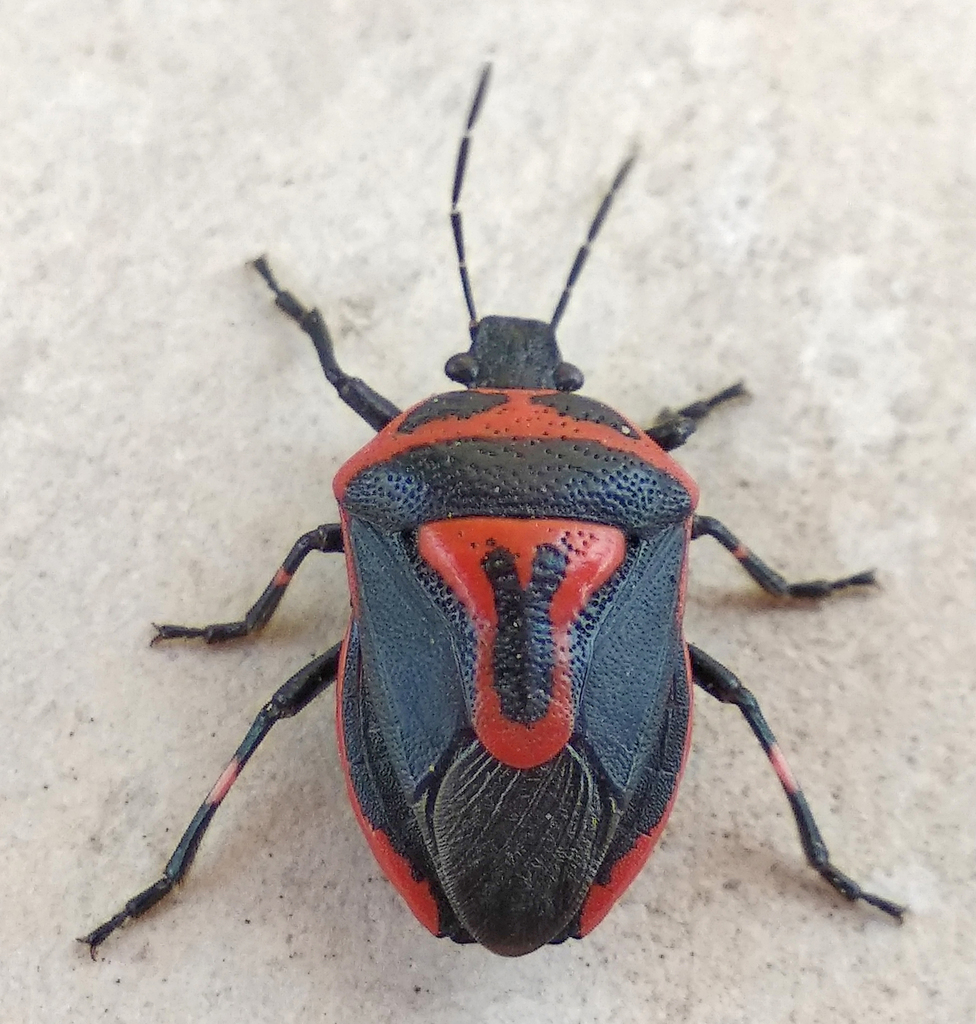
(c) katunchik, some rights reserved (CC BY) · licence
Family: Pentatomidae · Class: Insecta · Order: Hemiptera
Perillus bioculatus (Two-spotted Stink Bug) is a California animal in the Pentatomidae family.
The two-spotted stink bug is a predatory pentatomid measuring approximately 8-12 millimeters (0.3-0.5 inches) in length. Adults display a distinctive coloration pattern with a brown to reddish-brown dorsal surface marked by two prominent pale yellow or cream-colored spots on the pronotum, giving the species its common name. The scutellum typically bears additional pale markings, and the legs are banded with alternating light and dark segments. Like other stink bugs, the species possesses piercing-sucking mouthparts and well-developed scent glands that produce defensive chemicals when disturbed. Perillus bioculatus occurs throughout much of North America, with documented populations extending from southern Canada through the United States and into northern Mexico. The species is widely distributed across the continental United States, including California, where it inhabits various agricultural and natural ecosystems. Regional populations show some variation in size and coloration patterns, but the characteristic two-spot marking remains consistent across the range. This species occupies diverse habitats including agricultural fields, gardens, grasslands, and forest edges. Two-spotted stink bugs are commonly found in association with solanaceous crops, particularly potato fields where their primary prey, the Colorado potato beetle, is abundant. They also occur in natural plant communities supporting various beetle species and other arthropod prey. The bugs are typically active from spring through fall, overwintering as adults in protected locations such as leaf litter or under bark. As a specialized predator, Perillus bioculatus feeds primarily on soft-bodied insects and their larvae, with a particular preference for Colorado potato beetles (Leptinotarsa decemlineata) (Xerces Society). Adults and nymphs use their piercing mouthparts to penetrate prey and extract body fluids. According to biological control research, a single two-spotted stink bug can consume multiple Colorado potato beetle larvae per day, making it an important natural enemy of this agricultural pest (Xerces Society). Mating occurs in spring and early summer, with females depositing clusters of barrel-shaped eggs on plant surfaces. Nymphs undergo five instars before reaching adulthood, with development time varying based on temperature and prey availability. The two-spotted stink bug holds no federal or state conservation listing status and is considered a beneficial species in agricultural systems. Populations appear stable across most of the range, though local abundance fluctuates with prey availability and agricultural practices. The species plays a significant role in biological pest control, particularly in potato production systems where it helps suppress Colorado potato beetle populations. However, like other beneficial arthropods, two-spotted stink bugs may be susceptible to broad-spectrum insecticides applied for pest management. Conservation of this species benefits from integrated pest management approaches that preserve natural enemy populations while managing agricultural pests. Habitat diversity, including field margins and non-crop vegetation, supports population stability by providing overwintering sites and alternative prey sources when primary pest species are less abundant.
Classification
Class: Insecta · Order: Hemiptera · Family: Pentatomidae
Frequently asked questions
How is Perillus bioculatus classified?
Perillus bioculatus belongs to class Insecta, order Hemiptera, family Pentatomidae.
What family does Perillus bioculatus belong to?
Perillus bioculatus is in the Pentatomidae family.
What is Perillus bioculatus?
The two-spotted stink bug is a predatory pentatomid measuring approximately 8-12 millimeters (0.3-0.5 inches) in length.
Is Perillus bioculatus found in California?
Yes. Perillus bioculatus is recorded in California in The California Species Project's catalogue.
Related species
Other California species in the same genus, family, or bioregion.
Data from The California Species Project — 14,000+ California species with verified data from CNPS, CDFW, USFWS, and more.