Perisoreus canadensis
Gray Jay
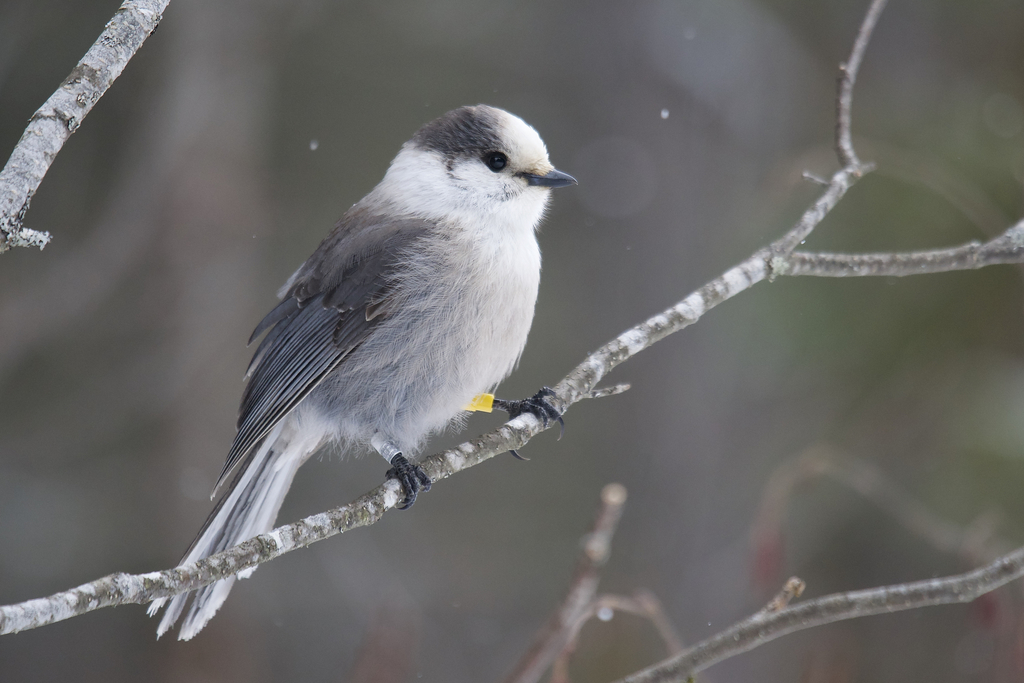
(c) Owen Strickland, some rights reserved (CC BY) · licence
Family: Corvidae · Class: Aves · Order: Passeriformes
Perisoreus canadensis (Gray Jay) is a California animal in the Corvidae family.
The Gray Jay is a medium-sized corvid measuring 25 to 33 cm (10 to 13 inches) in length with a wingspan of 45 cm (18 inches). Adults weigh between 65 to 70 grams. The species displays a distinctive three-toned plumage pattern: dark brownish-gray on the back and wings, white or pale gray on the underparts, and a contrasting dark cap covering the back of the head and nape. The face and throat are white or light gray, creating a clear demarcation with the dark cap. Juveniles appear darker overall with a sooty-gray head that gradually lightens to adult coloration by their first winter. Gray Jays inhabit the boreal and montane coniferous forests of North America, with their range extending from Alaska across Canada to the northeastern United States and south through the Rocky Mountains. In California, the species occurs in high-elevation coniferous forests of the Sierra Nevada and Cascade Range, primarily above 1,500 meters (4,900 feet) elevation. Historical records document populations in the Warner Mountains of northeastern California, though current status in this region remains uncertain. The species occupies mature coniferous forests dominated by spruce, fir, pine, and hemlock. Gray Jays show particular affinity for forests with dense canopy cover and abundant deadfall. They require territories with diverse microhabitats including forest openings, edges, and areas with standing snags. The species is non-migratory and maintains year-round territories, necessitating habitats that provide reliable food sources through harsh winter conditions. Gray Jays are opportunistic omnivores with a diet comprising arthropods, small vertebrates, bird eggs and nestlings, berries, and carrion. The species exhibits specialized food-caching behavior, using sticky saliva to adhere food items to tree bark and conifer needles for winter storage. Breeding occurs early in the year, typically beginning in February or March while snow remains on the ground. Females construct nests in conifer trees, usually positioned close to the trunk for thermal protection. Clutch size ranges from 2 to 5 eggs, with incubation lasting 16 to 18 days. Only one offspring typically survives to independence due to sibling competition and resource limitations. Social behavior centers on family groups consisting of a breeding pair and one or two retained offspring from previous years. These helper juveniles assist in territory defense and food caching but do not breed until they establish their own territories. Gray Jays are highly intelligent, demonstrating problem-solving abilities and complex social behaviors typical of corvids. The Gray Jay is not federally listed and appears stable across most of its range. However, climate change poses emerging threats to southern populations, including those in California. Warming temperatures may reduce suitable habitat at high elevations and affect food availability during critical winter months. Research indicates that Gray Jay populations in some southern portions of their range have experienced local declines attributed to climate-related factors. Conservation efforts focus on monitoring population trends and protecting high-elevation coniferous forest habitats from development and climate impacts.
Classification
Class: Aves · Order: Passeriformes · Family: Corvidae
Frequently asked questions
How is Perisoreus canadensis classified?
Perisoreus canadensis belongs to class Aves, order Passeriformes, family Corvidae.
What family does Perisoreus canadensis belong to?
Perisoreus canadensis is in the Corvidae family.
What is Perisoreus canadensis?
The Gray Jay is a medium-sized corvid measuring 25 to 33 cm (10 to 13 inches) in length with a wingspan of 45 cm (18 inches).
Is Perisoreus canadensis found in California?
Yes. Perisoreus canadensis is recorded in California in The California Species Project's catalogue.
Related species
Other California species in the same genus, family, or bioregion.
Data from The California Species Project — 14,000+ California species with verified data from CNPS, CDFW, USFWS, and more.