Perognathus alticola inexpectatus
Tehachapi Pocket Mouse
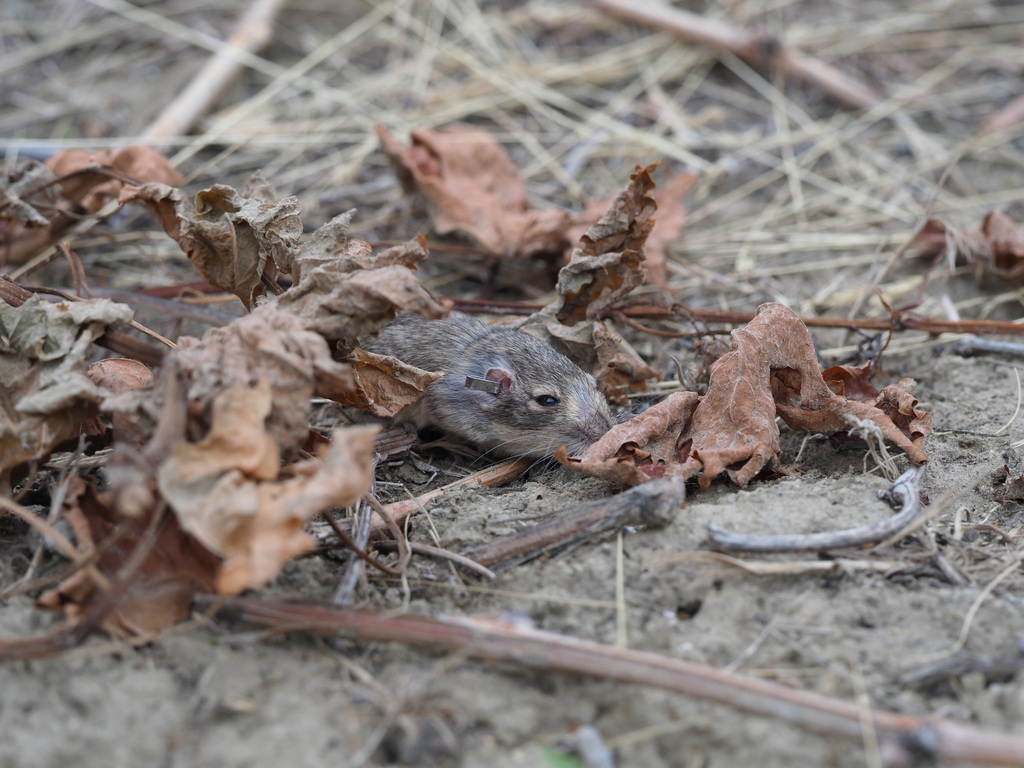
(c) Nathan Earley, some rights reserved (CC BY) · licence
Family: Heteromyidae · Class: Mammalia · Order: Rodentia
Conservation status: G2T1T2 S1S2
Perognathus alticola inexpectatus (Tehachapi Pocket Mouse) is a California animal in the Heteromyidae family.
The Tehachapi pocket mouse (Perognathus alticola inexpectatus) is a critically endangered subspecies of the white-eared pocket mouse endemic to California's Tehachapi Mountains. This small rodent belongs to the family Heteromyidae and represents one of the most imperiled mammals in North America. Adults measure approximately 65-75 mm (2.6-3.0 inches) in head-body length with a tail length of 80-95 mm (3.1-3.7 inches). The species displays typical pocket mouse characteristics including large hind feet adapted for saltatory locomotion, silky fur coloration ranging from pale buff to grayish-brown dorsally with white underparts, and distinctive white patches behind the ears that give the species its common name. Historically, the Tehachapi pocket mouse occupied shrubland and grassland habitats throughout the Tehachapi Mountains in Kern County. The subspecies was thought to be extinct for over 20 years until a small population was rediscovered in 2001. Current distribution is extremely restricted, limited to a few isolated patches of suitable habitat within the Tehachapi Mountain range. The total occupied habitat encompasses less than 1,000 acres, making it one of the most range-restricted mammals in California. The species inhabits shrub-steppe communities dominated by sagebrush, bitterbrush, and native bunch grasses at elevations between 1,200-1,800 meters (3,900-5,900 feet). Suitable habitat requires sandy or gravelly soils that facilitate burrow construction and support seed-producing plants. The subspecies shows strong preference for areas with moderate shrub cover that provides protection from predators while maintaining open spaces for foraging. Habitat fragmentation and degradation from urban development, agriculture, and invasive plant species have severely reduced available territory. Tehachapi pocket mice are primarily granivorous, feeding on seeds from shrubs and forbs including sagebrush, buckwheat, and various annual plants. Like other heteromyids, they possess specialized cheek pouches for seed transport and exhibit water conservation adaptations that allow survival without free water. The species is nocturnal and crepuscular, remaining in underground burrows during daylight hours. Breeding occurs from spring through early summer, with females typically producing 2-5 young per litter. Population dynamics remain poorly understood due to the subspecies' extreme rarity and secretive nature. The Tehachapi pocket mouse faces imminent extinction risk with populations estimated at fewer than 200 individuals. Primary threats include habitat loss from residential and commercial development, invasion by non-native plant species, increased fire frequency, and genetic bottlenecking due to small population size. The U.S. Fish and Wildlife Service has developed recovery strategies focusing on habitat protection, population monitoring, and potential captive breeding programs. Conservation efforts include habitat restoration, invasive species management, and coordination with local land management agencies to protect remaining occupied sites. The subspecies' survival depends on immediate implementation of comprehensive recovery measures and long-term habitat conservation.
Classification
Class: Mammalia · Order: Rodentia · Family: Heteromyidae
Conservation status
G2T1T2 S1S2
Frequently asked questions
How is Perognathus alticola inexpectatus classified?
Perognathus alticola inexpectatus belongs to class Mammalia, order Rodentia, family Heteromyidae.
What family does Perognathus alticola inexpectatus belong to?
Perognathus alticola inexpectatus is in the Heteromyidae family.
Is Perognathus alticola inexpectatus protected or of conservation concern?
Perognathus alticola inexpectatus carries the following status: G2T1T2 S1S2.
What is Perognathus alticola inexpectatus?
The Tehachapi pocket mouse (Perognathus alticola inexpectatus) is a critically endangered subspecies of the white-eared pocket mouse endemic to California's Tehachapi Mountains.
Is Perognathus alticola inexpectatus found in California?
Yes. Perognathus alticola inexpectatus is recorded in California in The California Species Project's catalogue.
Related species
Other California species in the same genus, family, or bioregion.
Data from The California Species Project — 14,000+ California species with verified data from CNPS, CDFW, USFWS, and more.