Perognathus inornatus
San Joaquin Pocket Mouse
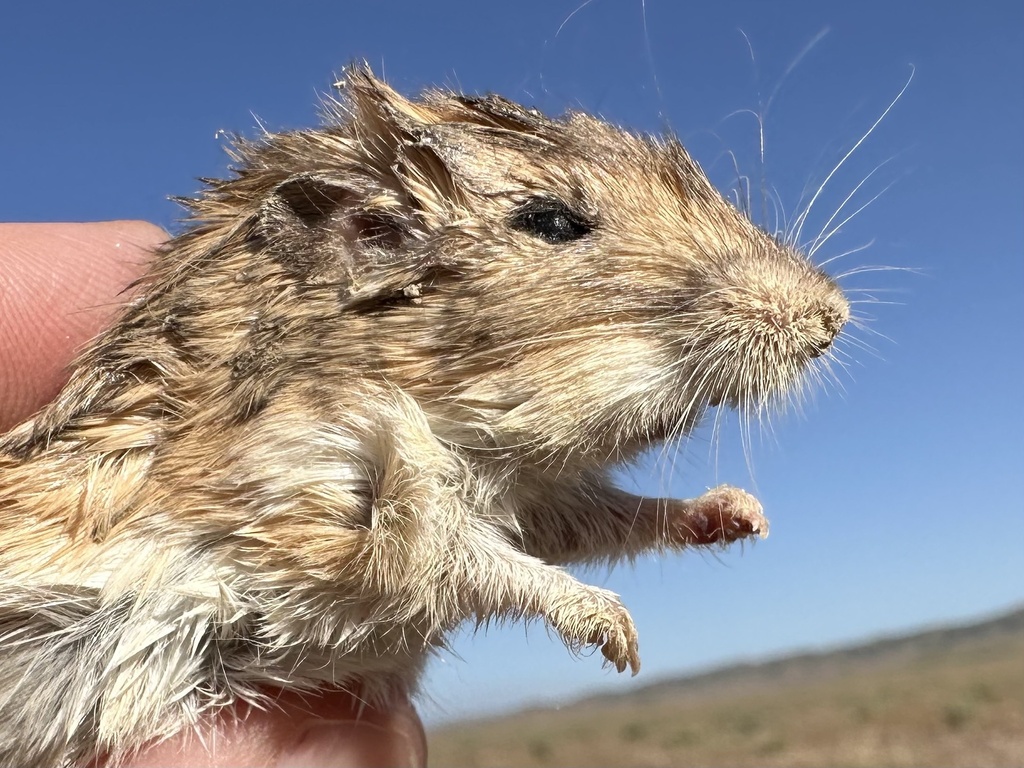
no rights reserved · CC0
Family: Heteromyidae · Class: Mammalia · Order: Rodentia
Conservation status: G2G3 S2S3
Perognathus inornatus (San Joaquin Pocket Mouse) is a California animal in the Heteromyidae family.
The San Joaquin pocket mouse (Perognathus inornatus) is a small granivorous rodent endemic to central California. Adults measure approximately 65-75 mm (2.6-3.0 inches) in head-body length with a tail of similar length. The species displays typical heteromyid features including large hind feet adapted for saltatorial locomotion, small forefeet for seed manipulation, and specialized cheek pouches for seed transport. The pelage is pale buff to sandy brown dorsally with lighter underparts, providing effective camouflage in arid environments. The species exhibits sexual dimorphism, with males typically larger than females. Historically, San Joaquin pocket mice were widespread throughout central California, particularly in the San Joaquin Valley (NatureServe Explorer). The species once occupied extensive areas from Suisun Bay and the American River southward through the San Joaquin Valley and into portions of the western Mojave Desert. Current distribution has been severely fragmented, with populations now restricted to scattered remnant habitats. Recent research has identified chromosomal variation within the species, with some populations exhibiting a distinct 52-chromosome karyotype in the western Mojave Desert region, which may represent a taxonomically significant form (CDFW Journal 2022). San Joaquin pocket mice inhabit arid grassland, savanna, and desert scrub habitats characterized by sparse vegetation and sandy or gravelly soils (CDFW Journal 2022). The species shows strong preference for areas with scattered shrub cover providing protection from predators while maintaining open foraging areas. Elevation ranges from near sea level in valley floors to approximately 1,200 meters (3,937 feet) in foothill regions. Suitable habitat requires a combination of annual grassland with sparse shrub cover, typically dominated by species such as Atriplex, Ephedra, and various annual forbs. As granivorous specialists, San Joaquin pocket mice feed primarily on small seeds collected from the soil surface and cached in underground burrow systems. Their cheek pouches allow efficient seed transport to storage chambers within extensive burrow networks that may extend 1-2 meters below ground. The species exhibits primarily nocturnal activity patterns, remaining in burrows during daylight hours to avoid temperature extremes and predation. Reproduction typically occurs from late spring through early summer, with females producing 2-5 young per litter after a gestation period of approximately 21-23 days. The San Joaquin pocket mouse faces severe conservation challenges due to extensive habitat loss throughout its historical range. Agricultural conversion, urban development, and habitat fragmentation have eliminated an estimated 95% of suitable habitat in the San Joaquin Valley. The species' conservation status reflects these pressures, with global ranks of G2G3 and state ranks of S2S3 indicating populations at risk. Recent genetic research suggesting the presence of distinct chromosomal forms emphasizes the importance of maintaining genetic diversity across remaining populations. Current conservation efforts focus on habitat protection, restoration of native grassland communities, and population monitoring to prevent further decline.
Classification
Class: Mammalia · Order: Rodentia · Family: Heteromyidae
Conservation status
G2G3 S2S3
Frequently asked questions
How is Perognathus inornatus classified?
Perognathus inornatus belongs to class Mammalia, order Rodentia, family Heteromyidae.
What family does Perognathus inornatus belong to?
Perognathus inornatus is in the Heteromyidae family.
Is Perognathus inornatus protected or of conservation concern?
Perognathus inornatus carries the following status: G2G3 S2S3.
What is Perognathus inornatus?
The San Joaquin pocket mouse (Perognathus inornatus) is a small granivorous rodent endemic to central California.
Is Perognathus inornatus found in California?
Yes. Perognathus inornatus is recorded in California in The California Species Project's catalogue.
Related species
Other California species in the same genus, family, or bioregion.
Data from The California Species Project — 14,000+ California species with verified data from CNPS, CDFW, USFWS, and more.