Perognathus inornatus psammophilus
Salinas Pocket Mouse
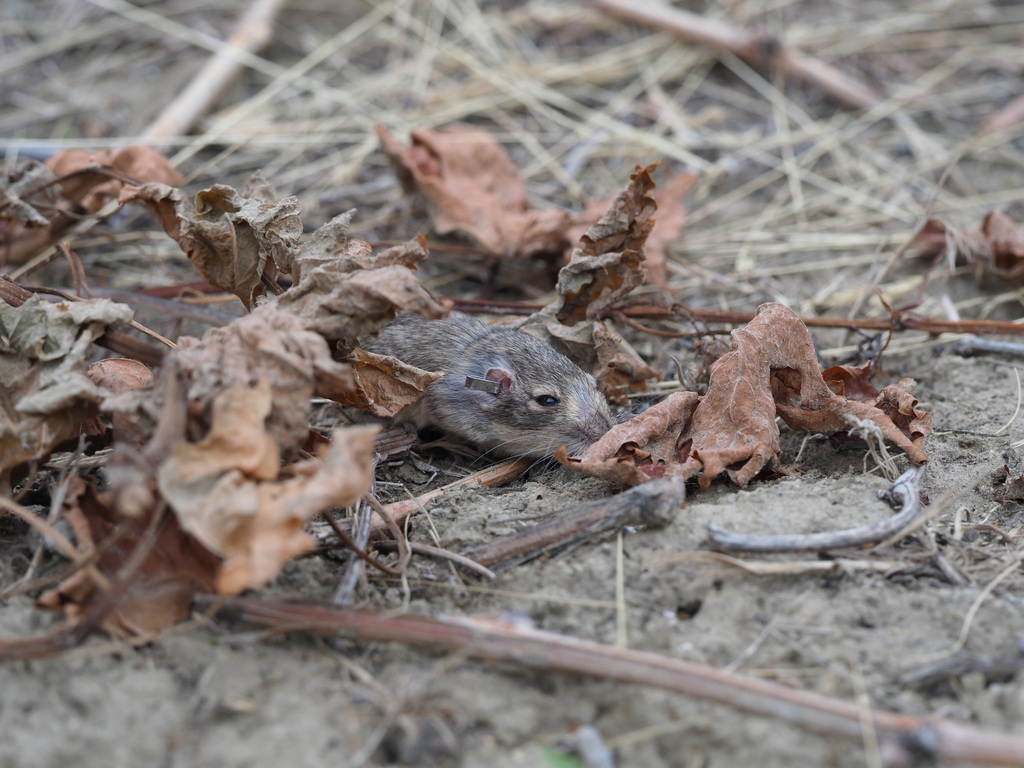
(c) Nathan Earley, some rights reserved (CC BY) · licence
Family: Heteromyidae · Class: Mammalia · Order: Rodentia
Conservation status: G2G3T2? S1
Perognathus inornatus psammophilus (Salinas Pocket Mouse) is a California animal in the Heteromyidae family.
The Salinas pocket mouse (Perognathus inornatus psammophilus) is a small heteromyid rodent subspecies endemic to California. This diminutive mammal typically measures 110-130 mm (4.3-5.1 inches) in total length, with a tail comprising approximately half of this measurement. The pelage is pale sandy brown to grayish-brown dorsally, blending to white or pale buff on the ventral surface. The species exhibits the characteristic features of pocket mice, including specialized cheek pouches for seed transport, large hind feet adapted for saltatorial locomotion, and a long, tufted tail that exceeds head-body length. Historically, the Salinas pocket mouse occurred in the coastal areas of Monterey County, California, particularly in the Salinas Valley region. The subspecies represents one of several geographically distinct populations of the San Joaquin pocket mouse complex (Perognathus inornatus), which collectively occupy arid grassland, savanna, and desert scrub habitats across California's Central Valley and adjacent regions (Animal Diversity Web). Current distribution data for this specific subspecies remains limited in available literature. The Salinas pocket mouse inhabits open grasslands, coastal scrub, and sandy areas with sparse vegetation cover. Like other pocket mouse subspecies, it shows preference for areas with fine, sandy soils that facilitate burrow construction. The species is most abundant in uncultivated areas with native vegetation, though specific habitat requirements for the Salinas subspecies have not been comprehensively documented in recent literature. These mice construct elaborate burrow systems with multiple entrances and specialized chambers for seed storage. As granivorous specialists, Salinas pocket mice feed primarily on small seeds collected during nocturnal foraging excursions. They exhibit the typical pocket mouse behavior of collecting seeds in their specialized cheek pouches and transporting them to underground caches. The species is well-adapted to arid conditions, obtaining most of its water from metabolic processes rather than free water sources. Breeding typically occurs during spring months, with females producing litters of 2-4 young after a gestation period of approximately 30 days. The species exhibits a relatively solitary lifestyle outside of the breeding season. The conservation status of the Salinas pocket mouse reflects significant concern, with a state rank of S1 indicating critically imperiled status in California and a global subspecies rank of T2, suggesting the taxon is imperiled throughout its range. According to NatureServe, a relatively low proportion of pocket mouse occurrences are located on protected conservation lands, though the degree of threat remains classified as unknown (NatureServe Explorer). The California Conservation Genomics Project notes that conservation status assessments for pocket mouse subspecies are based primarily on loss of critical habitat (CCGP). Primary threats likely include habitat conversion, agricultural development, and urban expansion throughout the historically suitable coastal and valley habitats of Monterey County. The subspecies' extremely limited distribution makes it particularly vulnerable to local extinctions from habitat modification or fragmentation.
Classification
Class: Mammalia · Order: Rodentia · Family: Heteromyidae
Conservation status
G2G3T2? S1
Frequently asked questions
How is Perognathus inornatus psammophilus classified?
Perognathus inornatus psammophilus belongs to class Mammalia, order Rodentia, family Heteromyidae.
What family does Perognathus inornatus psammophilus belong to?
Perognathus inornatus psammophilus is in the Heteromyidae family.
Is Perognathus inornatus psammophilus protected or of conservation concern?
Perognathus inornatus psammophilus carries the following status: G2G3T2? S1.
What is Perognathus inornatus psammophilus?
The Salinas pocket mouse (Perognathus inornatus psammophilus) is a small heteromyid rodent subspecies endemic to California.
Is Perognathus inornatus psammophilus found in California?
Yes. Perognathus inornatus psammophilus is recorded in California in The California Species Project's catalogue.
Related species
Other California species in the same genus, family, or bioregion.
Data from The California Species Project — 14,000+ California species with verified data from CNPS, CDFW, USFWS, and more.