Perognathus inornatus ssp. psammophilus
Salinas pocket mouse
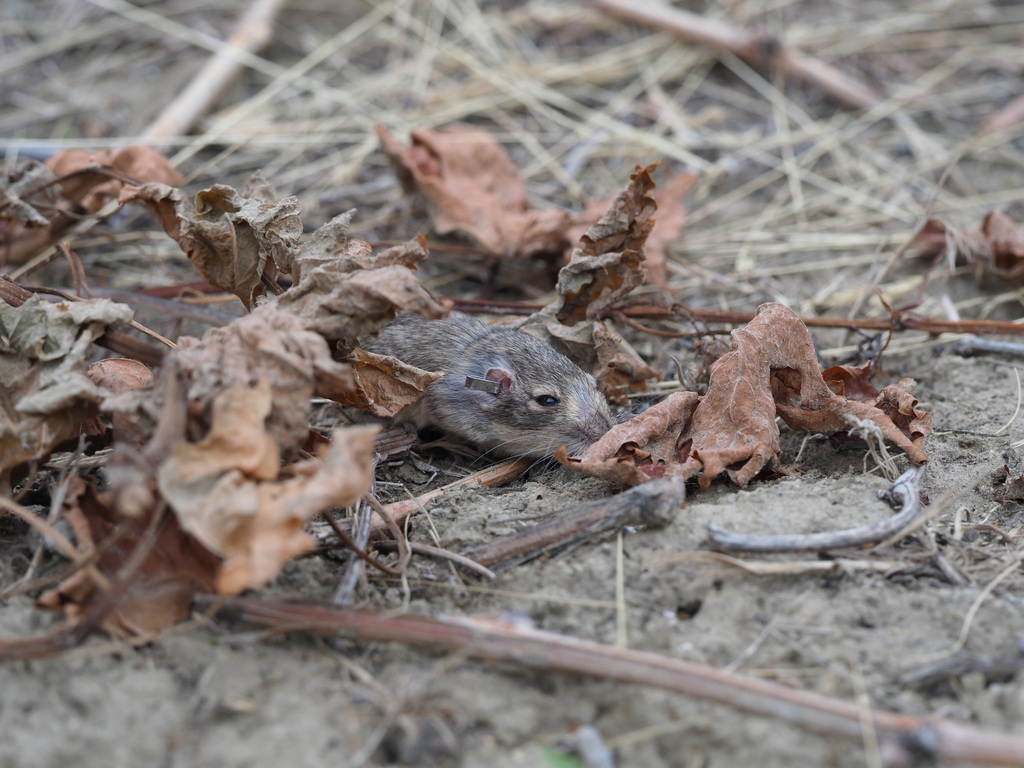
(c) Nathan Earley, some rights reserved (CC BY) · licence
Family: Heteromyidae · Class: Mammalia · Order: Rodentia
Conservation status: G4T2? S1
Perognathus inornatus ssp. psammophilus (Salinas pocket mouse) is a California animal in the Heteromyidae family.
The Salinas pocket mouse (Perognathus inornatus psammophilus) is a small heteromyid rodent endemic to California's central coast region. This subspecies of the San Joaquin pocket mouse is distinguished by its specialized adaptations to sandy coastal habitats. Adults typically measure 60-75 mm in body length with a tail length of 75-100 mm, weighing approximately 7-10 grams. The pelage is pale buff to sandy brown dorsally, providing effective camouflage against coastal dune substrates, with white to cream-colored ventral surfaces. The species exhibits the characteristic enlarged hind legs and long tail typical of pocket mice, along with specialized cheek pouches for seed transport. Historically, the Salinas pocket mouse occurred in coastal dune systems and sandy grasslands along the central California coast, primarily in Monterey County. The subspecies was known from locations near the Salinas River valley and adjacent coastal areas. Current distribution is extremely restricted, with California Natural Diversity Database maintaining records of only 9 occurrences spanning from 1918 to 2006 (NatureServe 2025). The most recent confirmed observation was recorded in 2006, indicating the species may be extirpated or reduced to critically small populations. The species inhabits sandy coastal dune systems, grasslands, and scrubland environments characterized by loose, well-drained soils. Preferred habitats include areas with scattered shrub cover providing protection from predators while maintaining open sandy patches for foraging. The subspecies shows strong association with native coastal vegetation communities, including coastal sage scrub and dune grassland systems. Elevation range is typically from sea level to approximately 200 meters in coastal terraces and adjacent inland areas. Salinas pocket mice are primarily granivorous, feeding on small seeds of grasses and forbs characteristic of coastal dune ecosystems. Like other heteromyids, they are nocturnal and exhibit water-conserving adaptations that allow survival without free water. Individuals construct burrow systems in sandy substrates, with multiple entrances and food caching chambers. Breeding likely occurs from spring through early fall, with females producing 2-4 young per litter. The species exhibits typical pocket mouse behaviors including sand-kicking to cover scent trails and bipedal locomotion when moving rapidly. The Salinas pocket mouse is not currently federally listed but carries a state conservation rank of S1, indicating it is critically imperiled in California. NatureServe ranks the subspecies as G4T2?, reflecting uncertainty about its global status as a subspecies of a more widespread species. The primary threats include habitat loss and fragmentation from coastal development, agricultural conversion, and recreational activities in dune systems. Invasive plant species may alter seed availability and habitat structure. The lack of confirmed observations since 2006 has raised concerns about potential extirpation, though suitable habitat remnants persist in some coastal areas. No current recovery plans or critical habitat designations exist for this subspecies, highlighting the urgent need for targeted surveys and conservation assessment.
Classification
Class: Mammalia · Order: Rodentia · Family: Heteromyidae
Conservation status
G4T2? S1
Frequently asked questions
How is Perognathus inornatus ssp. psammophilus classified?
Perognathus inornatus ssp. psammophilus belongs to class Mammalia, order Rodentia, family Heteromyidae.
What family does Perognathus inornatus ssp. psammophilus belong to?
Perognathus inornatus ssp. psammophilus is in the Heteromyidae family.
Is Perognathus inornatus ssp. psammophilus protected or of conservation concern?
Perognathus inornatus ssp. psammophilus carries the following status: G4T2? S1.
What is Perognathus inornatus ssp. psammophilus?
The Salinas pocket mouse (Perognathus inornatus psammophilus) is a small heteromyid rodent endemic to California's central coast region.
Is Perognathus inornatus ssp. psammophilus found in California?
Yes. Perognathus inornatus ssp. psammophilus is recorded in California in The California Species Project's catalogue.
Related species
Other California species in the same genus, family, or bioregion.
Data from The California Species Project — 14,000+ California species with verified data from CNPS, CDFW, USFWS, and more.