Perognathus longimembris
Little Pocket Mouse
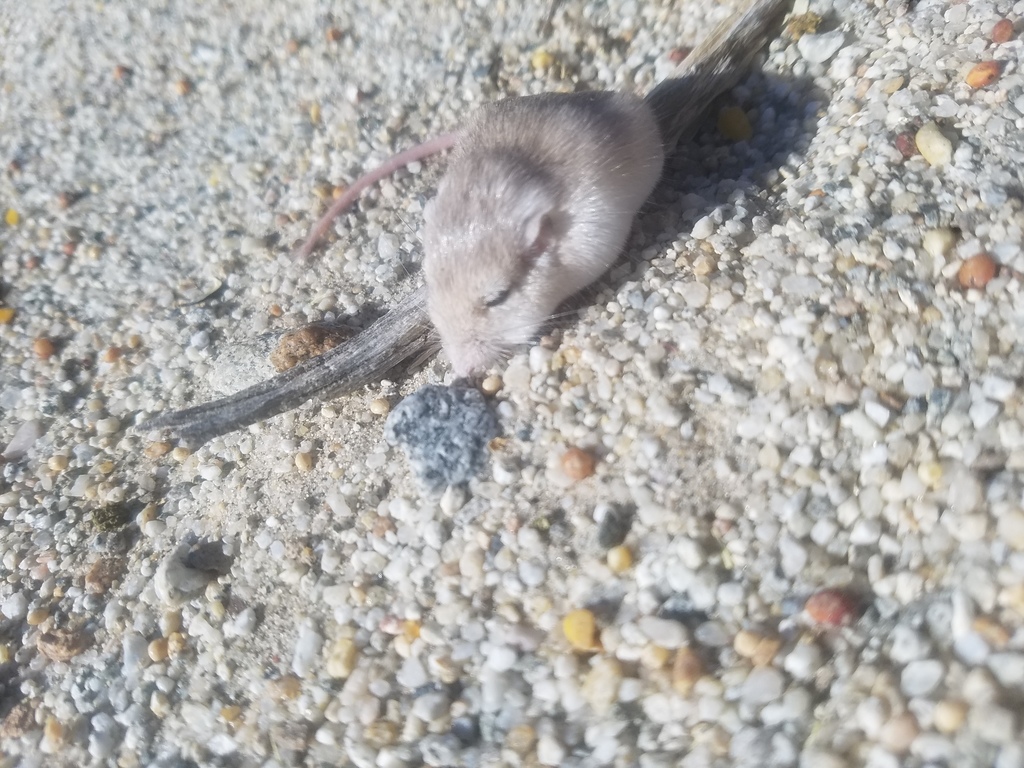
(c) Danny Mccamish, some rights reserved (CC BY) · licence
Family: Heteromyidae · Class: Mammalia · Order: Rodentia
Perognathus longimembris (Little Pocket Mouse) is a California animal in the Heteromyidae family.
The scientific name Perognathus longimembris encompasses multiple subspecies of small heteromyid rodents known as little pocket mice. However, the common name "Little Pocket Mouse" most commonly refers to the critically endangered Los Angeles little pocket mouse (Perognathus longimembris brevinasus), one of several federally protected subspecies within this taxonomic group. Little pocket mice are among the smallest rodents in North America, typically measuring 100-120 mm (4-5 inches) in total length, with approximately half of that length consisting of the tail. Adults weigh between 7-12 grams (0.25-0.42 ounces). The pelage is generally pale buff to sandy brown dorsally, with white or cream-colored underparts. The species exhibits the characteristic features of pocket mice, including specialized cheek pouches for seed transport, relatively large hind legs adapted for saltatorial locomotion, and a long, tufted tail that aids in balance during jumping. The distribution of P. longimembris subspecies is highly fragmented across California. The Los Angeles little pocket mouse historically occurred throughout the Los Angeles Basin but is now restricted to small habitat fragments (USFWS). The Pacific pocket mouse (P. l. pacificus) is found only on San Clemente Island, while the Palm Springs pocket mouse (P. l. bangsi) occupies desert areas near Palm Springs. Each subspecies has experienced severe range contractions from their historical distributions. These mice inhabit shrubland and coastal sage scrub communities, typically in areas with sandy soils that facilitate burrow construction. The Los Angeles subspecies prefers coastal sage scrub dominated by California sagebrush and other native shrubs. Pacific pocket mice on San Clemente Island utilize maritime desert scrub and grassland habitats. All subspecies construct complex burrow systems with multiple entrances, food storage chambers, and nesting areas. Little pocket mice are primarily granivorous, feeding on small seeds collected during nocturnal foraging activities. According to USFWS recovery documents, Pacific pocket mice consume seeds and stems of grasses and forbs, with dietary analysis revealing consumption of both plant material and arthropods. The species exhibits typical heteromyid behavior, storing seeds in specialized cheek pouches for transport to underground caches. Reproduction occurs primarily in spring and early summer, with females producing litters of 2-5 young after a gestation period of approximately 23-25 days. Multiple subspecies face severe conservation challenges, with several federally listed as endangered. The Los Angeles little pocket mouse was believed extinct until its rediscovery in 1993 and subsequent federal listing. According to USFWS, all known populations are threatened by habitat fragmentation, degradation, and small population sizes. Primary threats include urban development, habitat conversion, invasive plant species, and climate change effects on already restricted ranges. Recovery efforts focus on habitat restoration, captive breeding programs, and establishment of additional populations to reduce extinction risk from catastrophic events affecting single locations.
Classification
Class: Mammalia · Order: Rodentia · Family: Heteromyidae
Frequently asked questions
How is Perognathus longimembris classified?
Perognathus longimembris belongs to class Mammalia, order Rodentia, family Heteromyidae.
What family does Perognathus longimembris belong to?
Perognathus longimembris is in the Heteromyidae family.
What is Perognathus longimembris?
The scientific name Perognathus longimembris encompasses multiple subspecies of small heteromyid rodents known as little pocket mice.
Is Perognathus longimembris found in California?
Yes. Perognathus longimembris is recorded in California in The California Species Project's catalogue.
Related species
Other California species in the same genus, family, or bioregion.
Data from The California Species Project — 14,000+ California species with verified data from CNPS, CDFW, USFWS, and more.