Perognathus longimembris bangsi
Palm Springs Little Pocket Mouse, Palm Springs Pocket Mouse
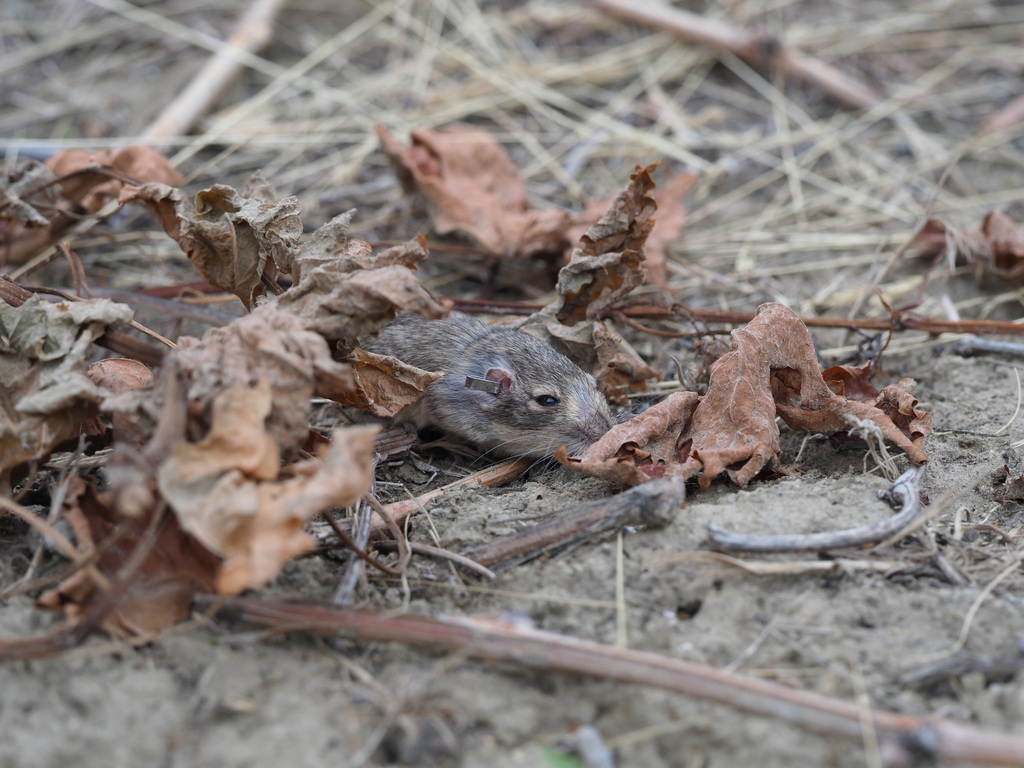
(c) Nathan Earley, some rights reserved (CC BY) · licence
Family: Heteromyidae · Class: Mammalia · Order: Rodentia
Conservation status: G5T2 S1
Perognathus longimembris bangsi (Palm Springs Little Pocket Mouse, Palm Springs Pocket Mouse) is a California animal in the Heteromyidae family.
The Palm Springs pocket mouse (Perognathus longimembris bangsi) is a small heteromyid rodent and the smallest subspecies of the little pocket mouse. Adults measure approximately 108 to 125 mm (4.3 to 4.9 inches) in total length, with the tail comprising roughly half of this measurement. The pelage is pale sandy buff to pale cinnamon buff dorsally, providing excellent camouflage against desert substrates. The underparts are white to pale buff, and the species exhibits the characteristic cheek pouches used for seed storage that define the heteromyid family. Historically, the Palm Springs pocket mouse occurred throughout the Coachella Valley in Riverside County, California. The subspecies was once distributed across sandy flats and washes from Palm Springs south to the Salton Sea. Currently, the species persists in only a few small populations on protected lands, primarily within the Coachella Valley National Wildlife Refuge and on tribal lands near the original Palm Springs population sites. The dramatic range reduction represents one of the most severe contractions documented for any North American mammal subspecies. This subspecies inhabits sparse desert scrub communities characterized by fine, sandy soils and scattered shrub cover. Preferred habitat consists of sandy flats, washes, and gentle slopes with less than 30 percent shrub cover, dominated by desert saltbush (Atriplex polycarpa), burrobush (Ambrosia dumosa), and desert lavender (Hyptis emoryi). The species requires areas with stable sand for burrow construction and foraging, typically at elevations between 70 and 200 meters (230 to 660 feet) above sea level. Microhabitat selection appears linked to soil particle size and vegetation structure that provides optimal foraging conditions while minimizing predation risk. Palm Springs pocket mice are primarily granivorous, feeding on small seeds of shrubs and annual plants. Peak activity occurs during cooler months, with reduced activity during extreme summer heat. The species exhibits typical heteromyid behaviors including bipedal locomotion, extensive burrowing, and food hoarding in underground caches. Reproduction likely peaks in spring following winter precipitation that stimulates annual plant growth and seed production. Females produce one to two litters annually, with litter sizes ranging from two to five young based on related subspecies. The Palm Springs pocket mouse was emergency-listed as endangered under the Endangered Species Act on May 22, 2006, due to extreme population decline and habitat loss (USFWS). The species was believed extinct until rediscovered in 1993 after a 20-year absence from scientific records. Primary threats include habitat destruction from urban development, agriculture, and recreational activities in the Coachella Valley. Additional threats include habitat fragmentation, invasive plant species that alter soil structure and native plant communities, and potential impacts from climate change affecting precipitation patterns essential for annual plant reproduction. Current population estimates suggest fewer than 200 individuals remain across all known sites, making this one of North America's most endangered mammals.
Classification
Class: Mammalia · Order: Rodentia · Family: Heteromyidae
Conservation status
G5T2 S1
Frequently asked questions
How is Perognathus longimembris bangsi classified?
Perognathus longimembris bangsi belongs to class Mammalia, order Rodentia, family Heteromyidae.
What family does Perognathus longimembris bangsi belong to?
Perognathus longimembris bangsi is in the Heteromyidae family.
Is Perognathus longimembris bangsi protected or of conservation concern?
Perognathus longimembris bangsi carries the following status: G5T2 S1.
What is Perognathus longimembris bangsi?
The Palm Springs pocket mouse (Perognathus longimembris bangsi) is a small heteromyid rodent and the smallest subspecies of the little pocket mouse.
Is Perognathus longimembris bangsi found in California?
Yes. Perognathus longimembris bangsi is recorded in California in The California Species Project's catalogue.
Related species
Other California species in the same genus, family, or bioregion.
Data from The California Species Project — 14,000+ California species with verified data from CNPS, CDFW, USFWS, and more.