Perognathus longimembris brevinasus
Los Angeles Pocket Mouse
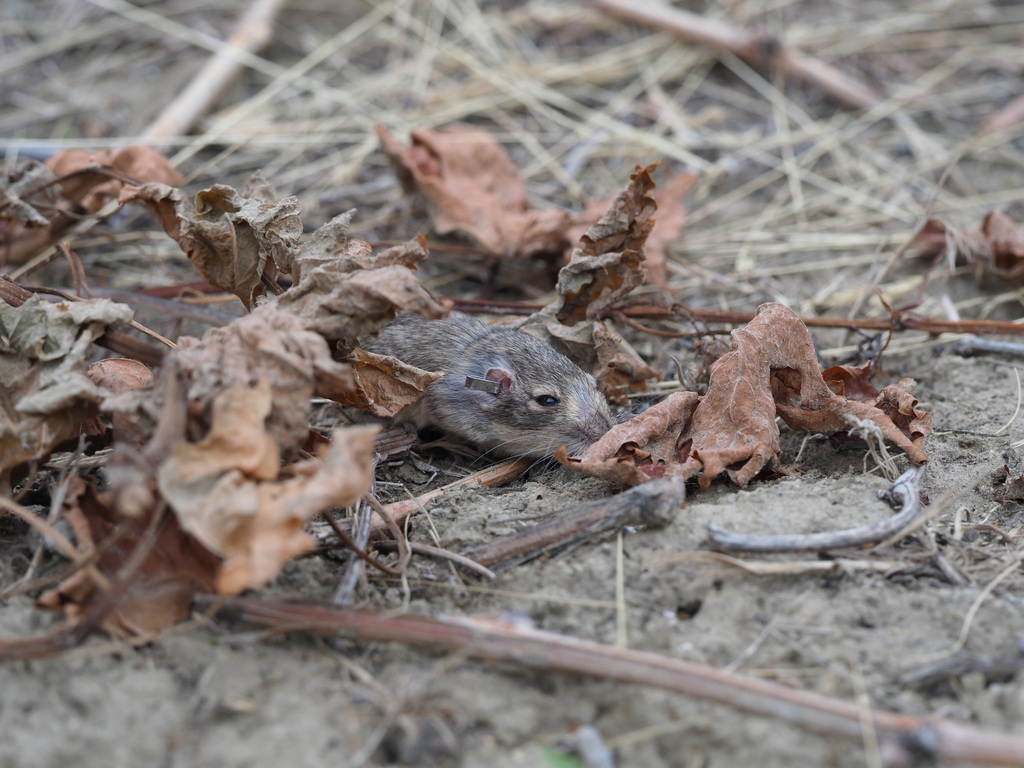
(c) Nathan Earley, some rights reserved (CC BY) · licence
Family: Heteromyidae · Class: Mammalia · Order: Rodentia
Conservation status: G5T2 S1S2
Perognathus longimembris brevinasus (Los Angeles Pocket Mouse) is a California animal in the Heteromyidae family.
The Los Angeles pocket mouse (Perognathus longimembris brevinasus) is a small heteromyid rodent endemic to coastal southern California. This subspecies of the little pocket mouse is distinguished by its compact size, typically measuring 110-130 mm (4.3-5.1 inches) in total length, with the tail comprising approximately half of this length. The pelage is pale sandy brown to grayish-brown dorsally, providing camouflage against coastal substrates, with white to pale buff underparts. The species possesses enlarged hind legs adapted for bipedal locomotion and cheek pouches for seed transport. Historically, the Los Angeles pocket mouse occurred in coastal areas from Marina del Rey and El Segundo in Los Angeles County south through the South Bay region. The subspecies' range has been severely reduced due to extensive urbanization and habitat conversion. Current populations are restricted to remnant patches of suitable habitat within this historically broader range, with the species now occupying less than 5% of its original distribution. The species inhabits sandy coastal scrub and grassland communities, typically in areas with open vegetation structure and sandy substrates that facilitate burrow construction. According to USFWS documentation, the subspecies requires lower elevation grasslands with appropriate soil conditions for extensive burrow systems (USFWS ECOS database). These underground networks serve as protection from predators and temperature extremes while providing food storage areas. The mice show strong association with areas containing native shrubs and forbs that produce small seeds. Los Angeles pocket mice are primarily granivorous, collecting and storing seeds from various coastal plants. They exhibit typical heteromyid behavioral patterns, including bipedal locomotion and extensive seed caching behavior. The species is largely nocturnal and solitary outside of breeding periods. Reproduction generally follows patterns described for P. longimembris, with breeding seasons typically peaking in spring when food resources are most abundant, though timing varies with temperature, food supply, and plant growth (NatureServe Explorer). Females typically produce one litter annually, though a second litter may occur in favorable years. The Los Angeles pocket mouse faces severe conservation challenges, reflected in its Global/State Rank of G5T2 S1S2, indicating the subspecies is imperiled both globally as a subspecies and within California. According to NatureServe, the subspecies has experienced large long-term population declines resulting from habitat destruction caused by urbanization and agricultural conversion. The small remaining range in southern California makes the subspecies particularly vulnerable to local extinctions from continued development pressure, habitat fragmentation, and environmental stochasticity. Conservation efforts focus on protecting remaining suitable habitat patches, particularly those areas with essential sandy substrates that support both the vegetation communities and soil conditions required for successful burrow construction and long-term population persistence.
Classification
Class: Mammalia · Order: Rodentia · Family: Heteromyidae
Conservation status
G5T2 S1S2
Frequently asked questions
How is Perognathus longimembris brevinasus classified?
Perognathus longimembris brevinasus belongs to class Mammalia, order Rodentia, family Heteromyidae.
What family does Perognathus longimembris brevinasus belong to?
Perognathus longimembris brevinasus is in the Heteromyidae family.
Is Perognathus longimembris brevinasus protected or of conservation concern?
Perognathus longimembris brevinasus carries the following status: G5T2 S1S2.
What is Perognathus longimembris brevinasus?
The Los Angeles pocket mouse (Perognathus longimembris brevinasus) is a small heteromyid rodent endemic to coastal southern California.
Is Perognathus longimembris brevinasus found in California?
Yes. Perognathus longimembris brevinasus is recorded in California in The California Species Project's catalogue.
Related species
Other California species in the same genus, family, or bioregion.
Data from The California Species Project — 14,000+ California species with verified data from CNPS, CDFW, USFWS, and more.