Perognathus longimembris internationalis
Jacumba Pocket Mouse
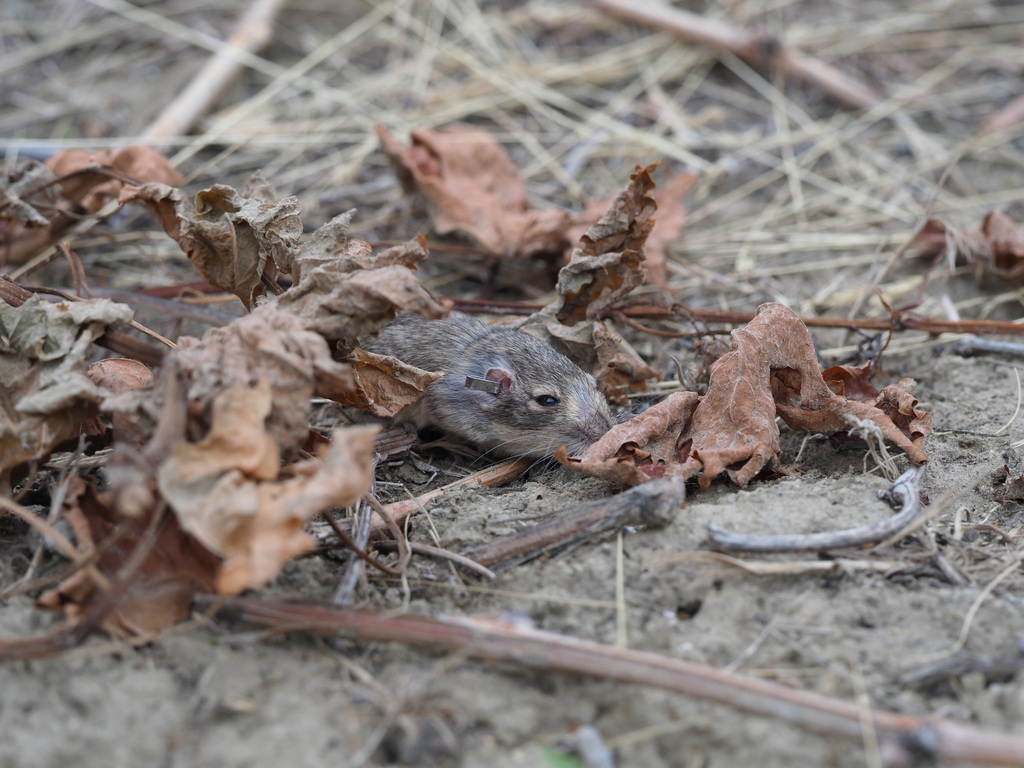
(c) Nathan Earley, some rights reserved (CC BY) · licence
Family: Heteromyidae · Class: Mammalia · Order: Rodentia
Conservation status: G5T2T3 S2
Perognathus longimembris internationalis (Jacumba Pocket Mouse) is a California animal in the Heteromyidae family.
The Jacumba pocket mouse (Perognathus longimembris internationalis) is a small subspecies of little pocket mouse endemic to southern California and northwestern Baja California, Mexico. Adults typically measure 60-70 mm (2.4-2.8 inches) in total body length with a tail of similar length. The species has a distinctive appearance with pale buff to grayish-brown dorsal coloration, white underparts, and large eyes adapted for nocturnal activity. Like other pocket mice, it possesses specialized cheek pouches for carrying seeds and has relatively large hind feet for saltatorial locomotion across sandy substrates. Historically, the Jacumba pocket mouse ranged across the Colorado Desert region of southeastern San Diego County, California, and adjacent areas of Baja California, Mexico. The subspecies is closely associated with the Jacumba Mountains and surrounding desert areas near the international border. Current distribution appears highly fragmented, with populations restricted to remnant habitat patches in this border region. The species inhabits desert scrub communities characterized by sparse shrub cover and sandy soils. Typical vegetation includes desert shrubs, cacti, and annual herbs that provide seed resources. The Jacumba pocket mouse prefers areas with loose, sandy substrates suitable for burrowing, often associated with desert washes and gentle slopes. Elevational range extends from approximately 500-1,200 meters (1,640-3,940 feet) above sea level in the transition zone between coastal and desert environments. Jacumba pocket mice are strictly nocturnal and solitary outside of breeding season. Their diet consists primarily of small seeds from desert annuals and perennial shrubs, which they cache in underground burrows for consumption during periods of food scarcity. The species exhibits physiological adaptations to arid environments, including concentrated urine production and minimal water requirements, obtaining most moisture from their diet. Breeding typically occurs from spring through early summer, with females producing litters of 2-4 young after a gestation period of approximately 23-25 days. The Jacumba pocket mouse is listed as a California Species of Special Concern (SSC) as of December 2025, reflecting serious population declines and habitat loss throughout its limited range. Unlike its closely related subspecies the Pacific pocket mouse (P. l. pacificus), which is federally endangered, the Jacumba subspecies lacks federal protection despite comparable conservation concerns. Primary threats include habitat destruction from residential and commercial development, off-road vehicle activity, invasive plant species that alter seed availability, and border security infrastructure development. The small, fragmented nature of remaining populations makes the subspecies particularly vulnerable to local extinctions from stochastic events. Conservation efforts focus on habitat protection and restoration within the remaining range, though the subspecies' distribution across the international border complicates management coordination. Population monitoring and research into specific habitat requirements remain critical for developing effective conservation strategies for this imperiled desert endemic.
Classification
Class: Mammalia · Order: Rodentia · Family: Heteromyidae
Conservation status
G5T2T3 S2
Frequently asked questions
How is Perognathus longimembris internationalis classified?
Perognathus longimembris internationalis belongs to class Mammalia, order Rodentia, family Heteromyidae.
What family does Perognathus longimembris internationalis belong to?
Perognathus longimembris internationalis is in the Heteromyidae family.
Is Perognathus longimembris internationalis protected or of conservation concern?
Perognathus longimembris internationalis carries the following status: G5T2T3 S2.
What is Perognathus longimembris internationalis?
The Jacumba pocket mouse (Perognathus longimembris internationalis) is a small subspecies of little pocket mouse endemic to southern California and northwestern Baja California, Mexico.
Is Perognathus longimembris internationalis found in California?
Yes. Perognathus longimembris internationalis is recorded in California in The California Species Project's catalogue.
Related species
Other California species in the same genus, family, or bioregion.
Data from The California Species Project — 14,000+ California species with verified data from CNPS, CDFW, USFWS, and more.