Perognathus longimembris pacificus
Pacific pocket mouse
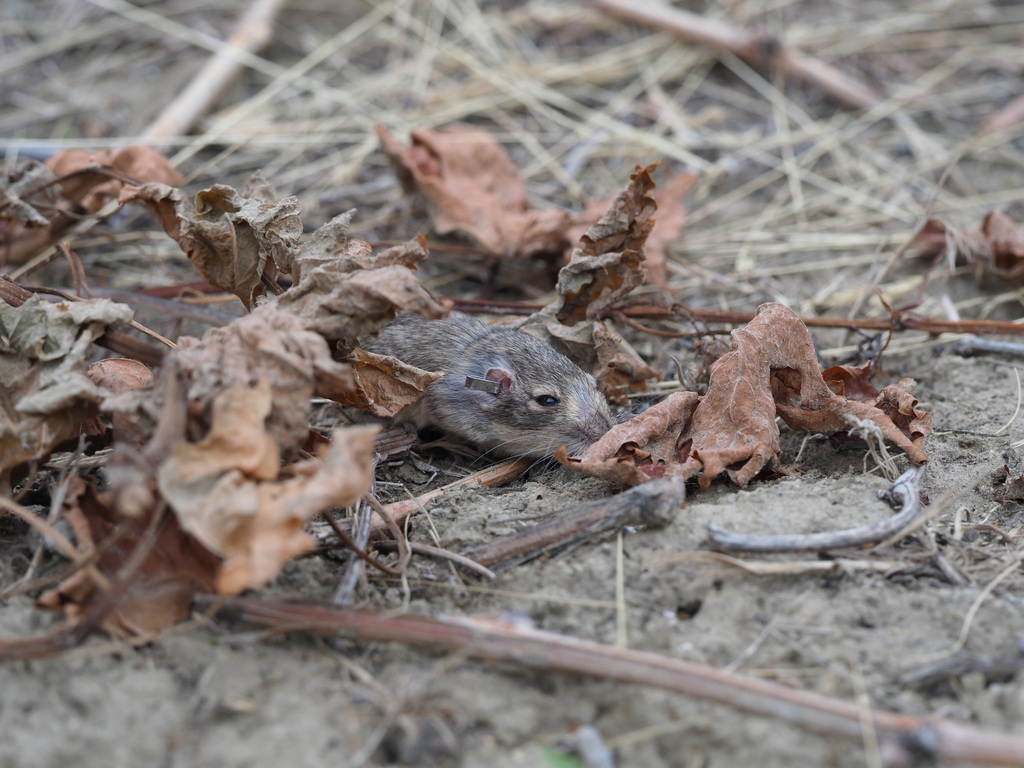
(c) Nathan Earley, some rights reserved (CC BY) · licence
Family: Heteromyidae · Class: Mammalia · Order: Rodentia
Conservation status: Endangered · G5T2 S2
Perognathus longimembris pacificus (Pacific pocket mouse) is a California animal in the Heteromyidae family.
The Pacific pocket mouse is a small rodent, one of 16 currently recognized subspecies of the little pocket mouse (Perognathus longimembris) distributed across arid regions of the western United States. Adults measure approximately 110-125 mm in total length, with the tail comprising about half of this length. The species displays brownish-tan coloration on the dorsal surface with lighter underparts, and possesses distinctive fur-lined cheek pouches used for seed transport. Historically, the Pacific pocket mouse occurred within 2.5 miles of the Pacific Ocean from Los Angeles County south to the Mexican border in San Diego County, California. The subspecies was believed extinct for 20 years until a single population was discovered in coastal Orange County in 1993, leading to emergency listing as federally endangered in 1994. Since listing, three additional populations have been found within Marine Corps Base Camp Pendleton in north San Diego County. Current distribution is extremely restricted compared to its historical range, which extended from Marina Del Rey and El Segundo in Los Angeles County southward through coastal areas. The Pacific pocket mouse inhabits sandy soils in coastal southern California ecosystems characterized by open vegetation structure. Primary habitats include coastal dunes, strands, mesas, and drainages supporting mixed coastal scrub communities with grasses and forbs. The species demonstrates strong association with areas containing fine-textured soils that facilitate burrow construction and seed caching behaviors. As a granivorous species, Pacific pocket mice feed primarily on small seeds collected from shrubs, grasses, and forbs within their habitat. They are nocturnal, emerging after dark to forage and transport seeds in their specialized cheek pouches to underground storage chambers. Breeding occurs primarily during spring months, with females producing litters of 2-5 young after a gestation period of approximately 23-25 days. The species exhibits typical pocket mouse behaviors including bipedal locomotion and extensive burrowing systems that provide protection from predators and temperature extremes. The Pacific pocket mouse remains federally listed as endangered with critical habitat designated. All known populations face significant threats from habitat fragmentation and degradation due to urban development, military activities, and invasive plant species that alter vegetation structure. Small population sizes increase vulnerability to genetic bottlenecks and local extinctions. Recovery efforts include habitat restoration, invasive species control, and population monitoring within protected areas. The U.S. Fish and Wildlife Service continues active management of remaining populations, with captive breeding programs established to support genetic diversity and potential reintroduction efforts. As of December 2025, the species' extremely limited distribution and small population sizes maintain its high conservation priority status.
Classification
Class: Mammalia · Order: Rodentia · Family: Heteromyidae
Conservation status
Endangered · G5T2 S2
Frequently asked questions
How is Perognathus longimembris pacificus classified?
Perognathus longimembris pacificus belongs to class Mammalia, order Rodentia, family Heteromyidae.
What family does Perognathus longimembris pacificus belong to?
Perognathus longimembris pacificus is in the Heteromyidae family.
Is Perognathus longimembris pacificus protected or of conservation concern?
Perognathus longimembris pacificus carries the following status: Endangered · G5T2 S2.
What is Perognathus longimembris pacificus?
The Pacific pocket mouse is a small rodent, one of 16 currently recognized subspecies of the little pocket mouse (Perognathus longimembris) distributed across arid regions of the western United States.
Is Perognathus longimembris pacificus found in California?
Yes. Perognathus longimembris pacificus is recorded in California in The California Species Project's catalogue.
Related species
Other California species in the same genus, family, or bioregion.
Data from The California Species Project — 14,000+ California species with verified data from CNPS, CDFW, USFWS, and more.