Perognathus longimembris salinensis
Saline Valley Pocket Mouse
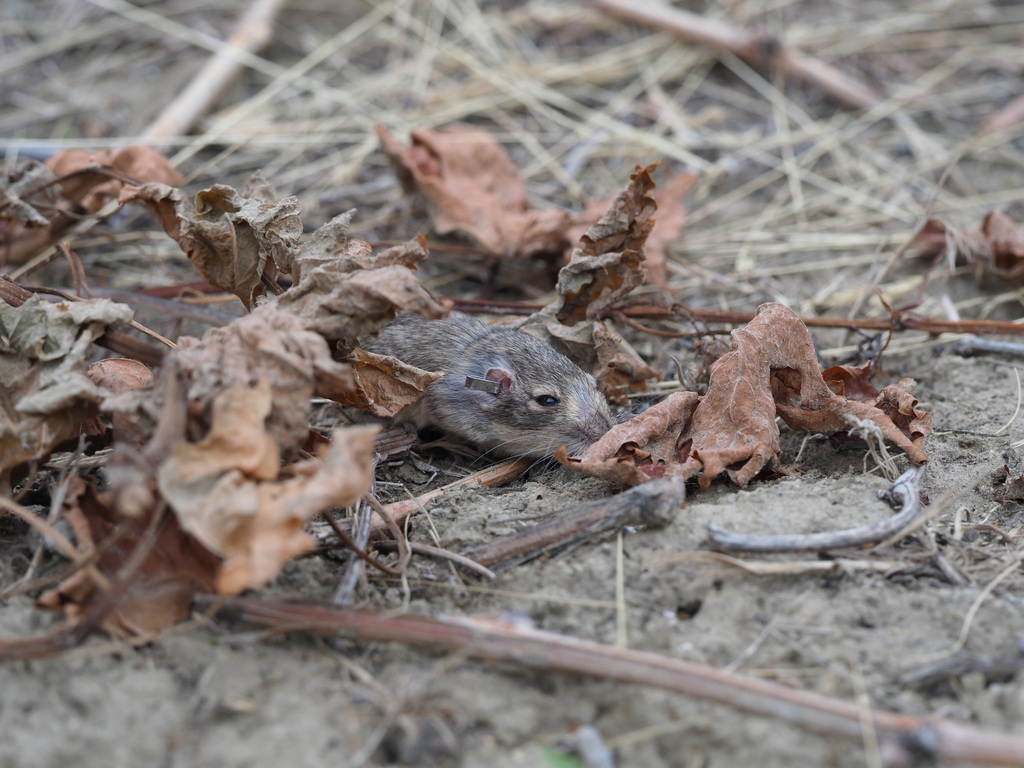
(c) Nathan Earley, some rights reserved (CC BY) · licence
Family: Heteromyidae · Class: Mammalia · Order: Rodentia
Conservation status: G5T1 S1
Perognathus longimembris salinensis (Saline Valley Pocket Mouse) is a California animal in the Heteromyidae family.
The Saline Valley pocket mouse is a small rodent subspecies of the little pocket mouse (Perognathus longimembris) endemic to California's Inyo County. This diminutive mammal measures approximately 100-130 mm (4-5 inches) in total length, with nearly half consisting of a long, tufted tail. The pelage is pale sandy-buff to grayish above, contrasting with white underparts. Like other pocket mice, it possesses specialized cheek pouches for seed transport and strong hind legs adapted for saltatorial locomotion across desert terrain. Historically, the Saline Valley pocket mouse was known only from the Saline Valley area of eastern California, within the Inyo Mountains region of the Great Basin Desert. This extremely restricted range makes it one of California's most geographically limited mammalian subspecies. The subspecies appears to be confined to specific habitat patches within this remote valley system, located approximately 50 kilometers east of the Sierra Nevada crest. The species inhabits arid shrubland communities characterized by sandy to gravelly substrates and sparse vegetation cover. Elevation ranges from approximately 300-600 meters (1,000-2,000 feet) above sea level. The habitat consists primarily of creosote bush scrub and saltbush communities, with open areas between shrubs providing foraging opportunities. Soils are typically well-drained and sandy, allowing for burrow construction and seed caching activities essential to pocket mouse survival. Saline Valley pocket mice are nocturnal and solitary, emerging after sunset to forage for small seeds from grasses, forbs, and shrubs. Based on studies of closely related subspecies, breeding likely occurs during spring months when food resources are most abundant following winter precipitation. Females typically produce one to two litters annually, with litter sizes ranging from two to six young. The species constructs elaborate burrow systems with multiple entrances, food storage chambers, and nesting areas. These burrows provide protection from predators and extreme temperatures while serving as seed storage facilities during resource-scarce periods. The Saline Valley pocket mouse carries a global rank of G5T1, indicating the subspecies is critically imperiled despite the overall species being secure. The S1 state rank reflects its extreme rarity within California. Primary threats include habitat degradation from off-road vehicle use, grazing impacts, and potential climate change effects on desert ecosystems. The subspecies' extremely limited range makes it particularly vulnerable to stochastic events such as drought, wildfire, or habitat destruction. Conservation efforts focus on habitat protection and monitoring of remaining populations, though comprehensive surveys are needed to determine current population status and distribution. Scientific documentation for this subspecies remains limited compared to other pocket mouse taxa. The information presented here is based on available taxonomic and ecological sources. If you have additional verified information about this subspecies' biology, distribution, or ecology, please contact us to help improve this species account.
Classification
Class: Mammalia · Order: Rodentia · Family: Heteromyidae
Conservation status
G5T1 S1
Frequently asked questions
How is Perognathus longimembris salinensis classified?
Perognathus longimembris salinensis belongs to class Mammalia, order Rodentia, family Heteromyidae.
What family does Perognathus longimembris salinensis belong to?
Perognathus longimembris salinensis is in the Heteromyidae family.
Is Perognathus longimembris salinensis protected or of conservation concern?
Perognathus longimembris salinensis carries the following status: G5T1 S1.
What is Perognathus longimembris salinensis?
The Saline Valley pocket mouse is a small rodent subspecies of the little pocket mouse (Perognathus longimembris) endemic to California's Inyo County.
Is Perognathus longimembris salinensis found in California?
Yes. Perognathus longimembris salinensis is recorded in California in The California Species Project's catalogue.
Related species
Other California species in the same genus, family, or bioregion.
Data from The California Species Project — 14,000+ California species with verified data from CNPS, CDFW, USFWS, and more.