Perognathus longimembris tularensis
Tulare Pocket Mouse
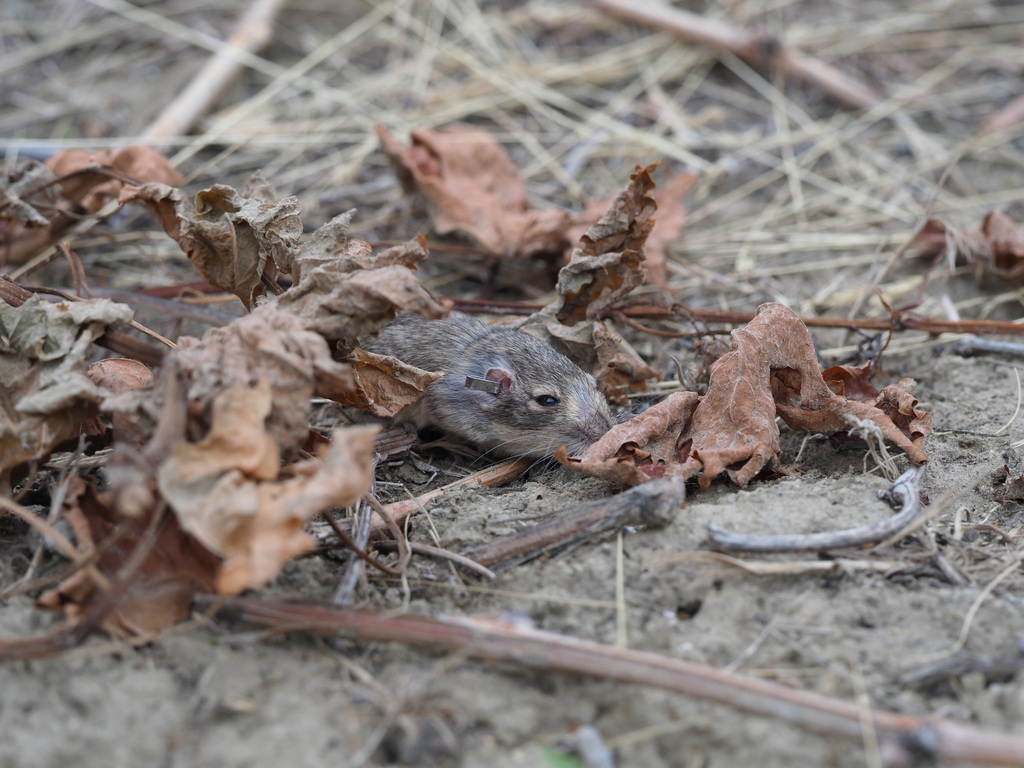
(c) Nathan Earley, some rights reserved (CC BY) · licence
Family: Heteromyidae · Class: Mammalia · Order: Rodentia
Conservation status: G5T1 S1
Perognathus longimembris tularensis (Tulare Pocket Mouse) is a California animal in the Heteromyidae family.
The Tulare pocket mouse (Perognathus longimembris tularensis) is a critically endangered subspecies of little pocket mouse endemic to California's San Joaquin Valley. This small rodent measures approximately 100-125 mm (3.9-4.9 inches) in total length, with nearly half of that length consisting of the tail. Adults typically weigh 6-10 grams (0.2-0.4 ounces). The species exhibits the characteristic features of pocket mice, including large hind feet adapted for saltatorial locomotion, silky fur ranging from pale sandy to grayish-brown dorsally with white underparts, and specialized cheek pouches for seed transport. The tail is distinctly bicolored with a dark dorsal stripe and white ventral surface, ending in a slight tuft. Historically, the Tulare pocket mouse occurred throughout the southern San Joaquin Valley floor in Fresno, Kern, Kings, and Tulare counties. The subspecies inhabited alkali sink scrubland and grassland communities characteristic of the valley's lowest elevations. Current distribution is extremely restricted, with the species persisting at only a few remnant sites in the Carrizo Plain and surrounding areas of southeastern San Luis Obispo and southwestern Kern counties. The species requires sparse shrubland and grassland habitats with sandy or fine-textured soils that facilitate burrow construction. Preferred vegetation communities include alkali sink scrubland dominated by iodine bush (Allenrolfea occidentalis), saltbush (Atriplex spp.), and other halophytic shrubs. The mice construct extensive burrow systems in areas with 10-50% shrub cover, avoiding both dense vegetation and completely open areas. Elevation range is typically below 700 meters (2,300 feet). Tulare pocket mice are nocturnal and primarily granivorous, feeding on small seeds collected from the soil surface and cached in underground granaries. Their specialized kidneys allow them to survive without free water, obtaining necessary moisture from metabolic processes and their seed-based diet. Breeding occurs from March through May, with females producing litters of 2-6 young after a gestation period of approximately 30 days. The species exhibits seasonal torpor during winter months when food resources become scarce. The Tulare pocket mouse holds global conservation rank G5T1 and state rank S1, indicating it is critically imperiled. The subspecies has experienced severe population decline due to habitat conversion for agriculture, urban development, and altered hydrological regimes in the San Joaquin Valley. Over 95% of the original San Joaquin Valley floor habitat has been converted to other uses. Remaining threats include habitat fragmentation, invasive plant species, grazing impacts, and climate change effects on precipitation patterns. The subspecies was considered extinct for several decades before small populations were rediscovered in the 1990s. Current population estimates suggest fewer than 200 individuals remain in the wild, making this one of the most endangered mammals in North America.
Classification
Class: Mammalia · Order: Rodentia · Family: Heteromyidae
Conservation status
G5T1 S1
Frequently asked questions
How is Perognathus longimembris tularensis classified?
Perognathus longimembris tularensis belongs to class Mammalia, order Rodentia, family Heteromyidae.
What family does Perognathus longimembris tularensis belong to?
Perognathus longimembris tularensis is in the Heteromyidae family.
Is Perognathus longimembris tularensis protected or of conservation concern?
Perognathus longimembris tularensis carries the following status: G5T1 S1.
What is Perognathus longimembris tularensis?
The Tulare pocket mouse (Perognathus longimembris tularensis) is a critically endangered subspecies of little pocket mouse endemic to California's San Joaquin Valley.
Is Perognathus longimembris tularensis found in California?
Yes. Perognathus longimembris tularensis is recorded in California in The California Species Project's catalogue.
Related species
Other California species in the same genus, family, or bioregion.
Data from The California Species Project — 14,000+ California species with verified data from CNPS, CDFW, USFWS, and more.