Perognathus mollipilosus xanthonotus
Yellow-eared Pocket Mouse
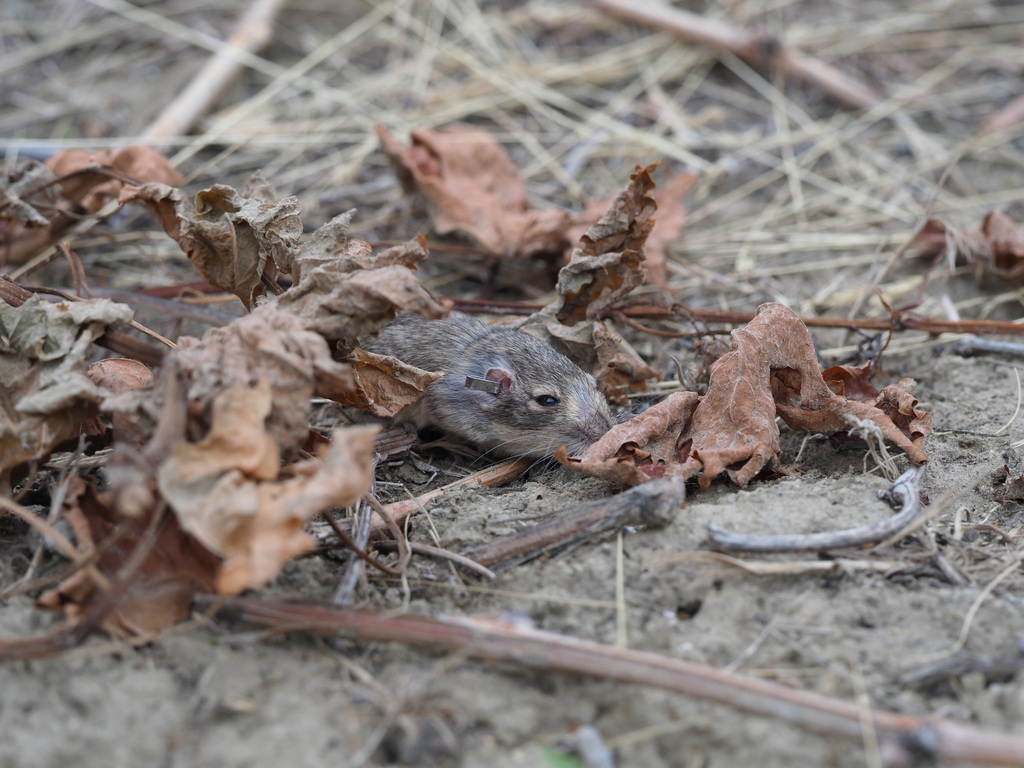
(c) Nathan Earley, some rights reserved (CC BY) · licence
Family: Heteromyidae · Class: Mammalia · Order: Rodentia
Conservation status: GNRT2 S2
Perognathus mollipilosus xanthonotus (Yellow-eared Pocket Mouse) is a California animal in the Heteromyidae family.
The Yellow-eared Pocket Mouse (Perognathus mollipilosus xanthonotus) is a small heteromyid rodent endemic to the arid regions of southern California. This subspecies belongs to the Great Basin pocket mouse complex, recently recognized through molecular studies that revealed cryptic divergence within the formerly broader Perognathus parvus group (Riddle et al. 2000). Adults typically measure 60-75 mm (2.4-3.0 inches) in head-body length with a tail of similar length, weighing 7-12 grams. The species is distinguished by its soft, silky fur, large hind feet adapted for jumping, and cheek pouches used for seed transport. The common name derives from yellowish coloration on the ears, though overall pelage is typically buff to grayish-brown dorsally with white underparts. The Yellow-eared Pocket Mouse has an extremely restricted range in southern California, occurring in several canyons on the eastern slope of the Piute Mountains and southern Sierra Nevada. Known localities include Sand Canyon, Indian Wells Canyon, Freeman Canyon, Sage Canyon, Horse Canyon, and Kelso Valley (Hall 1981). The subspecies' total range encompasses only a few hundred square kilometers, making it one of California's most geographically restricted mammals. Similar habitat exists in intervening canyons and areas north and south of the documented range, suggesting the actual distribution may be somewhat larger than currently known. This subspecies occupies diverse arid and semi-arid habitats, including Joshua tree woodland, desert scrub, pinyon-juniper woodland, mixed and montane chaparral, sagebrush communities, and bunchgrass areas. The species shows a strong preference for sandy soils with sparse to moderate shrub cover, which facilitate burrow construction. Elevational range extends from desert floors to montane zones, typically between 900-2,100 meters (3,000-7,000 feet). Friable soils of various textures are essential for the extensive burrow systems these mice construct. Yellow-eared Pocket Mice are primarily granivorous, feeding on small seeds collected in specialized cheek pouches and cached in underground burrows. They are strictly nocturnal and well-adapted to arid conditions, obtaining most water from their food and producing highly concentrated urine. Home ranges vary from 0.06 to 3.09 hectares, depending on habitat quality and food availability. Breeding occurs primarily in spring and early summer when seed production peaks. Females typically produce 2-6 young per litter, with potential for multiple litters in favorable years. The Yellow-eared Pocket Mouse is ranked G5T2 (subspecies imperiled) by NatureServe, reflecting its restricted range and small population size. Population estimates and trends remain unknown due to limited research. Some occupied canyons are relatively undisturbed, while others, including Sand Canyon, receive recreational use that may impact habitat quality. Major roads can serve as significant barriers to movement for these small mammals. Climate change poses additional concerns through altered precipitation patterns and potential habitat shifts. The subspecies lacks federal or state listing protection, and no populations are known to occur within protected areas, highlighting the need for further population assessment and habitat conservation measures.
Classification
Class: Mammalia · Order: Rodentia · Family: Heteromyidae
Conservation status
GNRT2 S2
Frequently asked questions
How is Perognathus mollipilosus xanthonotus classified?
Perognathus mollipilosus xanthonotus belongs to class Mammalia, order Rodentia, family Heteromyidae.
What family does Perognathus mollipilosus xanthonotus belong to?
Perognathus mollipilosus xanthonotus is in the Heteromyidae family.
Is Perognathus mollipilosus xanthonotus protected or of conservation concern?
Perognathus mollipilosus xanthonotus carries the following status: GNRT2 S2.
What is Perognathus mollipilosus xanthonotus?
The Yellow-eared Pocket Mouse (Perognathus mollipilosus xanthonotus) is a small heteromyid rodent endemic to the arid regions of southern California.
Is Perognathus mollipilosus xanthonotus found in California?
Yes. Perognathus mollipilosus xanthonotus is recorded in California in The California Species Project's catalogue.
Related species
Other California species in the same genus, family, or bioregion.
Data from The California Species Project — 14,000+ California species with verified data from CNPS, CDFW, USFWS, and more.