Peromyscus californicus
California Mouse
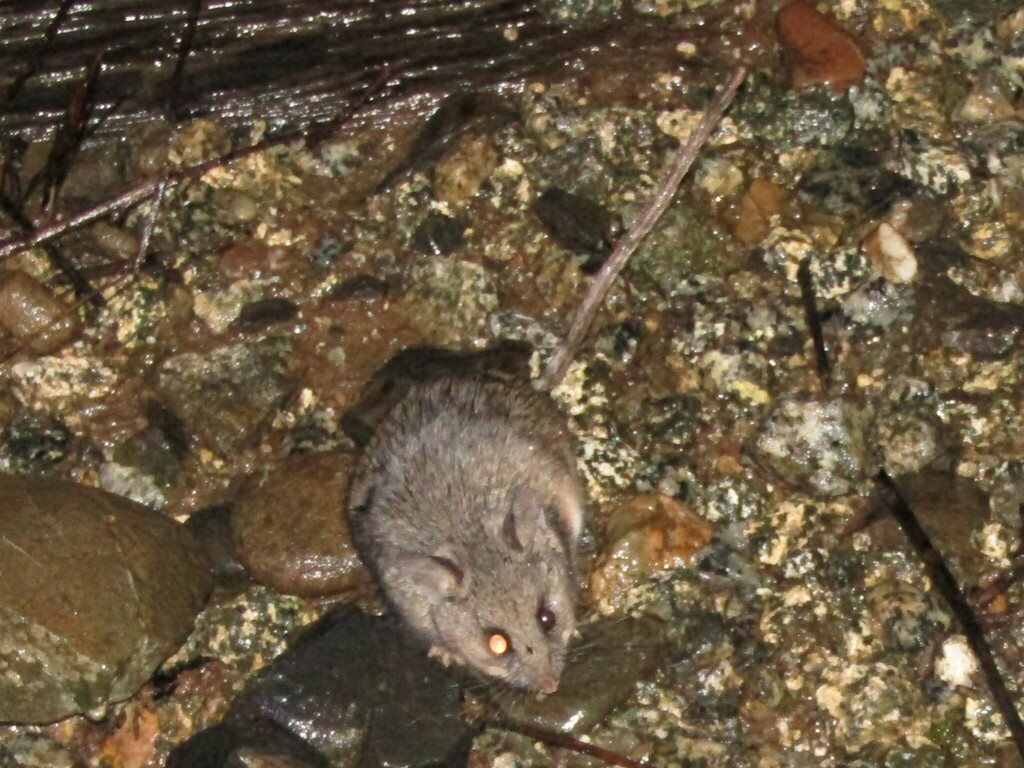
(c) Matt D'Agrosa, some rights reserved (CC BY) · licence
Family: Cricetidae · Class: Mammalia · Order: Rodentia
Peromyscus californicus (California Mouse) is a California animal in the Cricetidae family.
The California mouse (Peromyscus californicus) is one of the largest members of the deer mouse genus in North America. Adults measure 240 to 290 mm (9.4 to 11.4 inches) in total length, with the tail comprising approximately half of this measurement. Body weight ranges from 37 to 80 grams (1.3 to 2.8 ounces), making it significantly larger than most Peromyscus species. The dorsal pelage is dark grayish-brown to brownish-gray, contrasting with white to pale gray underparts. The tail is distinctly bicolored, dark above and white below, and is densely furred with a slight tuft at the tip. The ears are large and prominent, measuring 20 to 25 mm in length. The California mouse occurs in a narrow coastal distribution from San Luis Obispo County south through Los Angeles and Orange counties, extending into Baja California, Mexico. Historically, the species ranged throughout suitable habitat in southern California, but current populations are fragmented and restricted to remaining patches of native shrubland. Inland populations once extended into the foothills of the San Gabriel and Santa Monica mountains. This species inhabits coastal sage scrub and chaparral communities, typically below 760 meters (2,500 feet) elevation. California mice show strong association with dense shrub cover, particularly areas dominated by ceanothus, manzanita, and scrub oak. They require rocky outcrops, fallen logs, or dense vegetation for nesting sites and prefer areas with moderate to steep slopes that provide both foraging opportunities and escape cover. California mice are primarily granivorous, feeding on seeds of shrubs and forbs, though they also consume green vegetation, fruits, and occasionally insects. Unlike most Peromyscus species, California mice are largely monogamous and maintain year-round pair bonds. Breeding occurs from February through September, with females typically producing two to three litters per year. Litter size ranges from one to four young, with an average of 2.3 offspring. The gestation period is approximately 24 days, and young become independent at four to five weeks of age. Adults are primarily nocturnal and exhibit strong territorial behavior, with pairs defending territories of 0.2 to 1.0 hectares. While not federally or state listed, California mouse populations have declined significantly due to habitat loss and fragmentation from urban development, agriculture, and fire suppression that has altered natural vegetation communities. Coastal development has eliminated an estimated 85 to 90 percent of historical coastal sage scrub habitat in southern California. Remaining populations are increasingly isolated, making them vulnerable to local extinctions from wildfires, drought, or random demographic events. The species is considered a sensitive species by the U.S. Forest Service and is included in various regional conservation plans as an indicator species for coastal shrubland ecosystems.
Classification
Class: Mammalia · Order: Rodentia · Family: Cricetidae
Frequently asked questions
How is Peromyscus californicus classified?
Peromyscus californicus belongs to class Mammalia, order Rodentia, family Cricetidae.
What family does Peromyscus californicus belong to?
Peromyscus californicus is in the Cricetidae family.
What is Peromyscus californicus?
The California mouse (Peromyscus californicus) is one of the largest members of the deer mouse genus in North America.
Is Peromyscus californicus found in California?
Yes. Peromyscus californicus is recorded in California in The California Species Project's catalogue.
Related species
Other California species in the same genus, family, or bioregion.
Data from The California Species Project — 14,000+ California species with verified data from CNPS, CDFW, USFWS, and more.