Peromyscus eremicus
Cactus Mouse
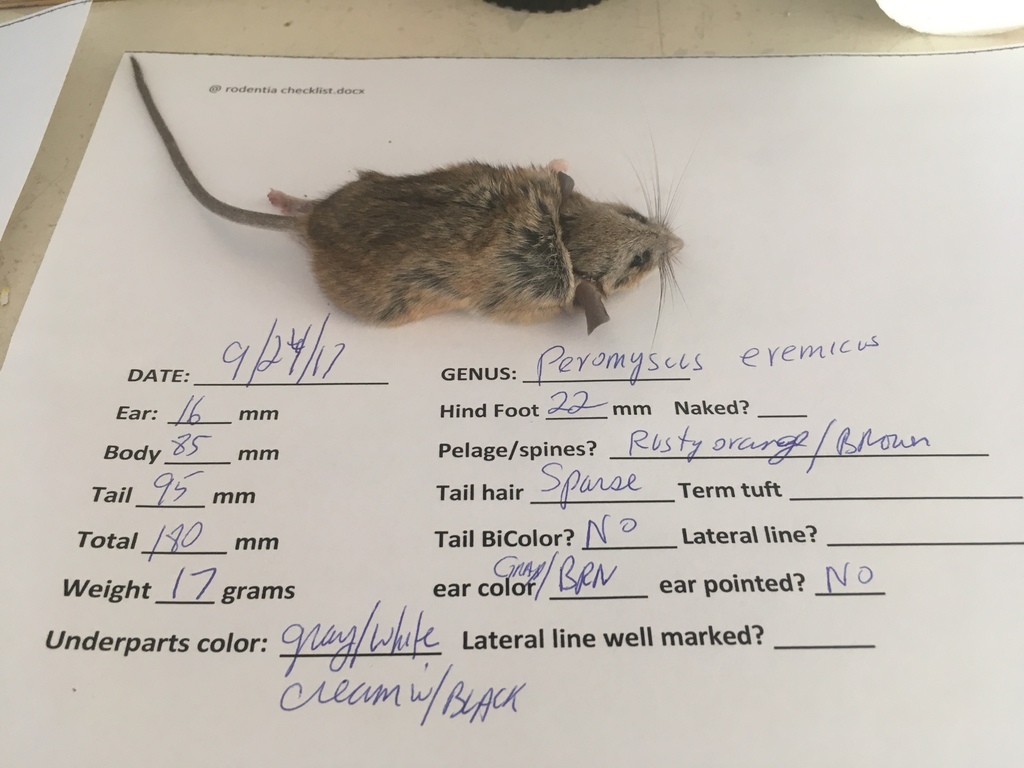
(c) W. Terry Hunefeld, some rights reserved (CC BY) · licence
Family: Cricetidae · Class: Mammalia · Order: Rodentia
Peromyscus eremicus (Cactus Mouse) is a California animal in the Cricetidae family.
The cactus mouse (Peromyscus eremicus) is a medium-sized rodent belonging to the deer mouse complex. Adults measure 160 to 190 mm (6.3 to 7.5 inches) in total length, including a tail of 85 to 110 mm. Body mass ranges from 18 to 35 grams. The pelage is buff to grayish-brown dorsally, with a distinct pale lateral line separating the darker dorsal coloration from the white to cream-colored ventral surface. The tail is distinctly bicolored, dark above and light below, and is well-haired with a slight tuft at the tip. The ears are relatively large and prominent, measuring 15 to 20 mm in length. The hind feet are pale with dark patches on the digits. Cactus mice occur throughout much of California's desert regions, including the Mojave and Sonoran deserts. Their range extends from Inyo County southward through the eastern Sierra Nevada, across the Mojave Desert, and into the Colorado Desert of Imperial and eastern Riverside counties. The species also occurs in portions of San Bernardino County. Outside California, the range extends into Nevada, Arizona, Utah, and northwestern Mexico. The species inhabits arid and semi-arid environments, typically below 1,200 meters (3,900 feet) elevation, though populations occur up to 1,500 meters in some areas. Cactus mice prefer rocky habitats including boulder fields, cliff faces, canyon walls, and rocky outcrops within desert scrub communities. They are closely associated with various cacti species, particularly cholla (Cylindropuntia spp.) and prickly pear (Opuntia spp.), which provide both food resources and protective cover. The species also utilizes desert shrubs including creosote bush (Larrea tridentata), brittlebush (Encelia farinosa), and various Atriplex species. Cactus mice are primarily nocturnal and semi-arboreal, demonstrating exceptional climbing ability on cacti and rocky surfaces. Their diet consists mainly of seeds, green vegetation, and cactus fruits and pads. They consume the seeds and pulp of cholla and prickly pear cacti, as well as seeds from shrubs and forbs. The species exhibits water conservation adaptations typical of desert rodents, obtaining most moisture from food sources. Breeding occurs primarily from February through October, with peak activity during spring and early summer. Females produce 2 to 4 litters annually, with litter sizes ranging from 2 to 5 young. Gestation period is approximately 23 to 27 days. Nests are constructed in rock crevices, among cactus joints, or in abandoned woodrat middens. Cactus mice are not federally or state-listed as threatened or endangered. Population trends appear stable across most of their range, though localized declines may occur due to habitat fragmentation from urban development, off-road vehicle use, and renewable energy projects. Climate change poses potential long-term threats through altered precipitation patterns and increased temperatures that may affect food plant phenology and water availability. The species' association with intact desert scrub communities makes habitat conservation important for maintaining viable populations throughout California's desert regions.
Classification
Class: Mammalia · Order: Rodentia · Family: Cricetidae
Frequently asked questions
How is Peromyscus eremicus classified?
Peromyscus eremicus belongs to class Mammalia, order Rodentia, family Cricetidae.
What family does Peromyscus eremicus belong to?
Peromyscus eremicus is in the Cricetidae family.
What is Peromyscus eremicus?
The cactus mouse (Peromyscus eremicus) is a medium-sized rodent belonging to the deer mouse complex.
Is Peromyscus eremicus found in California?
Yes. Peromyscus eremicus is recorded in California in The California Species Project's catalogue.
Related species
Other California species in the same genus, family, or bioregion.
Data from The California Species Project — 14,000+ California species with verified data from CNPS, CDFW, USFWS, and more.